
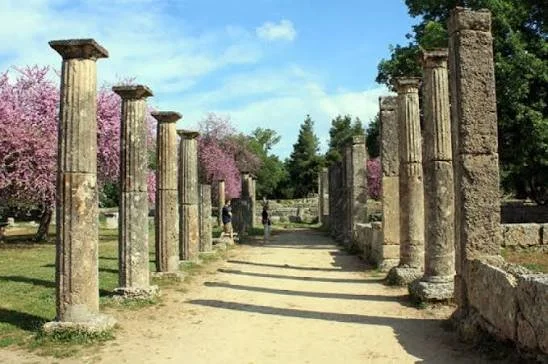
Long before modern stadiums, television broadcasts, national teams, and Olympic medals, athletes gathered in a sacred valley in the western Peloponnese.
That place was Olympia.
Olympia was the sanctuary of Zeus and the setting of the ancient Olympic Games.
The Games became one of the most important recurring events in the Greek world, bringing competitors and visitors together from different communities that were otherwise politically independent and frequently hostile toward one another.
Yet Olympia was never simply an athletic stadium.
It was a religious sanctuary, political meeting place, artistic center, and symbol of Greek cultural identity.
A Sacred Valley
Olympia lies in a fertile valley near the confluence of the Alpheios and Kladeos rivers.
The landscape differs significantly from the dramatic mountain environment of Delphi.
Here, the sanctuary developed within a relatively open and green setting.
UNESCO identifies evidence of prehistoric occupation at Olympia and notes that the sanctuary became an important center of Zeus worship by approximately the tenth century BCE.
The site therefore existed long before the Olympic Games reached their later fame.
The Sanctuary of Zeus
At the center of Olympia was the Altis, the sacred precinct.
It contained temples, altars, monuments, treasuries, and other religious structures.
The most important building was the Temple of Zeus.
Constructed during the fifth century BCE, it became one of the great examples of Doric architecture.
The temple once housed the famous gold-and-ivory statue of Zeus created by the sculptor Pheidias.
The statue was considered one of the Seven Wonders of the ancient world.
It no longer survives.
Its disappearance is a reminder that ancient monuments known to us through historical descriptions can be far more magnificent than their surviving archaeological remains suggest.
The Olympic Games
The ancient Olympic Games were traditionally dated from 776 BCE.
They were held every four years.
The four-year interval became an important chronological unit in Greek history.
The Games were dedicated to Zeus.
Athletes competed in events such as:
foot races;
wrestling;
boxing;
pankration;
pentathlon;
chariot racing;
horse racing.
The events reflected the physical ideals of the ancient Greek world.
Strength, endurance, speed, skill, and discipline were celebrated.
Athletic Competition and Religion
Modern audiences often separate sport from religion.
The ancient Greeks did not always make that distinction.
Athletic competitions formed part of religious festivals.
Athletes competed in sacred environments and honored gods through their participation.
Winning could bring enormous prestige to an individual and their community.
A victorious athlete could become a celebrated public figure.
Statues and inscriptions commemorated successful competitors.
The Sacred Truce
One of Olympia's most famous traditions involved the Sacred Truce.
The concept was intended to facilitate safe travel for participants and spectators.
It did not create permanent peace among Greek states.
Greek communities continued to fight wars.
Nevertheless, the institution demonstrates that religious festivals could create temporary spaces of shared participation even within a politically divided world.
UNESCO emphasizes the role of the Olympic festival as an event connecting communities across the Greek Mediterranean.
The Stadium
The ancient stadium remains one of the most recognizable parts of Olympia.
Unlike modern stadiums, it was not primarily designed around spectator comfort, corporate hospitality, or electronic entertainment.
Its essential purpose was athletic competition.
The elongated running track provided the setting for foot races.
The surrounding landscape reinforced the relationship between sport and the sacred sanctuary.
The Gymnasium and Palaestra
Athletes required training.
Olympia therefore contained facilities for physical preparation.
The gymnasium provided space for athletic training.
The palaestra was particularly associated with wrestling and other forms of exercise.
These buildings reveal that athletic success required systematic preparation.
The ideal athlete was not simply naturally talented.
Training, discipline, diet, and experience mattered.
The Olympic Athlete
Ancient athletes competed as individuals representing their communities.
The modern concept of the nation-state did not exist in the same form.
A victor might bring honor to his city.
This relationship between individual achievement and collective identity was important.
An athlete's victory could be celebrated through monuments, poetry, and public honors.
The athlete became a symbol of the community's prestige.
Women and the Olympic World
The ancient Games were not open to everyone.
Participation and attendance were shaped by gender, citizenship, social status, and other restrictions.
Women did not compete in the principal Olympic competitions in the same way male athletes did.
However, women were not completely absent from Greek athletic culture.
Other festivals and equestrian traditions created different opportunities.
It is therefore important to avoid imagining ancient Greek athletics as a simple historical equivalent of modern Olympic sport.
Art at Olympia
Olympia was also a major center of Greek art.
The sanctuary accumulated sculptures, bronze offerings, architectural decoration, inscriptions, and monuments.
Some of the most important surviving examples of ancient Greek sculpture originated from Olympia.
The famous Hermes of Praxiteles, for example, is associated with the sanctuary.
The site therefore demonstrates that athletics and artistic production existed within the same cultural environment.
Olympia and Political Competition
The Olympic Games also had political implications.
Greek communities could use monumental construction, dedications, and athletic victories to advertise their prestige.
A city might commission a treasury.
A ruler might dedicate a monument.
A victorious athlete might become a political symbol.
The sanctuary consequently functioned as a stage on which Greek communities represented themselves.
The Decline of Olympia
The Olympic tradition continued for many centuries.
The sanctuary survived political transformations and the expansion of Roman power.
Eventually, however, the religious system that supported the ancient Games declined.
The Christianization of the Roman Empire transformed the religious landscape.
The ancient Olympic Games eventually ended in late antiquity.
The sanctuary subsequently suffered from earthquakes, flooding, and other environmental processes.
Its monuments were gradually buried and forgotten.
Rediscovery and Archaeology
Modern archaeological investigations transformed understanding of Olympia.
Excavations uncovered temples, athletic facilities, workshops, inscriptions, sculptures, and other evidence.
The modern Olympic movement later adopted Olympia as a symbolic reference point.
The first modern Olympic Games were held in Athens in 1896.
The modern Games are not simply a continuation of the ancient event.
They operate under entirely different political, social, economic, and athletic systems.
But the symbolic connection remains powerful.
Visiting Olympia Today
A visit should include more than the stadium.
Explore the Altis.
Look at the Temple of Zeus.
Examine the Temple of Hera.
Walk through the athletic facilities.
Visit the archaeological museum.
Consider the relationship between the sanctuary and the surrounding landscape.
The archaeological museum is especially valuable because many sculptures and objects found during excavation provide context for the ruins.
What Olympia Teaches Us
Olympia demonstrates that sport has never existed independently of society.
Athletic competition can express:
religion;
identity;
social values;
political prestige;
artistic ideals;
ideas about the human body.
The ancient Greeks saw physical excellence as part of a broader conception of human achievement.
The body and mind were not always treated as completely separate.
Conclusion
Olympia was much more than the birthplace of the Olympic Games.
It was a sacred center dedicated to Zeus, an artistic environment, a political meeting point, and one of the most important athletic sanctuaries of the ancient Mediterranean.
Its ruins preserve evidence of a world in which religion and sport were deeply interconnected.
Walking through Olympia today therefore means entering a landscape where athletic competition became a form of religious celebration and where individual achievement could become collective cultural memory.
The modern Olympic Games have changed enormously since antiquity.
But the ancient sanctuary at Olympia remains a powerful reminder of how deeply competition, ritual, identity, and human aspiration have been connected throughout history.







