On a rocky hill in the northeastern Peloponnese stand the monumental remains of Mycenae, one of the most important archaeological sites of Bronze Age Greece.
The city is famous not only because of its enormous fortification walls and monumental tombs but also because of its connection with Greek mythology.
According to later tradition, Mycenae was the kingdom of Agamemnon, the legendary leader of the Greek forces during the Trojan War.
The archaeological evidence tells a more complex story.
Mycenae was a powerful center of the Mycenaean civilization, flourishing centuries before Classical Athens.
Understanding the site requires separating three overlapping worlds:
the archaeological Mycenaean civilization;
later Greek mythology;
the Homeric epics.
The Mycenaean Civilization
The Mycenaean civilization flourished during the Late Bronze Age.
Its major centers included Mycenae, Tiryns, Pylos, Thebes, and other settlements.
UNESCO describes Mycenae and Tiryns as among the most important surviving archaeological representatives of this civilization, which dominated much of the eastern Mediterranean during the second millennium BCE.
Mycenaean society possessed complex political and administrative systems.
Archaeologists have discovered evidence of palatial administration, craft production, trade, warfare, religion, and writing.
The writing system known as Linear B provides particularly important evidence.
Linear B tablets record an early form of Greek.
This is one of the strongest archaeological connections between the Mycenaean world and the later Greek linguistic tradition.
The Citadel
Mycenae's most spectacular remains are concentrated on its fortified citadel.
The settlement occupied a strategic position overlooking the Argolid plain.
From the hill, inhabitants could control important routes through the surrounding landscape.
The fortifications were enormous.
Later Greeks referred to such walls as Cyclopean, believing that the stones were too large for ordinary humans to move.
The mythological explanation reflects the impression the ruins made on later generations.
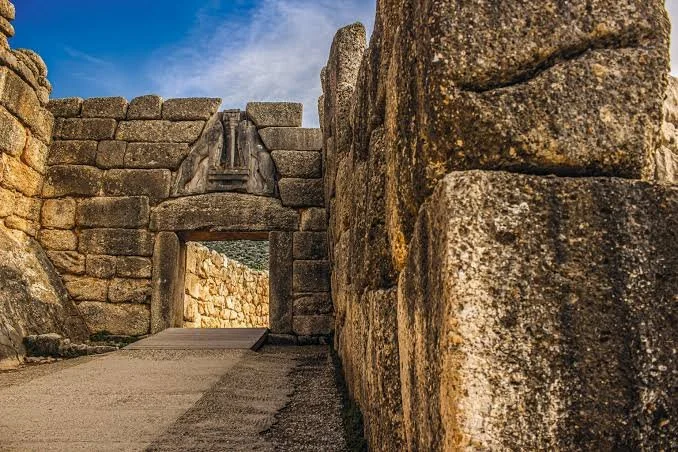
The Lion Gate
The Lion Gate is Mycenae's most famous architectural feature.
Constructed from massive stone blocks, it formed the monumental entrance to the citadel.
Above the entrance is a triangular relief featuring two lion-like animals standing beside a central column.
The exact symbolic meaning of the composition remains debated.
It may have represented royal authority, protection, or religious symbolism.
Whatever its precise interpretation, the relief demonstrates that architecture at Mycenae was designed to communicate power.
Visitors approaching the citadel would immediately encounter a monumental statement of authority.
The Treasury of Atreus
Near Mycenae is the monumental tomb traditionally known as the Treasury of Atreus.
Despite its traditional name, it was not actually a treasury.
It is a tholos tomb, a large beehive-shaped burial structure.
The tomb consists of a long entrance passage leading into a monumental circular chamber.
The construction required extraordinary engineering skill.
Large stone blocks were arranged in carefully planned courses to create the corbelled dome.
The result is one of the most impressive surviving structures of the Bronze Age Aegean.
Death and Elite Power
Mycenaean society invested enormous resources in elite burial.
Grave circles and monumental tombs contained valuable objects, including weapons, jewelry, vessels, and other prestige goods.
These burials demonstrate social hierarchy.
Not everyone in Mycenaean society possessed the resources to construct monumental tombs or acquire imported luxury goods.
Burial therefore became a means of displaying status and perhaps reinforcing political authority.
Mycenaean Warfare
The fortifications of Mycenae reveal that warfare mattered.
The citadel's walls were designed to protect an important political center.
Weapons found at Mycenaean sites include swords, spearheads, armor components, and other military equipment.
However, archaeology does not support every detail found in later heroic stories.
We cannot simply assume that every event described by Homer occurred exactly as narrated.
The archaeological record must be interpreted independently.
The Connection with Homer
Homer's Iliad and Odyssey were composed centuries after the height of Mycenaean civilization.
The poems preserve traditions about a heroic past involving kings, warriors, and powerful kingdoms.
Mycenae is identified as the realm of Agamemnon.
This association became extremely influential.
UNESCO specifically recognizes the strong cultural connection between Mycenae, Tiryns, and the Homeric epics.
But this does not mean archaeology has proven that Agamemnon existed exactly as Homer describes.
The Homeric poems are literary works combining traditions from different periods.
Agamemnon and Myth
According to Greek mythology, Agamemnon belonged to the cursed House of Atreus.
His family history includes Tantalus, Pelops, Atreus, Thyestes, Agamemnon, Menelaus, Orestes, Electra, and Iphigenia.
The mythology is filled with betrayal, murder, revenge, sacrifice, and divine punishment.
Mycenae therefore became more than an archaeological site.
It became a symbolic landscape of tragic Greek mythology.
The Bronze Age Palace
The Mycenaean political system appears to have been organized around palace centers.
Administrative documents recorded goods, workers, animals, and other economic information.
The Linear B tablets reveal a bureaucratic system capable of organizing production and redistribution.
This is important because the heroic image of Mycenae as simply a warrior kingdom is incomplete.
Behind the warriors were administrators, farmers, craftspeople, religious officials, traders, and laborers.
Trade and the Mediterranean
Mycenaean communities participated in extensive Mediterranean networks.
Archaeological evidence demonstrates contacts with regions including the Aegean, eastern Mediterranean, Cyprus, Anatolia, and beyond.
Imported objects reveal that Mycenae was part of a connected Bronze Age world.
This was not an isolated mountain fortress.
It belonged to a larger system of maritime exchange.
The Collapse of the Mycenaean World
Around the end of the Bronze Age, many Mycenaean centers experienced major disruption.
Palaces were destroyed or abandoned.
The causes remain debated.
Possible contributing factors include warfare, internal political instability, economic disruption, environmental changes, earthquakes, and breakdowns in long-distance exchange networks.
There was probably no single universal cause.
The collapse was followed by major transformations across the eastern Mediterranean.
The Importance of Archaeology
Mycenae demonstrates why archaeology matters.
Written mythology tells one story.
Archaeological evidence tells another.
Material remains reveal architecture, trade, administration, technology, burial practices, and economic organization.
Together, these sources allow historians to reconstruct a more complicated past.
The goal is not to force archaeology to prove mythology.
It is to understand how historical societies may have contributed to the traditions later remembered through mythology.
Visiting Mycenae
Visitors should allow time to experience the landscape.
Walk through the Lion Gate.
Explore the citadel.
Examine the grave circles.
Follow the routes through the fortified settlement.
Then visit the nearby monumental tombs.
The museum also provides important archaeological context.
Look particularly for evidence of everyday life rather than focusing only on legendary heroes.
The most interesting discoveries often concern ordinary systems of production, administration, burial, and craft.
Conclusion
Mycenae is famous as the city of Homer's heroes, but its archaeological importance goes far beyond mythology.
It was one of the great centers of Bronze Age Greece.
Its massive fortifications reveal political and military power.
Its tombs reveal social hierarchy and elite culture.
Its Linear B tablets reveal an early Greek administrative system.
Its imported goods reveal international connections.
Its relationship with Homer reveals how archaeological landscapes can become transformed into legendary ones.
The real Mycenae was already extraordinary before later Greeks imagined Agamemnon walking through its gates.
That is perhaps the site's greatest lesson.
History does not need mythology to make Mycenae fascinating.
The archaeological civilization itself was remarkable enough.