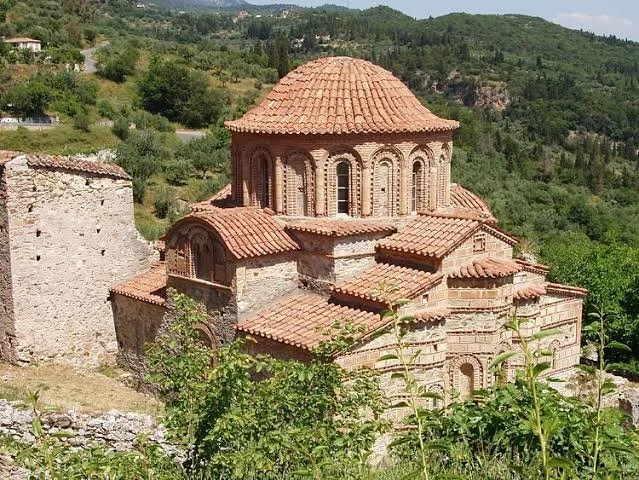
High on the slopes of Mount Taygetos, overlooking the plain of Sparta, lies one of the most remarkable medieval archaeological sites in Greece.
Mystra is often described as the "last capital of Byzantine Greece," although its historical role was more specifically connected with the Despotate of Morea, the Byzantine political state that governed much of the Peloponnese during the final centuries of the Byzantine Empire.
Today, Mystra appears as a haunting landscape of ruined palaces, fortified walls, churches, monasteries, houses, streets, and frescoes.
But during its height, it was a living city.
It was a political center, military stronghold, religious community, artistic center, and intellectual environment.
The Foundation of Mystra
The history of Mystra begins in the thirteenth century.
In 1249, William II of Villehardouin, ruler of the Frankish Principality of Achaea, built a fortress on the hill.
The site commanded the surrounding plain and provided a strategically powerful position.
The political situation soon changed.
The Byzantines recovered the fortress in 1262.
Mystra subsequently developed into one of the most important Byzantine centers in southern Greece.
The Despotate of Morea
By the fourteenth century, Mystra had become the center of the Byzantine Despotate of Morea.
The title "despot" in this context should not automatically be interpreted according to the modern English meaning of a cruel ruler.
In Byzantine political terminology, a despotēs was a high imperial title.
The Despotate of Morea was governed by members of the Byzantine imperial family.
Mystra became the administrative and political heart of the region.
A Medieval City on a Mountain
The geography of Mystra shaped its urban development.
The settlement expanded down the hillside beneath the fortress.
UNESCO describes it as an amphitheatrically developed medieval city containing fortifications, palaces, churches, monasteries, houses, streets, and public spaces.
The steep terrain created a distinctive urban environment.
Visitors today must climb through the ruins.
That physical experience provides insight into medieval life.
Movement through the city required navigating slopes, stairs, narrow streets, and fortified boundaries.
The Churches of Mystra
The religious buildings are among the site's greatest treasures.
They include:
the Metropolis of Hagios Demetrios;
Hodegetria;
Hagioi Theodoroi;
Hagia Sophia;
Peribleptos;
Evangelistria;
Pantanassa.
Their architecture demonstrates the sophistication of Late Byzantine religious design.
The churches also preserve frescoes of extraordinary artistic significance.
Byzantine Frescoes
The paintings of Mystra reveal a sophisticated visual culture.
Religious scenes were arranged according to theological and liturgical principles.
Figures, gestures, colors, and architectural settings communicated religious narratives to worshippers.
These were not simply decorative paintings.
They formed part of the religious experience.
The frescoes also demonstrate connections between Mystra and Constantinopolitan artistic traditions.
The Palace Complex
The Palace of the Despots is one of the most important secular structures at Mystra.
It demonstrates that the city was not merely a religious center.
Political authority required administrative buildings and elite residences.
The palace complex reflects the wealth and importance of the Despotate.
Its architecture also demonstrates interaction between Byzantine and Western European traditions.
Byzantine and Western Influences
Mystra existed in a politically complex world.
The Peloponnese had experienced Frankish rule, Byzantine reconquest, Venetian involvement, and Ottoman expansion.
The architecture of Mystra reflects these interactions.
UNESCO notes the presence of Byzantine, Romanesque, and Gothic influences within the city's architectural environment.
This is one of the site's most fascinating characteristics.
Byzantine culture was not isolated from medieval Europe.
It interacted with Western European political and artistic traditions.
Mystra and Philosophy
Mystra was also an intellectual center.
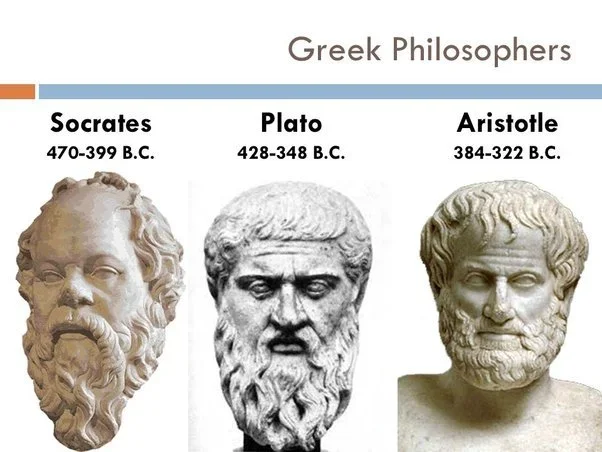
One of its most important thinkers was Georgios Gemistos Plethon, a philosopher associated with the revival of interest in ancient Greek thought.
Plethon was deeply influenced by Plato and Neoplatonism.
His ideas later attracted attention in Italy.
UNESCO emphasizes Mystra's intellectual significance and the role of figures such as Plethon in transmitting interest in Platonic philosophy to the Western European Renaissance.
This gives Mystra an extraordinary place in intellectual history.
The city was not simply preserving ancient Greek culture.
It was participating in the reinterpretation of that culture.
The Fall of Mystra
The Byzantine political situation deteriorated during the fifteenth century.
Constantinople fell to the Ottoman Empire in 1453.
Mystra itself came under Ottoman control in 1460.
The city continued to exist for centuries, experiencing later Ottoman and Venetian rule.
Eventually, however, the settlement declined.
After the establishment of the modern Greek state, inhabitants gradually moved toward the modern town of Sparta.
UNESCO notes that Mystra was progressively abandoned during the nineteenth century.
Why Mystra Is Sometimes Called the "Last Capital"
The phrase reflects the city's role as a major Byzantine political center during the final centuries of the empire.
Mystra became particularly important when Constantinople itself was under increasing pressure.
It represented the continued survival of Byzantine political and intellectual traditions in the Peloponnese.
Calling it the "last capital" can therefore be evocative, but the phrase should not be treated as a precise official constitutional designation.
Visiting Mystra
Mystra is best approached as a city rather than a single monument.
Expect walking.
The terrain is steep.
Comfortable footwear is essential.
Visitors should allow enough time to explore both upper and lower sections.
Important areas include the fortress, palace complex, churches, monasteries, and residential remains.
Because the site is extensive, rushing through it can make the city difficult to understand.
The Experience of the Ruins
Mystra has a distinctive atmosphere.
Unlike a single temple standing in isolation, it preserves an entire urban environment.
A visitor can walk along medieval streets, enter churches, examine frescoes, pass houses, and climb toward the fortress.
This makes Mystra particularly valuable archaeologically.
It allows visitors to reconstruct how multiple components of a medieval city functioned together.
Conclusion
Mystra is one of the most important surviving witnesses to Late Byzantine civilization.
Its fortress reveals military strategy.
Its palaces reveal political power.
Its churches reveal religious architecture.
Its frescoes reveal artistic achievement.
Its streets and houses reveal urban life.
Its intellectual history reveals the continuing importance of ancient Greek philosophy within Byzantine culture.
The city ultimately demonstrates that the history of Greece cannot be divided neatly into "ancient Greece" and everything that came afterward.
The Byzantine world preserved, transformed, and debated earlier Greek traditions.
Mystra stands as one of the clearest places where those traditions can still be experienced in the landscape itself.