Answer by Steve Theodore
_________
Nothing good.
323 BC
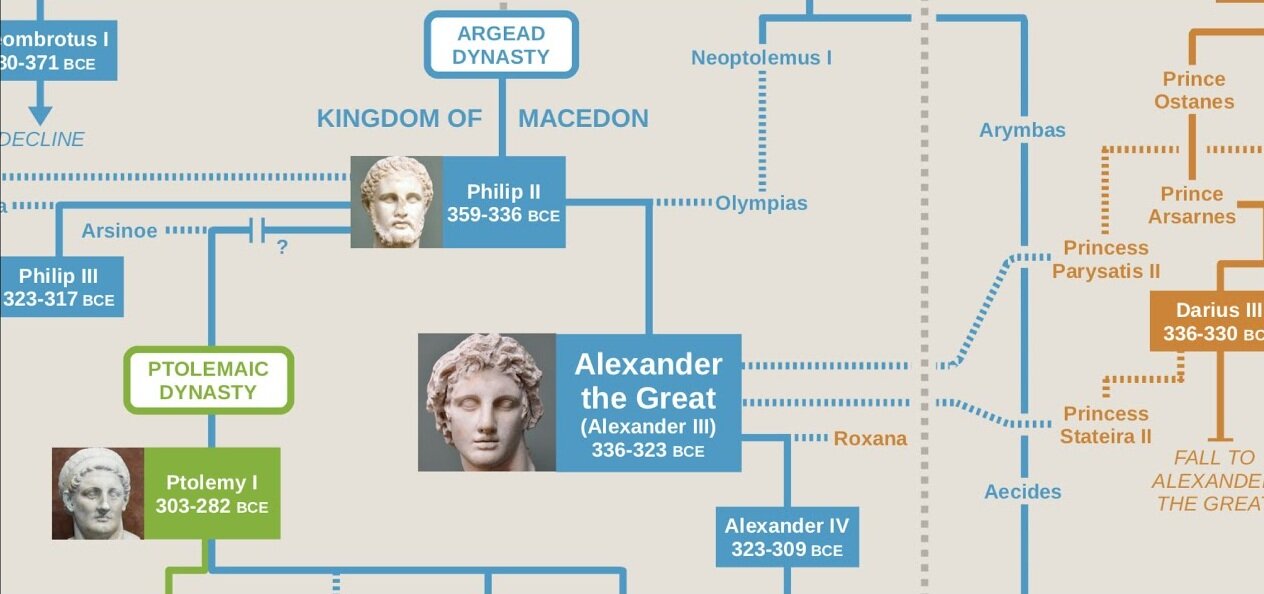
Alexander had two wives when he died. Statira was one of the daughters of the defeated Persian emperor Darius, and Roxane, a Sogdian princess.
Both of them were pregnant when Alexander died in 323 BC. Alexander had not left any firm plan his succession. When his ministers tried to get him to tell who would succeed him, he only said kratistos, “the strongest.” At the time and ever since people have wondered if he was trying to name Krateros, one of his most senior generals — but the damage was done.
Things were complicated by the presence of Alexander’s mentally disabled brother Philip Arrhidaeus — most of the generals wanted a regency to hold the kingdom for a child of Alexander, but there was a faction that wanted Arrhidaeus on the throne.
Roxane gave birth to a son, Alexander IV. This helped forge a compromise with the supporters of Arrhidaeus: a kind of dual regency for the “king” and the heir. But the possibility of a rival heir — potentially, one attractive to the Persians — threatened the fragile compromise. Statira was soon murdered along with Alexander’s other, unborn, child. Rumor ever since has blamed Roxane and Perdiccas, the new regent.
320 BC
Tensions among the Macedonian generals began to snowball, with plots and counterplots. Within a year there was open warfare. Alexander’s body — and the enormous golden hearse which was carrying it — was hijacked on the road back to Macedonia and dragged off to Egypt. After a botched battle in Egypt, Perdiccas was murdered.

This is believed to be the urn for the ashes of Alexander IV, the boy who never became king, from the royal tombs at Vergina.
Now, Roxane and young Alexander were now the subjects of another political scramble. A hasty peace conference packed them off to Macedonia under a new regent, the elderly Antipater. Within a year, though, Antipater was dead and there was a new regent, Polyperchon. Antipater’s son Cassander thought he should have been named regent; he intrigued with Arrhidaeus’ wife Eurydice and gained control of the unfortunate king.
See also: Alexander the Great Genealogy Tree: Ancestors and Descendants of Alexander The Great
317–316 BC
Now the rival factions each had their own branch of the royal bloodline. The formidable queen mother Olympias — exiled in Epirus — raised an army and joined Polyperchon, intending to protect Alexander’s child. She captured Arrhidaeus and Eurydice and had them murdered leaving only one legitimate claimant to the throne — and herself as the real power behind the throne. Unfortunately, her fiery temperament won her few friends; when Cassander counterattacked her armies dissolved and she herself was captured and killed.
Cassander now controlled Roxane and young Alexander. The next several years were consumed with another complex multi-way civil war, which finally ended in 311. But Alexander was now approaching puberty, and the unpopular Cassander worried that a teenaged Alexander would be a focus for opposition to himself.
309 BC
Finally, in 309, Cassander ordered Roxane and Alexander poisoned. Alexander was 14, and had never really lived a free day in his life.
After the murders became known, Polyperchon produced another possible heir: Heracles, an illegitimate child of Alexander the Great and Barsine, a Persian noblewoman who had been living in obscurity for the past decade. Polyperchon tried to raise a rebellion in the name of this potential heir, but new candidate did not rouse the hoped-for support. Polyperchon cut a deal with Cassander, and murdered the last of Alexander’s children along with his mother. Alexander’s line was completely extinguished, 14 years after his death.