Did Ancient Greeks Invent Shadow Puppetry? The Surprising Truth Behind the “Forgotten” Art
The idea of a major, well-documented tradition of ancient Greek shadow puppetry requires an important historical correction.
Ancient Greece certainly possessed traditions of performance involving storytelling, masks, theatrical machinery, puppets, and visual illusion. However, the claim that the Greeks developed a clearly established art of shadow puppetry comparable to later traditions in Asia or the Ottoman and Greek Karagiozis tradition is not strongly supported by the surviving evidence.
The real story is more complicated—and more interesting.
Puppets in the Ancient World
The ancient Mediterranean knew various forms of articulated figures and mechanical devices.
Greek and Roman writers described automata and ingenious machines.
Some objects may have been used for entertainment, ritual, or demonstration.
Puppetry, in a broad sense, was therefore not unknown.
Greek Theater and Visual Illusion
Ancient Greek theater developed extraordinary methods for creating spectacle.
Performers wore masks.
Stage machinery could create dramatic appearances.
The mechane could lift actors, allowing gods to appear above the stage.
Other devices helped create visual effects.
Greek audiences were already familiar with the idea that technology could transform performance.
Shadows and Storytelling
Humans have used shadows for storytelling in many cultures.
A fire can transform an ordinary object into a moving silhouette.
It is entirely possible that shadows were used informally for entertainment in ancient societies.
But possibility is not the same as evidence.
Historians need to distinguish between:
What may have happened.
What is documented.
The evidence for a major institutionalized Greek shadow-puppet tradition in classical antiquity is limited.
Karagiozis and the Later Greek Tradition
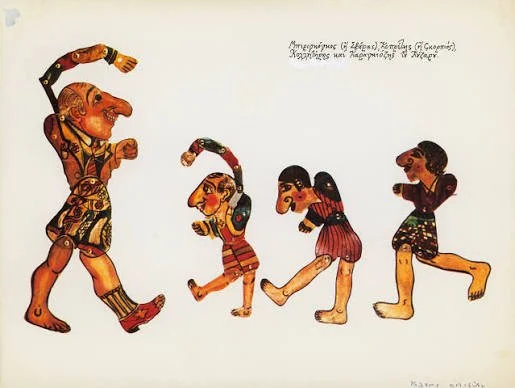
The best-known Greek shadow-theater tradition is Karagiozis.
However, Karagiozis belongs primarily to a much later historical context and developed through interaction with Ottoman Karagöz shadow theater.
It should not be projected backward as proof that classical Greeks practiced the same form of entertainment.
The distinction matters.
Greek culture did not remain unchanged for two thousand years.
Later Greek traditions developed through Byzantine, Ottoman, Balkan, Mediterranean, and modern influences.
Why the Myth of Ancient Greek Shadow Puppetry Is Attractive
The Greeks are often presented as inventors of everything.
Democracy.
Theater.
Philosophy.
Science.
Because Greek civilization genuinely produced influential traditions, later writers sometimes exaggerate its role.
But history becomes more interesting when we acknowledge cultural exchange.
Shadow theater developed through multiple regions and traditions.
No civilization existed in isolation.
Ancient Greek Automata
One area where Greek ingenuity was genuinely remarkable was mechanical technology.
Engineers such as Hero of Alexandria, working in the Greek-speaking world of the Roman period, described mechanical devices capable of producing movement and theatrical effects.
These included automated systems involving:
Water.
Air pressure.
Weights.
Cords.
Gears.
Some devices could create dramatic scenes.
This was not shadow puppetry in the later theatrical sense.
But it demonstrates that the ancient Greek world possessed sophisticated traditions of mechanical performance.
The Real Legacy
If we remove the exaggerated claim that classical Greeks developed a fully documented shadow-puppet tradition, we do not lose the story.
We gain a better one.
Ancient Greek performance involved:
Masks.
Puppets and articulated objects.
Stage machinery.
Automata.
Optical effects.
Dramatic storytelling.
Later Greek shadow theater emerged through centuries of cultural interaction.
The result was not a single isolated invention.
It was part of a much larger history of human imagination.
The “forgotten art” is therefore not simply shadow puppetry.
It is the ancient understanding that a performance can transform reality.
A mask can become a god.
A machine can make a human fly.
A shadow can become a story.
And technology can turn an ordinary stage into another world.