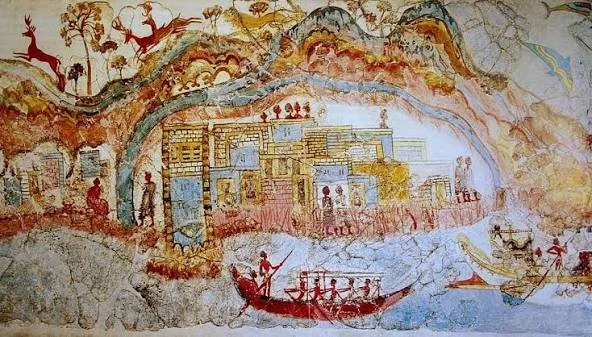
Bronze Age art, digital heritage, and emerging methods for visualizing an ancient settlement.
Bringing Ancient Images into a New Dimension
The prehistoric settlement of Akrotiri on Santorini preserves some of the most important evidence of Bronze Age life in the Aegean. Buried by volcanic activity during the second millennium BCE, the settlement has yielded architecture, artifacts, and wall paintings that illuminate the artistic and cultural world of the period.
The idea of holographic reconstructions of its frescoes offers an exciting possibility: visitors might experience ancient scenes as immersive, three-dimensional presentations rather than as images viewed through a conventional display.
However, the existence of a hidden or secret holographic reconstruction project should not be treated as established without documentation. The broader subject is the growing use of digital technology to study, interpret, and present archaeological heritage.
Why Akrotiri's Frescoes Matter
Akrotiri's wall paintings depict people, animals, landscapes, and scenes that provide insights into artistic conventions and cultural relationships in the prehistoric Aegean.
The surviving paintings are valuable but incomplete. Some sections have been lost, damaged, or separated from their original architectural settings. Archaeologists and conservators therefore need to distinguish what survives directly from what can reasonably be reconstructed.
Color, composition, and placement can offer information about how rooms were used and how images contributed to the experience of a building. Yet interpretations must account for missing material and uncertainty about original appearance.
From Photography to Three-Dimensional Models
Digital documentation can combine high-resolution photography, photogrammetry, laser scanning, and structured-light scanning. These methods capture different aspects of an artifact or architectural space.
Photogrammetry uses overlapping photographs to reconstruct three-dimensional geometry. Scanning can record surfaces in greater detail, while color-calibrated imaging helps preserve information about pigments and painted layers.
Once assembled, digital models can support conservation research, comparative analysis, and virtual exhibitions. They may allow scholars to examine details that are difficult to see in person without moving or touching fragile material.
A digital model is not necessarily a hologram. A true holographic display reconstructs light in a way that can provide depth cues beyond those of a conventional flat image. Many immersive archaeological presentations instead use projection, augmented reality, virtual reality, or stereoscopic displays.
Reconstructing What No Longer Survives
Digital technology can help visualize missing sections of a fresco, but reconstruction involves interpretation. Researchers may infer the original design from surviving fragments, repeated motifs, historical comparisons, or the geometry of the room.
The confidence attached to each reconstructed element should be clear. Surviving pigment, inferred outlines, and speculative additions should not be presented as equally certain.
A responsible reconstruction can show alternative interpretations or visually distinguish preserved material from modern additions. This allows technology to support scholarship rather than conceal gaps in the evidence.
Holographic Heritage and Public Access
Immersive displays could make ancient art more accessible to people who cannot visit archaeological sites. They could also help students understand scale, spatial relationships, and the relationship between a painting and the architecture around it.
Any system associated with Akrotiri should be assessed through the institution's published projects, conservation documentation, or technical demonstrations. Without that evidence, a claim about hidden holographic reconstructions remains unverified.
The future of archaeological visualization is promising because it combines scientific documentation with public interpretation. Its greatest value lies in helping people encounter ancient art while preserving the distinction between what has survived and what modern technology has recreated.