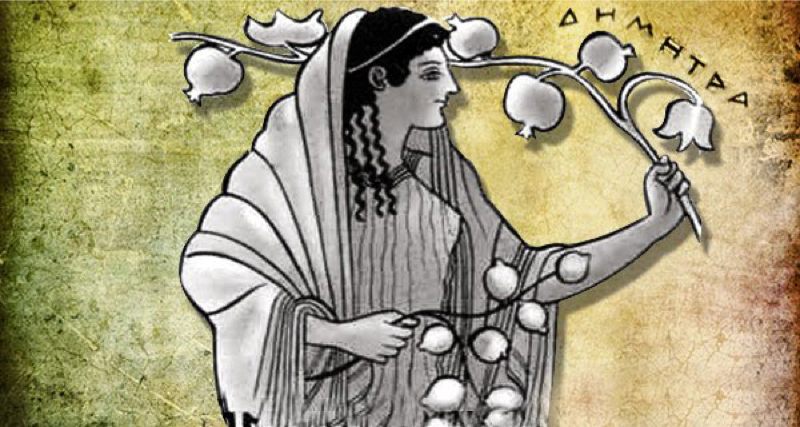
Demeter is the goddess of the harvest and presides over grains and the fertility of the earth. Although she was most often referred to as the goddess of the harvest, she was also goddess of sacred law and the cycle of life and death.
Her virgin daughter PERSEPHONE was abducted by the god of the underworld, HADES, and Demeter endlessly searched for her, preoccupied with loss and grief. The seasons halted and living things stopped growing and died. At this point, ZEUS had to intervene and send his messenger HERMES to the underworld to bring Persephone back and prevent the extinction of all life on Earth.
Hades agreed to Persephone’s relief but gave her a pomegranate as she left. When she ate the pomegranate seeds, she was bound to him for one third of the year, either the dry Mediterranean summer, when plant life is threatened by drought, or the autumn and winter.
Demeter and Persephone were also the central figures to the Eleusinian Mysteries – a series of large and secretive concerts held every five years. These mysteries represented the abduction of Persephone by Hades in three phases. The “descent” (loss), the “search” and the “ascent”. The main theme is the “ascent” of Persephone and the reunion with her mother.
Related video:
Facts about Demeter
Demeter was the daughter of Cronos and Rhea.
She was the goddess of harvest and fertility.
She had one daughter, Persephone; Zeus was Persephone’s father.
After Hades abducted Persephone, Demeter grieved. The earth became barren through her neglect; thus, the winter season and its manifestations were a reflection of Demeter’s emotional state during Persephone’s absence.
She revealed to man the art of growing and using corn.
Only women attended the Thesmophoria, a fertility festival held in honor of Demeter.
The fields of grain and the threshing-floor were under her protection. They were temples at which she could occupy at any moment.
Her chief festival came at the harvest time. It began as a humble feast and over time morphed into a mysterious worship. This great festival occurred only every five years.
Demeter and Dionysus were worshipped at Eleusis, a little town near Athens. Their worship was referred to as the Eleusinian Mysteries.
Demeter was older than Dionysus. They were the two great gods of THE EARTH.
Metaneira, a mother herself, comforted Demeter in Persephone’s absence. In fact, Demeter nursed one of Metaneira’s children. She doted on the child and anointed him with ambrosia on a daily basis. Demeter’s attachment to the child alarmed Metaneira, and the two ultimately went their separate ways.
Still angry over the abduction of Persephone, Demeter subjected the world to famine. Zeus sent the gods to Demeter one by one to try and bring her out of her despondency. Demeter and Persephone were ultimately reunited at Zeus’s decree.
Demeter was granted four months per year with Persephone; her daughter would remain with Hades for the remaining months.
Men called Demeter the “Good Goddess” despite the desolation she had brought about as a result of her grief.
She named Triptolemus her ambassador to men.
She taught Triptolemus and Celeus her sacred rites.
In ancient art, Demeter was pictured wearing a wreath made of ears of corn.
The snake and the pig were sacred to her.
The torch is often depicted in connection with Demeter because of her persistent search for Persephone.
Demeter came to Eleusis during the reign of King Erechtheus of Athens.
Source: https://greekgodsandgoddesses.net/goddesses/demeter