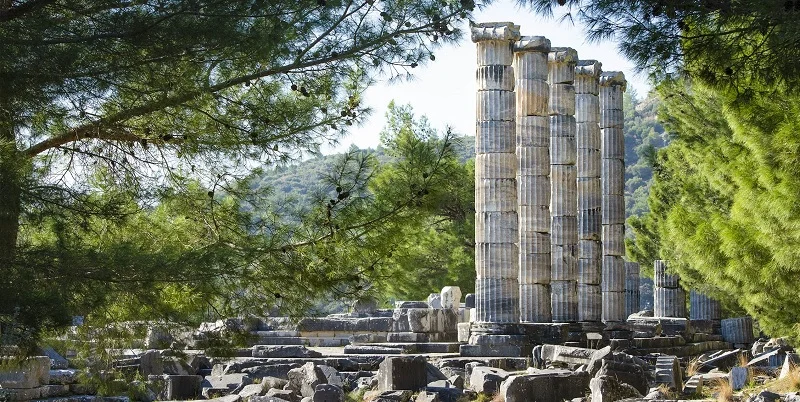
Priene, ancient city of Ionia about 6 miles (10 km) north of the Menderes (Maeander) River and 10 miles (16 km) inland from the Aegean Sea, in southwestern Turkey. Its well-preserved remains are a major source of information about ancient Greek town planning.
By the 8th century bc Priene was a member of the Ionian League, whose central shrine, the Panionion, lay within the city’s territory. Priene was sacked by Ardys of Lydia in the 7th century bc but regained its prosperity in the 8th. Captured by the generals of the Persian king Cyrus (c. 540), the city took part in several revolts against the Persians (499–494). Priene originally lay along the Maeander River’s mouth, but about 350 bc the citizens built a new city farther inland, on the present site. The new city’s main temple, of Athena Polias, was dedicated by Alexander the Great in 334.
The little city grew slowly over the next two centuries and led a quiet existence; it prospered under the Romans and Byzantines but gradually declined, and after passing into Turkish hands in the 13th century ad, it was abandoned. Excavations of the site, which is occupied by the modern town of Samsun Kale, began in the 19th century.
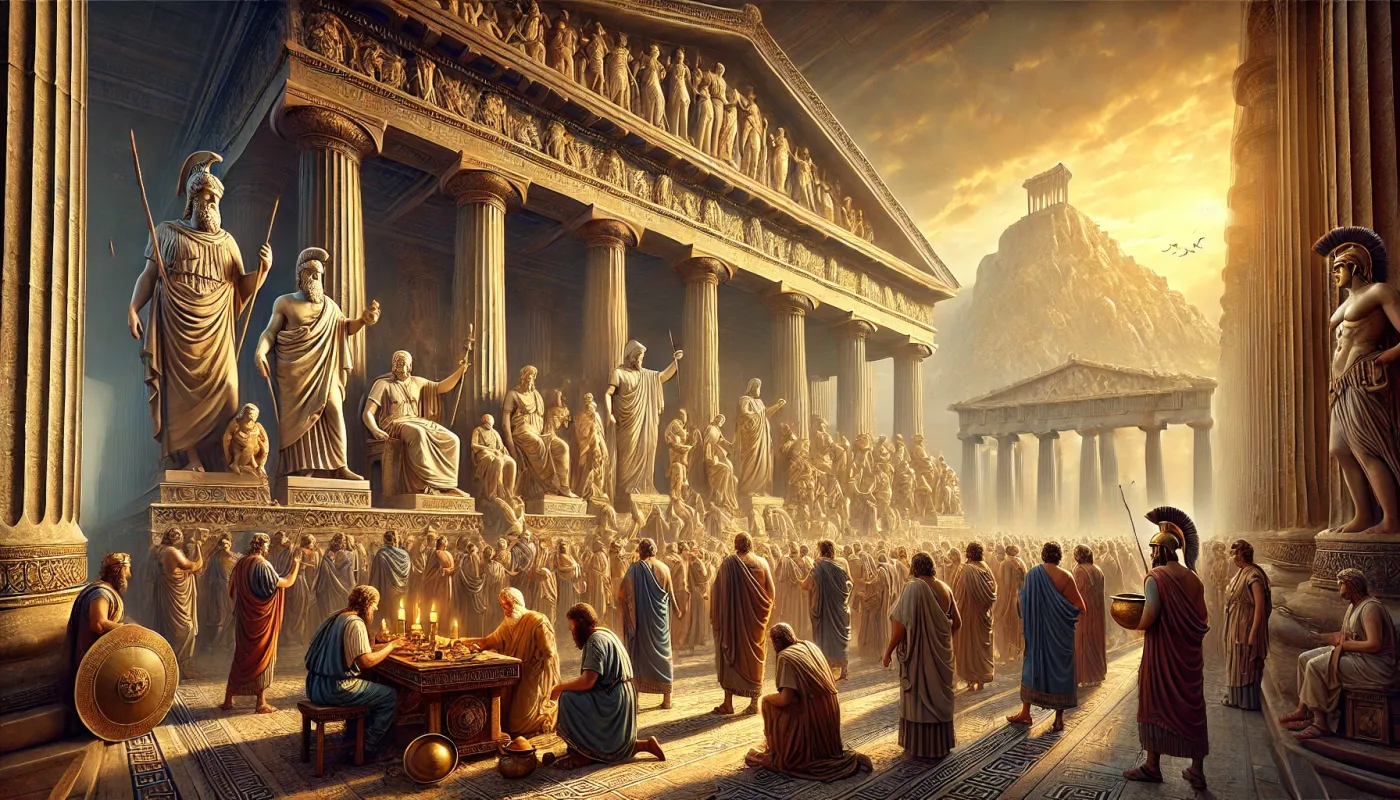
Modern excavations have revealed one of the most beautiful examples of Greek town planning. The city’s remains lie on successive terraces that rise from a plain to a steep hill upon which stands the Temple of Athena Polias. Built by Pythius, probable architect of the Mausoleum of Halicarnassus, the temple was recognized in ancient times as the classic example of the pure Ionic style. Priene is laid out on a grid plan, with 6 main streets running east-west and 15 streets crossing at right angles, all being evenly spaced. The town was thereby divided into about 80 blocks, or insulae, each averaging 150 by 110 feet (46 by 34 m). About 50 insulae are devoted to private houses; the better-class insulae had four houses apiece, but most were far more subdivided. In the centre of the town stand not only the Temple of Athena but an agora, a stoa, an assembly hall, and a theatre with well-preserved stage buildings. A gymnasium and stadium are in the lowest section.
The private houses typically consisted of a rectangular courtyard enclosed by living quarters and storerooms and opening to the south onto the street by way of a small vestibule.