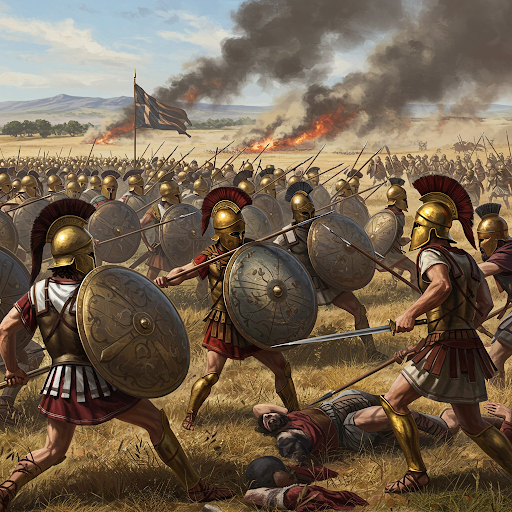
The Persian Wars (499–449 BCE) were a defining moment in Western history, pitting the small, fragmented city-states of Greece against the colossal Persian Empire. Against all odds, the Greeks repelled multiple invasions, demonstrating the power of unity, strategy, and innovative warfare. This article explores the key battles of the conflict, particularly Marathon, Thermopylae, and Salamis, and examines how Greece managed to defeat one of the most formidable empires of the ancient world.
Background: Why Did the Persian Wars Begin?
The wars were sparked by tensions between the Greek city-states and the Achaemenid Persian Empire under King Darius I. Several key events led to the full-scale conflict:
The Ionian Revolt (499–494 BCE) – Greek city-states in Ionia (modern-day Turkey) rebelled against Persian rule, with Athens and Eretria offering support. Though Persia crushed the revolt, it provoked Persian hostility towards mainland Greece.
Darius I’s Desire for Revenge – Furious at Athenian involvement, Darius vowed to punish Athens and expand Persian influence into Greece.
Persian Expansionism – Persia sought to consolidate its control over the Aegean region, seeing Greece as a strategic and economic threat.
Thus began the first phase of the Persian Wars, culminating in the famous Battle of Marathon.
The Battle of Marathon (490 BCE): Athens’ Stunning Victory
Darius I launched his invasion of Greece in 490 BCE, landing his forces at Marathon, about 26 miles from Athens. The Athenians, heavily outnumbered, made a bold decision—to attack the Persians head-on.
Key Factors in the Greek Victory:
Strategic Formation: The Athenian general Miltiades devised a plan to strengthen the flanks of the Greek army while keeping the center weak. When the Persians pushed forward, the Greek flanks enveloped them in a pincer movement.
Hoplite Warfare: The well-trained Greek hoplites, armed with spears, shields, and armor, proved superior to the lightly armored Persian infantry.
Persian Tactical Mistakes: The Persians underestimated Greek resistance and failed to use their cavalry effectively.
The result was a decisive Greek victory, with only 192 Athenian casualties compared to over 6,000 Persian losses. This battle boosted Greek confidence and demonstrated that Persia was not invincible.
The Second Persian Invasion: The Return of Xerxes (480 BCE)
Following Darius I’s death, his son Xerxes I sought revenge. He assembled a massive army, reportedly numbering over one million soldiers (though modern estimates suggest around 200,000). In 480 BCE, he launched a new invasion, crossing into Greece via a massive pontoon bridge over the Hellespont.
Greek city-states, often divided by internal rivalries, formed the Hellenic League to unite against Persia. Led by Athens and Sparta, they prepared for a brutal confrontation.
The Battle of Thermopylae (480 BCE): A Heroic Last Stand
At the narrow pass of Thermopylae, King Leonidas I of Sparta and 300 elite Spartans, supported by 7,000 Greek allies, blocked the Persian advance.
Why Thermopylae Was Important:
Geographical Advantage: The narrow pass prevented the Persians from utilizing their superior numbers.
Greek Determination: The Spartans and their allies fought fiercely, inflicting heavy casualties.
Betrayal by Ephialtes: A Greek traitor revealed a hidden mountain path, allowing the Persians to outflank the defenders.
Though the Greeks were ultimately overwhelmed, their sacrifice delayed the Persian advance and inspired future resistance. Thermopylae became a symbol of courage and defiance.
The Battle of Salamis (480 BCE): Athenian Naval Brilliance
As the Persian army advanced, the Greek navy, under the command of Themistocles, lured the Persian fleet into the narrow straits of Salamis.
Key Factors in the Greek Victory:
Deception and Strategy: Themistocles tricked Xerxes into believing the Greeks were retreating, drawing the Persian navy into a confined space.
Superior Naval Tactics: The smaller, more maneuverable Greek triremes outmaneuvered the larger Persian ships.
Xerxes’ Overconfidence: The Persian king watched the battle from a throne on a hill, believing victory was assured. Instead, his fleet suffered catastrophic losses.
Salamis was a turning point, forcing Xerxes to retreat and marking the beginning of Persian decline in Greece.
The Final Blow: The Battle of Plataea (479 BCE)
A year later, the Greek forces, now unified under Spartan leadership, decisively defeated the remaining Persian army at Plataea.
The heavily armored Greek hoplites dominated the battlefield.
The Persian forces, lacking effective cavalry support, collapsed.
This final victory ended Persia’s ambitions in Greece, securing Greek independence.
Aftermath: How the Persian Wars Shaped History
The Persian Wars had far-reaching consequences:
Greek Confidence and the Golden Age of Athens – Athens emerged as a dominant power, leading to a flourishing of philosophy, art, and democracy.
The Delian League and Athenian Imperialism – Athens formed the Delian League to protect against future Persian threats, eventually leading to Athenian empire-building.
The Decline of Persia – Though still powerful, Persia never again attempted a full-scale invasion of Greece.
The Foundation of Western Civilization – Greek values of freedom, strategy, and resilience became central to Western identity.
Conclusion: How Did Greece Defeat Persia?
Despite being vastly outnumbered, Greece triumphed due to:
Superior military tactics (e.g., hoplite warfare, naval strategy at Salamis).
Greek unity in the face of invasion.
Persian overconfidence and logistical challenges.
The Persian Wars stand as one of history’s greatest underdog stories, proving that determination, strategy, and unity can overcome even the mightiest empires.