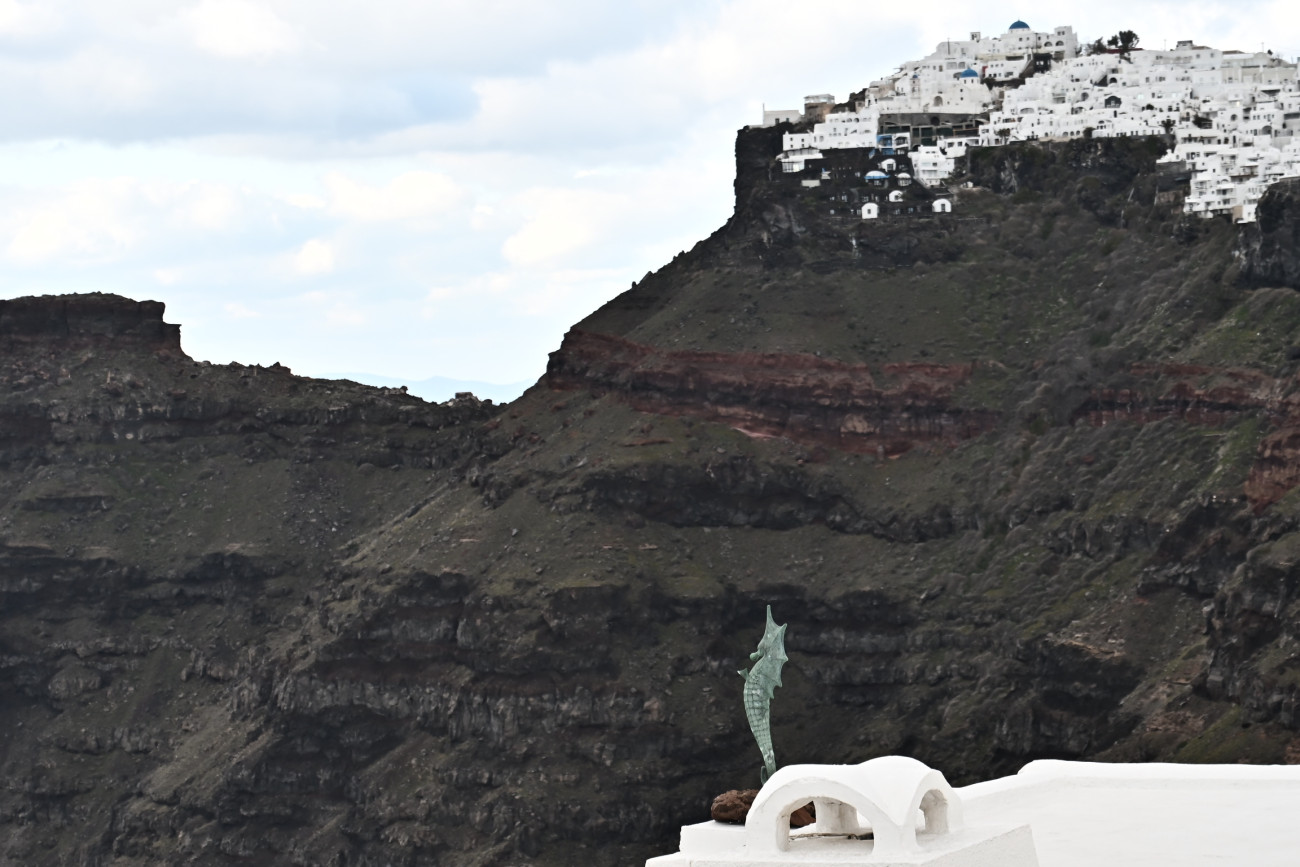
Scientific findings attribute the prolonged seismic activity between Santorini and Amorgos last January to the upward movement of magma from underwater volcanoes in the region of Anydro.
According to researchers involved in the recent international oceanographic expedition "Discovery," deep-seated magmatic processes were responsible for the unprecedented seismic activity that left Santorini in a near standstill for almost a month.
The Role of Magma in Seismic Activity
These conclusions were presented during the "Dialogues on Santorini" event at the Academy of Athens. Another significant revelation from the event was the detection of geological shifts in Santorini, Ios, Naxos, and Astypalaia since early February 2025 due to complex geodynamic processes in the South Aegean.
Magma Intrusion and Seismic Crisis
As Professor Paraskevi Nomikou of the National and Kapodistrian University of Athens (NKUA) explained to TA NEA, the seismic crisis in the sea between Santorini and Amorgos was triggered by the intrusion of a magma-feeding vein from a deeper magmatic chamber in the Anydro region.
“We believe the seismic activity was activated by this intrusion, which occurred at a depth of approximately five kilometers beneath the Earth's surface,” she stated.
Professor Nomikou emphasized that these conclusions are based on extensive research, including numerous oceanographic missions in the area, seabed mapping, and analysis of hydrothermal fields in Kolumbo and Santorini. She also referenced data from seismic tomography conducted in 2015, when volcanic activity was also observed. The findings are set to be published in Nature.
Investigating the Santorini Caldera
During the Discovery expedition from March 3 to 28, 2025, a robotic vehicle conducted three dives into the Santorini Caldera and the Kolumbo submarine volcano. It collected gas and fluid samples from the hydrothermal field and volcanic chimneys.
Funded by the National Oceanography Center, the mission included scientists from the UK, Germany, and Greece, including Professor Nomikou.
“One remarkable discovery was the significant increase in bacterial deposits covering Kolumbo compared to December 2024. This indicates a higher production of volcanic gases during the seismic crisis, acting as a mirror of the volcano’s activity,” she explained.
The highest temperature recorded in Kolumbo’s hydrothermal fields exceeded 196 degrees Celsius, suggesting an increase in fluid movement. Elevated levels of radium were also detected in the region.
A Scientific Mystery Unfolds
A puzzling phenomenon was also observed: some of the depressions in the Caldera’s hydrothermal field that were previously filled with CO2 and methane in December 2024 were now empty. Scientists are conducting further analyses to determine the cause of this anomaly, Professor Nomikou revealed.
Ground Deformation and Volcanic Activity
Dr. Athanasios Ganas, seismologist and research director at the National Observatory of Athens, reported that his team analyzed geodetic data from GNSS stations and satellite radar (SAR), uncovering significant ground deformation in the Santorini Caldera.
Between the summer of 2024 and January 2025, the caldera experienced a four-centimeter uplift, peaking during the seismic crisis. Horizontal displacements were also observed in a radial pattern.
“This expansion subsided by late January, giving way to ground contraction,” Dr. Ganas explained.
In early February 2025, a second phase of deformation began, during which the entire island of Santorini shifted northeast. This movement resulted from magma intrusion from the mantle into the Earth’s crust at a depth of approximately ten kilometers, closely linked to volcanic activation.
The impact extended beyond Santorini. Ios and Naxos also experienced displacement—Naxos by 2.8 cm northwestward—while Astypalaia moved southeast. Additionally, a GNSS receiver installed in Anydro on February 12 recorded subsidence of the island towards the west.
Unraveling the South Aegean’s Geological Puzzle
These findings underscore the dynamic nature of Santorini’s volcanic system and its broader geological impact on the South Aegean. As research continues, scientists aim to decipher the intricate interplay of magma movement, seismic activity, and ground deformation—shedding new light on the mysteries of the Santorini Caldera.