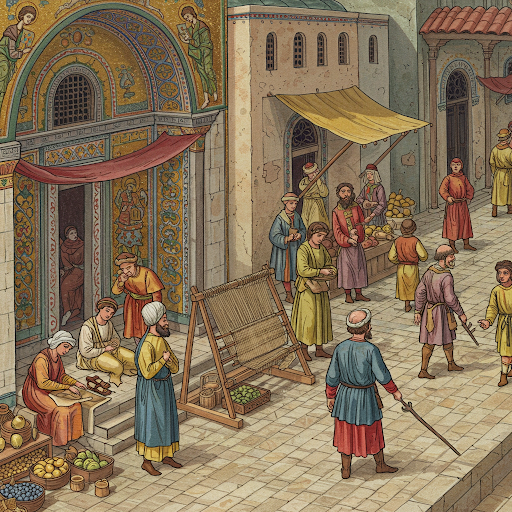
The cities of the Byzantine Empire supported a wide range of economic activities, from large-scale trade and administration to small workshops producing goods for local households. While monumental churches, defensive walls, and public buildings often dominate archaeological discussions of Byzantine urban life, much of the work that sustained city populations took place in modest spaces. Small workshops could be located within houses, beneath upper floors, along narrow streets, or inside buildings that changed function over time. Their remains provide an opportunity to investigate how urban residents produced, repaired, and exchanged everyday goods within the crowded and changing environments of Byzantine cities.
The term Byzantine refers broadly to the eastern Roman Empire and the societies that developed within it, from Late Antiquity until the fall of Constantinople in 1453. Urban conditions varied considerably across this long period and between different regions. Some cities remained important administrative and commercial centers, while others experienced changes in population, infrastructure, and economic activity. Workshops therefore cannot be understood as a uniform feature of every Byzantine city. Their size, organization, and relationship to markets depended on local resources, consumer demand, political conditions, and the historical development of each settlement.
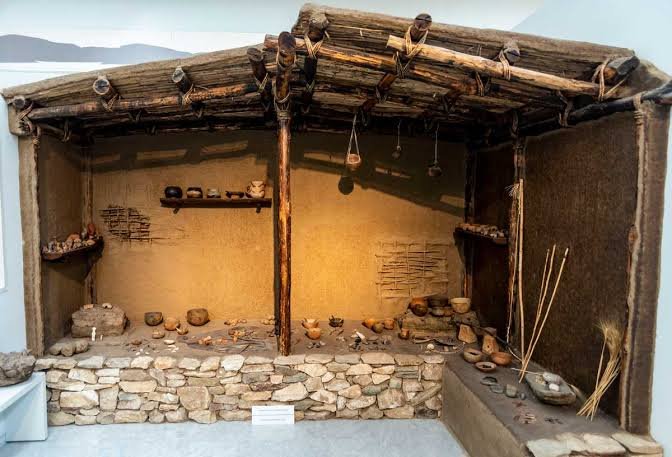
Small workshops often occupied spaces that were not originally designed for specialized production. A room within a domestic building might have been adapted for metalworking, textile production, pottery-related activities, woodworking, or the repair of household objects. Changes in the use of a building could leave traces in the floor, walls, drainage systems, and deposits of discarded materials. A room that once served as a living area might later contain a work surface, a small hearth, or a concentration of craft debris. Archaeologists must examine these changes carefully because the function of a room may have shifted several times during the life of the building.
The physical evidence for a workshop depends on the type of craft practiced there. Metalworking may leave slag, crucible fragments, metal droplets, molds, or heat-altered surfaces. Textile production can be associated with spindle whorls, loom weights, needles, and fibers, although the survival of the fibers themselves is often poor. Bone and antler working may produce small fragments and offcuts, while woodworking can leave chips, tool marks, or residues that are difficult to preserve. Pottery-related production may be indicated by wasters, kiln furniture, or concentrations of clay and ceramic debris. Each category of evidence requires a different approach, and the absence of a particular artifact does not necessarily rule out a craft activity.
The location of workshops within urban neighborhoods can reveal how production was integrated into everyday life. Some activities could be carried out with relatively little noise or waste and might have been compatible with domestic spaces. Others generated smoke, heat, odors, or dangerous debris, making them more suitable for courtyards, peripheral areas, or buildings with adequate ventilation. The distribution of workshop remains across a city may therefore reflect practical requirements as well as social and economic organization. However, modern assumptions about which crafts were acceptable inside homes should not be applied automatically to Byzantine settings.
Archaeological layers beneath later buildings can preserve traces of workshops that disappeared when streets and structures were rebuilt. Urban excavation often reveals several phases of occupation stacked on top of one another. A workshop floor may survive beneath a later house, shop, or public building, while its tools and waste are mixed with deposits from other activities. These remains are especially valuable because they can reveal how the use of urban space changed over time. A location that functioned as a production area during one period may later have become residential or commercial, reflecting shifts in the city's economy and population.
Small workshops also depended on networks of supply. Artisans needed raw materials, fuel, tools, and access to customers. Some materials could be obtained locally, while others may have arrived through regional or long-distance trade. Chemical and mineralogical analyses can help identify the origins of particular stones, clays, metals, and other substances, although sourcing is not always precise. The presence of imported raw materials may indicate connections with distant production areas, but it does not necessarily mean that the workshop itself participated directly in long-distance commerce. Materials could have passed through several merchants or intermediaries before reaching the artisan.
Waste products can reveal how production was organized. Repeated concentrations of offcuts, broken tools, slag, or defective objects may indicate that particular tasks were performed in the same location over an extended period. Differences in the composition of waste can help researchers distinguish between stages of production. A workshop that contains unfinished objects and manufacturing debris offers stronger evidence of local production than a room containing only finished goods. Even so, craft waste can be transported and dumped away from the place where it was created, so the distribution of debris must be examined in relation to floors, work surfaces, and nearby structures.
The scale of a workshop does not necessarily reveal the status of its owner. A small room with specialized tools could have belonged to an independent artisan, a household producing goods for its own use, or a worker operating within a larger commercial arrangement. Some artisans may have worked under the authority of employers, institutions, or state-linked organizations, while others may have sold their products directly to local customers. Archaeological evidence can sometimes indicate specialization and production intensity, but the exact legal and economic relationships are often difficult to reconstruct without written records.
Byzantine written sources can provide useful context for understanding craft production, markets, taxation, and the organization of labor. However, these documents often reflect the interests of particular authors or institutions and may not describe the daily experiences of ordinary artisans in detail. Archaeological evidence can help balance this picture by revealing what people actually produced, how they adapted buildings, and how craft activities were distributed across neighborhoods. When written and material evidence are compared, researchers can investigate where official descriptions match the physical record and where important aspects of everyday work remain undocumented.
Dating workshops is complicated by repeated rebuilding and changes in use. Pottery and coins found in occupation layers can help establish chronological ranges, while architectural features may reveal the sequence of alterations. Radiocarbon dating can be useful when suitable organic material is preserved, although the relationship between the sample and the workshop's operation must be clear. A coin found on a floor may indicate that the floor was used after the coin was produced, but it does not necessarily provide an exact construction date. Researchers therefore combine several types of evidence to reconstruct the chronology of an urban workshop.
Small workshops also illuminate the social character of Byzantine cities. Production brought artisans into contact with customers, suppliers, neighbors, and other workers. Noise, smoke, waste, and the movement of materials could shape relationships between workshops and surrounding households. Shared streets and courtyards may have provided spaces for both economic and social interaction. In some neighborhoods, specialized crafts could cluster together because of shared resources or customer demand, while in others production may have been dispersed throughout residential areas. These arrangements reveal that urban economies were not confined to formal marketplaces or large industrial complexes.
The study of small Byzantine workshops helps recover the ordinary labor that supported urban life. Their traces may be hidden beneath later buildings or obscured by centuries of rebuilding, but tools, production waste, modified floors, and raw materials can reveal where and how goods were made. By examining workshop remains alongside architectural history, trade networks, and written evidence, archaeologists can reconstruct the changing relationship between domestic life and specialized production. These modest spaces provide an important perspective on Byzantine cities, showing how their economies depended not only on rulers, merchants, and monumental institutions but also on the everyday work of artisans operating within the urban fabric.