Introduction
Andritsaina is a historic settlement in the mountainous region of western Arcadia, in the Peloponnese. Its location near important inland routes and the wider landscape of ancient and medieval settlements makes it an interesting setting for investigating the region's changing military history.
During the medieval period, the Peloponnese experienced major political transformations. Following the Fourth Crusade in 1204, Frankish rulers established the Principality of Achaea, which controlled substantial parts of the region at different times.
Arrowheads associated with this period could provide evidence of military technology, conflict, and the movement of armed groups. However, the specific claim of Frankish arrowheads in Andritsaina hoards requires archaeological verification.
Andritsaina and Medieval Arcadia
Andritsaina occupies a mountainous area of the western Peloponnese, where natural valleys and passes connected inland settlements.
The region's terrain influenced military movement and settlement defense. Hills, narrow routes, and elevated positions could provide strategic advantages during periods of conflict.
Medieval communities depended on agricultural production, local trade, and regional transportation routes.
The surrounding landscape also contained older settlements and monuments, meaning that archaeological material from different historical periods can occur within the same area.
The Frankish Presence in the Peloponnese
The Fourth Crusade brought major political changes to the Byzantine world.
After Constantinople fell to the Crusaders in 1204, Frankish leaders established new political territories in parts of Greece, including the Principality of Achaea in the Peloponnese.
The principality developed a network of castles, settlements, and administrative centers.
Its history involved alliances, warfare, succession disputes, and relationships with Byzantine successor states and other regional powers.
Frankish authority changed over time, and not every medieval military object found in the Peloponnese can automatically be connected to Frankish forces.
Medieval Arrowheads and Their Forms
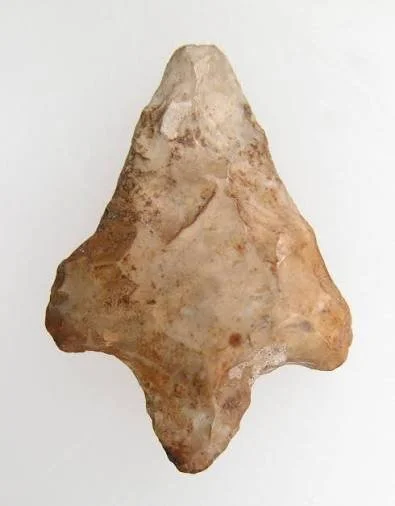
Arrowheads were important components of medieval warfare.
Their shape varied according to the intended purpose and the type of bow or crossbow used.
Some arrowheads had narrow, pointed forms designed to penetrate armor or other resistant materials. Others were broader and better suited to damaging unarmored targets.
Socketed and tang-mounted designs were among the methods used to attach arrowheads to wooden shafts.
Manufacturing techniques included forging, shaping, and heat treatment, depending on the material and workshop tradition.
Identifying Frankish Military Equipment
Dating an arrowhead can be difficult because similar designs were used by different military groups over long periods.
Researchers examine the shape, dimensions, manufacturing details, metallurgy, and archaeological context.
Comparisons with securely dated medieval assemblages can help narrow the possible chronology.
Associated pottery, coins, weapons, and defensive structures may provide additional evidence.
Even if an arrowhead dates to the thirteenth or fourteenth century, that does not necessarily prove it belonged to a Frankish soldier. Other groups used comparable military equipment.
What Is an Archaeological Hoard?
A hoard is a deliberate deposit of objects, often buried or concealed together.
Some hoards were hidden during periods of danger, while others may have been stored for practical or ritual reasons.
A collection of arrowheads might represent military equipment stored for later use, material recovered after a battle, or objects deposited during a period of insecurity.
However, a group of metal objects found together is not automatically a hoard. Its original context and the relationship between the objects must be established.
Warfare and the Medieval Peloponnese
The Peloponnese experienced repeated conflict during the medieval period.
Frankish rulers competed with Byzantine forces, local powers, and other regional authorities. Castles and fortified settlements played an important role in controlling territory.
Mountain passes and inland routes could become strategically significant because they connected agricultural communities with larger political centers.
Military remains from the region may therefore provide evidence of broader conflicts, but individual objects should not be assigned to a particular battle without supporting historical and archaeological information.
Metallurgical Analysis
Scientific analysis can help researchers understand how medieval arrowheads were produced.
Metallography examines the internal structure of metal, revealing patterns associated with forging, heat treatment, and manufacturing processes.
Chemical analysis can identify the composition of iron and other metals, although composition alone rarely identifies a particular army or workshop.
Tool marks and manufacturing features may reveal whether objects were produced in a centralized workshop or by local smiths.
Such studies become especially useful when comparing several objects from a securely documented assemblage.
Preservation and Archaeological Context
Iron arrowheads are vulnerable to corrosion, particularly when buried in damp or mineral-rich soils.
Their original shapes can become obscured by corrosion products, making conservation and imaging important parts of the research process.
The location and depth of each object should be recorded before removal. Metal detectors and unauthorized collecting can separate artifacts from their archaeological context, reducing their historical value.
Conclusion
Frankish-period arrowheads associated with Andritsaina would provide an interesting opportunity to study medieval military activity in the mountainous Peloponnese.
Their shapes, metallurgy, and archaeological contexts could help reconstruct weapon production and the movement of armed forces through the region. However, the specific claim of Frankish arrowhead hoards near Andritsaina requires reliable excavation or collection records.
The wider history of the Frankish presence in the Peloponnese provides an important framework for investigating medieval warfare, but individual weapons must be dated and attributed with care.