Introduction
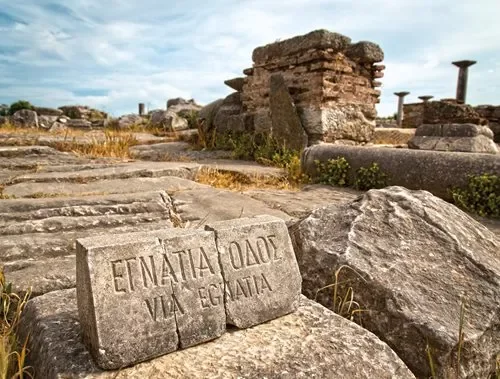
The ancient city of Gortys, located in the region of Arcadia in the central Peloponnese, is known for its long settlement history and its importance in the ancient Greek world. The name Gortys is associated with more than one ancient location, making precise geographical identification essential when discussing archaeological discoveries.
The Mycenaean civilization flourished during the Late Bronze Age and developed sophisticated systems of craft production, trade, and administration. Goldworking was among the specialized activities that produced valuable objects for elite display, religious offerings, and funerary use.
The possibility of Mycenaean goldsmith tools near Gortys raises questions about regional craft production and the distribution of precious-metal technologies. However, specific tools must be documented and securely dated before they can be attributed to a Mycenaean workshop.
Identifying the Ancient Gortys
The ancient name Gortys was used for more than one settlement in the Greek world.
In Arcadia, Gortys was an ancient settlement associated with the mountainous landscape near the Lousios River. It should not be confused with Gortyna in Crete, another important ancient city with a similar name.
This distinction matters because archaeological discoveries associated with one location cannot automatically be transferred to another.
Any proposed Mycenaean workshop near Gortys in Arcadia must be evaluated through local excavation records and evidence from the surrounding Bronze Age landscape.
Mycenaean Society and Specialized Crafts
Mycenaean civilization developed powerful centers across mainland Greece during the Late Bronze Age.
Its economy involved agriculture, livestock management, pottery production, metalworking, textile manufacture, and long-distance exchange.
Craft specialists produced objects for households, palatial authorities, religious activities, and elite burials.
Goldworking was particularly important because gold was rare, visually striking, and associated with wealth and prestige.
The production of elaborate gold objects required technical skill and access to specialized tools.
The Tools of Ancient Goldsmiths
Goldsmiths used several types of tools to shape, decorate, and assemble metal objects.
Small hammers and anvils allowed artisans to flatten gold into sheets or shape it into desired forms.
Punches, chisels, and engraving tools created lines, patterns, and decorative details.
Fine tweezers and other handling implements could assist with delicate work, while specialized equipment was used for joining and assembling components.
The exact tools depended on the techniques being practiced. Some objects could be produced through hammering and cutting, while others required casting, soldering, or the application of thin decorative sheets.
Goldworking Techniques in the Mycenaean World
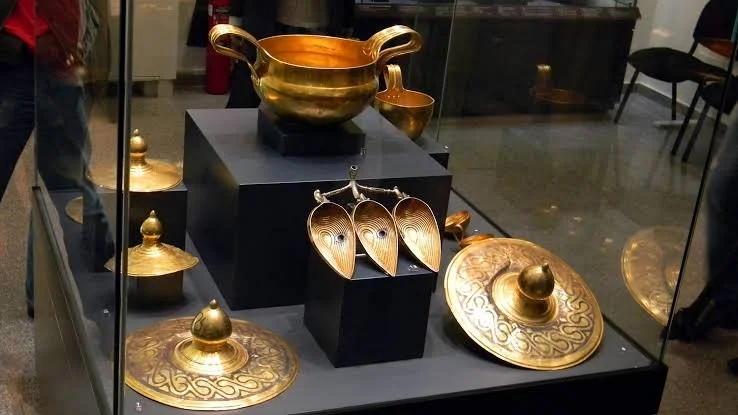
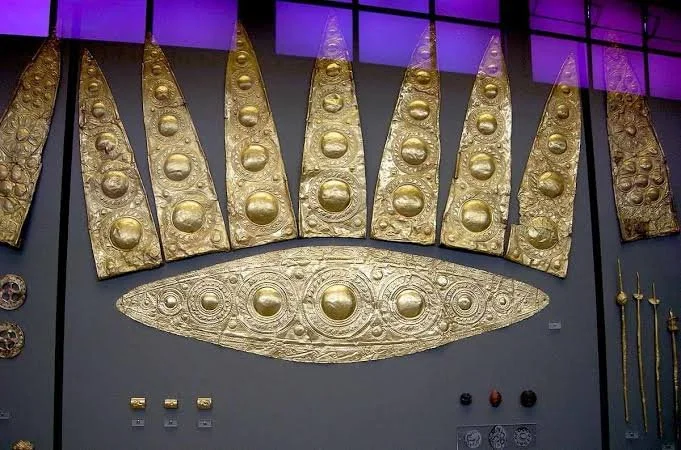
Mycenaean goldworkers demonstrated considerable skill in producing jewelry, vessels, ornaments, and funerary objects.
Gold could be hammered into thin sheets, shaped into beads, or worked into more complex decorative forms.
Granulation involved attaching tiny metal spheres to a surface to create elaborate patterns. Repoussé techniques allowed raised designs to be formed by working metal from the reverse side.
The combination of these techniques produced objects with complex textures and carefully controlled decoration.
Their presence in the archaeological record demonstrates that Mycenaean craftspeople possessed advanced knowledge of precious-metal working.
Why Goldsmith Tools Might Be Found Near a Settlement
Tools associated with metalworking may be recovered from workshops, domestic areas, storage deposits, or abandoned buildings.
Their location can help researchers understand how craft production was organized.
A small workshop might have been part of a household, while more specialized production could have been connected to an elite center or administrative authority.
The presence of tools does not automatically prove that gold was processed at the discovery site. Some implements may have been used for working other metals or materials.
Their function must be established through microscopic examination, residues, and comparison with known workshop equipment.
Trade and Access to Precious Metals
Mycenaean communities obtained gold through networks that connected the Aegean with regions farther east and south.
Gold could circulate through trade, diplomatic exchange, gifts, and the movement of individuals.
The availability of gold did not necessarily mean that every community possessed a local source. Raw material could be imported and then processed by local craftspeople.
If Mycenaean goldsmith tools were identified near Gortys, researchers would need to investigate whether they indicate local production, temporary craft activity, or the movement of specialized artisans.
Archaeological Evidence for a Workshop
A convincing identification of a goldworking workshop requires more than a few metal implements.
Evidence might include tools, unfinished objects, metal fragments, crucibles, casting waste, furnaces, and residues associated with production.
The arrangement of these materials can reveal how the working area was organized.
Scientific analysis may identify traces of gold or other metals on tools and workshop surfaces.
A securely dated deposit is also essential for establishing whether the activity belongs to the Mycenaean period.
Scientific Investigation and Conservation
Metallographic examination can reveal the manufacturing history of metal tools. Microscopic analysis may identify wear patterns caused by repeated hammering, cutting, or engraving.
Chemical testing can help identify metal residues, although contamination and later corrosion must be considered.
The preservation of ancient tools is important because even small implements can reveal sophisticated technical knowledge.
Accurate recording of their dimensions, material composition, and find context allows researchers to compare them with equipment from other Mycenaean sites.
Conclusion
Mycenaean goldsmith tools near Gortys would offer a valuable opportunity to investigate specialized craft production in the central Peloponnese.
Their study could reveal how precious-metal objects were manufactured, how technical knowledge circulated, and whether smaller settlements participated in the economic systems of the Mycenaean world.
However, the specific claim of a documented Mycenaean goldsmith assemblage near Gortys requires verification. The exact ancient location, archaeological context, and function of the tools must all be established before they can be connected to a particular workshop.
The broader study of Mycenaean metalworking demonstrates how specialized tools can illuminate the organization, technology, and exchange networks of Bronze Age Greek society.