Introduction
The island of Astypalaea occupies a strategic position in the southeastern Aegean, between the Cyclades and the Dodecanese. Its rugged coastline, sheltered bays, and elevated settlements made it part of a maritime landscape that connected islands, ports, and trading communities throughout antiquity.
During the Hellenistic period, ships were essential to commerce, warfare, migration, and communication. Images of vessels scratched or carved into stone can provide valuable evidence of how ancient people understood and represented maritime life.
The possibility of Hellenistic ship graffiti on Astypalaea's cliffs offers an intriguing subject for archaeological investigation. However, specific examples must be documented and dated before they can be confidently attributed to the Hellenistic period.
Astypalaea's Maritime Geography
Astypalaea's position gave it access to important routes linking the eastern and central Aegean. Ships traveling between the Dodecanese, Crete, the Cyclades, and the Anatolian coast could use the island's surrounding waters as part of their journeys.
Its coastline contains numerous rocky formations, coves, and naturally sheltered areas. These features influenced where vessels could anchor, seek protection from unfavorable weather, or approach settlements.
The island's maritime geography also shaped its economic and cultural relationships. Fishing, coastal transport, and participation in regional trade were important aspects of life in the wider Aegean.
Ship Graffiti in the Ancient Mediterranean
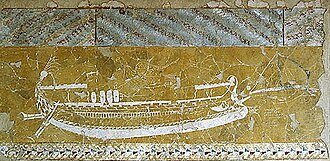
Ancient ship graffiti consists of vessel images scratched, incised, or carved into surfaces such as stone, pottery, and plaster. Some examples are highly simplified, while others include recognizable hulls, masts, sails, oars, and steering equipment.
Such representations are valuable because they can preserve details that are not always visible in archaeological shipwreck remains.
However, graffiti is often difficult to date. A ship image carved into an ancient wall may have been added centuries after the original construction. Its archaeological context must therefore be examined separately from the age of the surface.
Hellenistic Ships and Maritime Technology
The Hellenistic period, conventionally dated from the death of Alexander the Great in 323 BCE to the Roman conquest of the eastern Mediterranean, witnessed extensive maritime activity.
Ships varied according to their purposes. Merchant vessels were designed to carry cargo, while warships emphasized speed, maneuverability, and the ability to engage other vessels.
Naval technology continued to develop during this period. Larger warships, including vessels with multiple levels of oars, became important in the fleets of powerful Hellenistic kingdoms.
Merchant ships generally relied on a combination of sails and human-powered movement when necessary. Their designs reflected practical requirements such as cargo capacity, seaworthiness, and access to coastal harbors.
Reading a Ship Image
Interpreting a ship graffiti image requires attention to its individual features. A long hull with a raised bow and stern might represent a vessel designed for maritime travel, but simplified images can make identification difficult.
The presence of a mast, sail, steering oars, or rowing equipment may help distinguish different vessel types. Researchers also compare the proportions of the hull and the arrangement of visible structures with known ancient representations.
Nevertheless, an image should not be identified as a specific warship or merchant vessel based on one ambiguous feature. The artist may have omitted important details or represented the ship symbolically rather than realistically.
Why Cliffs Might Preserve Maritime Images
Rock surfaces near harbors, coastal routes, or lookout points could have attracted markings from sailors, travelers, and local residents.
A ship image carved into a cliff might have commemorated a voyage, expressed an individual's maritime identity, or served as a simple drawing made during a period of occupation.
Yet the location alone cannot establish the purpose of the image. A cliff carving might be connected to fishing, navigation, religious devotion, or an entirely different activity.
Researchers would need to examine nearby archaeological remains, inscriptions, and the physical condition of the carving to develop a reliable interpretation.
Dating and Archaeological Verification
Dating ship graffiti is particularly challenging because the carving process rarely produces organic material suitable for radiocarbon analysis.
Archaeologists instead examine the relationship between the image and its surface. Weathering patterns, tool marks, overlapping inscriptions, and nearby securely dated deposits may provide useful chronological clues.
If a ship image is cut into a wall belonging to a known Hellenistic structure, the carving must still be shown to belong to the same period. It could have been added later.
Digital recording and three-dimensional surface modeling can help preserve fine details and allow researchers to compare images without repeatedly touching fragile rock surfaces.
Preservation of Coastal Rock Art
Coastal environments can be damaging to ancient carvings. Salt crystallization, wind erosion, rainwater, biological growth, and temperature changes gradually alter exposed rock.
Modern development and uncontrolled visitor activity can also threaten archaeological surfaces.
Documentation should therefore begin with photography, measured drawings, and non-invasive recording. Any attempt to clean or enhance a carving should be conducted by qualified conservation specialists.
Conclusion
Hellenistic ship graffiti on Astypalaea's cliffs would provide a fascinating connection between the island's landscape and the maritime world of the ancient Aegean. Such images could help researchers investigate ship design, coastal movement, and the ways sailors represented their experiences.
However, the specific claim of confirmed Hellenistic ship graffiti on Astypalaea requires archaeological documentation and reliable dating. The broader study of ancient ship images remains important because even simple carvings can preserve clues about maritime technology and cultural identity.