Introduction
The Minoan civilization developed primarily on Crete during the Bronze Age, but its influence extended across the Aegean through trade, cultural exchange, and maritime interaction. The Cycladic islands played an important role in these networks, connecting Crete with mainland Greece and communities farther north.
Amorgos, located in the eastern Cyclades, occupies a strategic position within this maritime landscape. Its coastal geography and proximity to other islands make it an interesting setting for investigating Bronze Age exchange.
Lustral basins are particularly associated with Minoan architectural and ritual contexts. The possibility of such installations near or beneath the waters off Amorgos raises important questions, but the specific claim of submerged Minoan lustral basins requires archaeological confirmation.
Minoan Civilization and the Aegean
Minoan society flourished on Crete during the second millennium BCE, developing large palace centers, specialized craft production, extensive maritime connections, and distinctive artistic traditions.
Major centers such as Knossos, Phaistos, Malia, and Zakros provide evidence of complex architecture and organized economic activity.
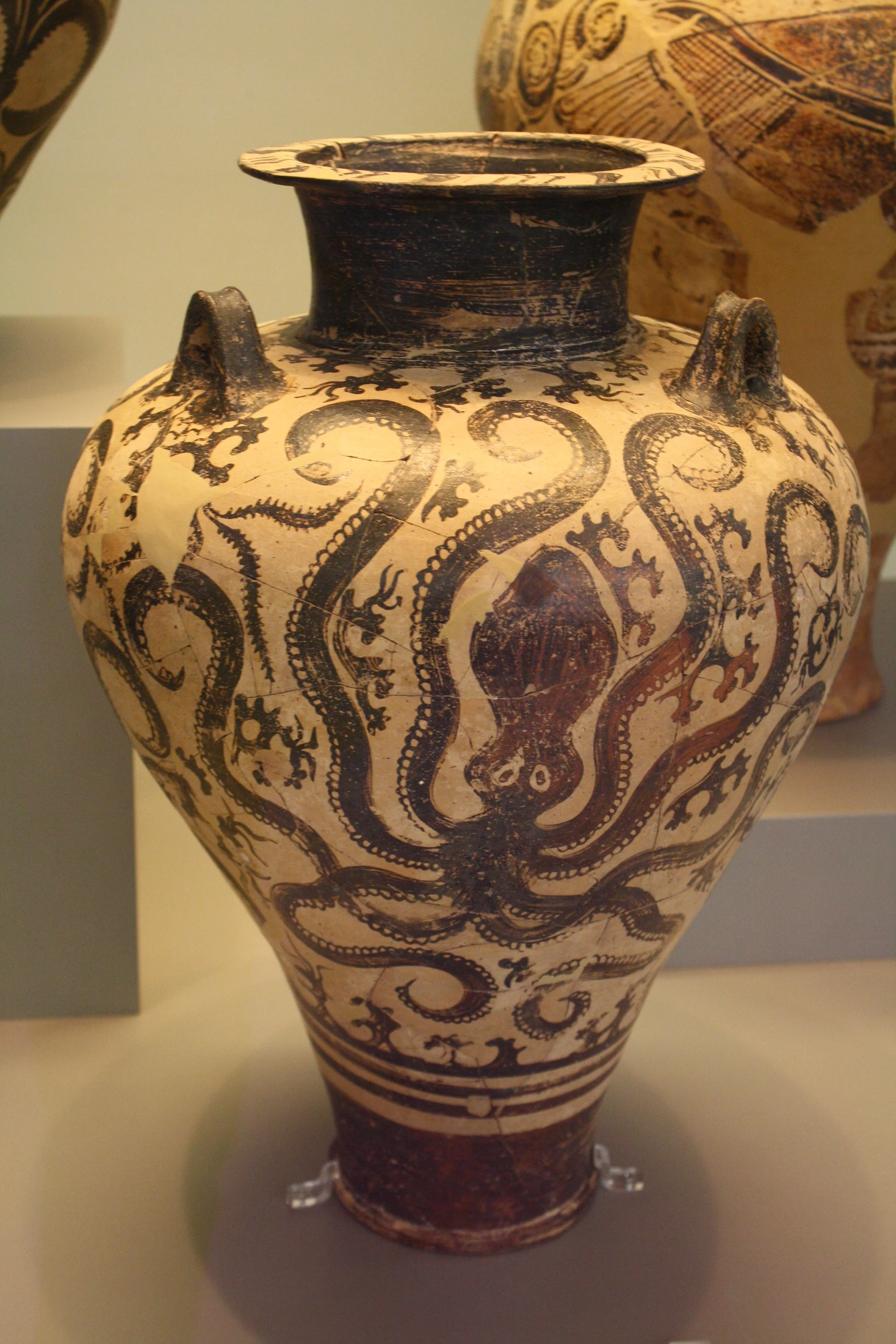
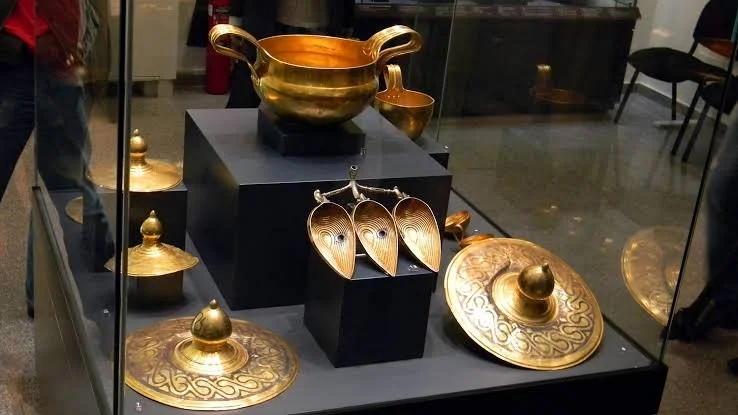
Minoan material culture circulated beyond Crete. Pottery, metal objects, seals, and artistic motifs have been identified at sites across the Aegean, including the Cyclades.
These connections demonstrate cultural interaction, although the presence of Minoan-style objects outside Crete does not automatically indicate direct political control.
What Was a Lustral Basin?
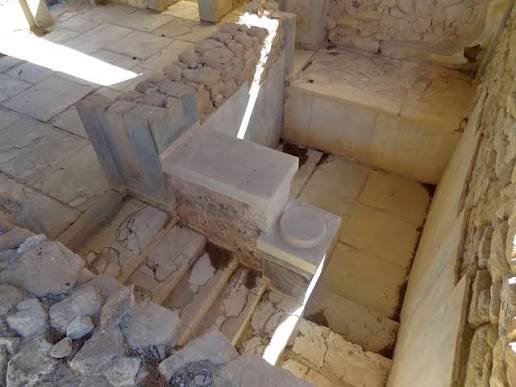
The term “lustral basin” is used in Aegean archaeology for a type of sunken architectural installation associated particularly with Minoan palatial buildings.
These spaces are often reached by steps and are located within specialized architectural settings. Their precise function remains debated.
Some interpretations associate them with ritual purification or ceremonial activity, while others question whether they were used for actual washing or served a more symbolic purpose.
Their identification depends on architectural form, construction details, and the relationship with surrounding rooms. A simple depression or water-holding feature should not automatically be classified as a Minoan lustral basin.
Amorgos and Bronze Age Maritime Connections
Amorgos lies along routes connecting the central and eastern Aegean. Its location would have made it relevant to maritime movement between the Cyclades, Crete, and the Anatolian coast.
The island also belongs to a region with a rich prehistoric record. Cycladic communities participated in networks involving obsidian, metals, pottery, and other materials.
Archaeological evidence from the wider Cyclades demonstrates that island communities were not isolated. Their settlements were connected through exchange and shared artistic traditions.
The Possibility of Submerged Archaeological Remains
Coastal archaeological sites can become submerged through sea-level changes, tectonic movement, erosion, and other geological processes. Ancient structures that once stood near the shoreline may now lie underwater.
This makes underwater archaeology important for reconstructing prehistoric coastal settlement patterns.
However, identifying a submerged building requires more than locating cut stones or architectural fragments. Researchers must establish whether the remains form a coherent structure and whether they belong to the period under investigation.
For a proposed Minoan lustral basin off Amorgos, the decisive evidence would include recognizable architectural features, secure dating, and a documented underwater context.
Ritual Architecture and Water
Water had practical and symbolic importance in ancient Mediterranean societies. It was necessary for drinking, cooking, bathing, agriculture, and craft production.
In religious settings, water could also be associated with purification, transition, and ceremonial activity.
Minoan architecture incorporated specialized spaces whose functions are still debated. Lustral basins are among the most discussed examples because their form suggests a deliberate architectural purpose, but the exact nature of their use remains uncertain.
Comparisons with other installations can help researchers develop interpretations, although each structure must be assessed within its own archaeological context.
Underwater Archaeological Methods
Investigating submerged remains requires careful documentation. Divers and underwater archaeologists may use measured surveys, photography, photogrammetry, and remote sensing to record structures.
Side-scan sonar and other acoustic methods can help identify anomalies on the seabed, while more detailed examination is needed to determine whether these features are archaeological.
Sediment samples and associated artifacts may provide dating evidence. Where organic material survives, scientific methods can help establish the age of the deposit.
The relationship between the structure and the ancient shoreline is also important. Geological studies can help determine whether the site was originally coastal, inland, or located in shallow water.
Distinguishing Minoan Influence from Minoan Construction
One of the central challenges in studying Minoan material outside Crete is distinguishing cultural influence from direct settlement or construction.
A building may incorporate architectural ideas associated with Minoan Crete without having been built by Minoan settlers. Likewise, imported pottery may indicate exchange rather than political occupation.
To identify a Minoan installation on Amorgos, researchers would need evidence beyond general stylistic resemblance. Architectural details, construction techniques, associated ceramics, and chronological analysis would all be important.
Conclusion
The proposed existence of Minoan lustral basins beneath the waters off Amorgos is an intriguing archaeological possibility, especially given the island's position within Bronze Age Aegean maritime networks. Yet no specific submerged basin should be presented as established without reliable survey and excavation evidence.
The broader subject remains valuable because it brings together Minoan ritual architecture, Cycladic exchange, coastal change, and underwater archaeology. Future discoveries in the region could help clarify how ideas, objects, and architectural traditions moved across the Bronze Age Aegean.