Introduction
Koroni, located on the southwestern coast of the Peloponnese, has long occupied an important position along Mediterranean maritime routes. Its natural harbor and elevated fortress made it a valuable strategic location for powers seeking to control shipping between the Ionian and eastern Mediterranean seas.
Venice recognized the importance of Koroni during its expansion into the eastern Mediterranean. The town became part of the Venetian maritime network, serving as a fortified stronghold and commercial center. Its defensive architecture developed in response to changing military technologies, including the increasing use of gunpowder artillery.
Venetian gunports in Koroni's sea forts provide an interesting subject for investigating how coastal fortifications adapted to cannon warfare. Their study connects military architecture with maritime strategy, engineering, and the political history of the Peloponnese.
Koroni's Strategic Importance
Koroni's position near the southern entrance to the Ionian Sea made it strategically valuable to maritime powers. Ships traveling between the Adriatic, the Aegean, and eastern Mediterranean frequently moved through waters near the southern Peloponnese.
The town's harbor provided shelter and access to regional trade routes. Its elevated fortress offered a commanding view of the surrounding coastline and maritime approaches.
Koroni was often considered alongside nearby Methoni, another important fortified port. Together, the two settlements became significant Venetian possessions and helped support the republic's commercial and naval interests.
Venetian Control and Fortification
Venice acquired Koroni in the late thirteenth century, establishing a presence that continued until the Ottoman conquest in the early sixteenth century.
During this period, the Venetians strengthened the settlement's defensive infrastructure. Fortifications were maintained and adapted as military threats changed.
The fortress was not simply a military installation. It also protected the town's population, commercial activity, and administrative institutions.
Its defensive layout reflected the need to protect both the elevated settlement and the harbor below.
The Development of Cannon Warfare
The spread of gunpowder artillery transformed European and Mediterranean fortification design.
Early cannon were often difficult to maneuver and required substantial space for operation. As artillery became more powerful and reliable, defenders increasingly needed structures that could accommodate guns while protecting their crews.
Traditional high walls and towers became vulnerable to concentrated artillery fire. Military engineers gradually developed thicker walls, lower defensive profiles, angled surfaces, and specially designed firing openings.
These changes influenced fortresses throughout Venetian-controlled territories.
Understanding Gunports
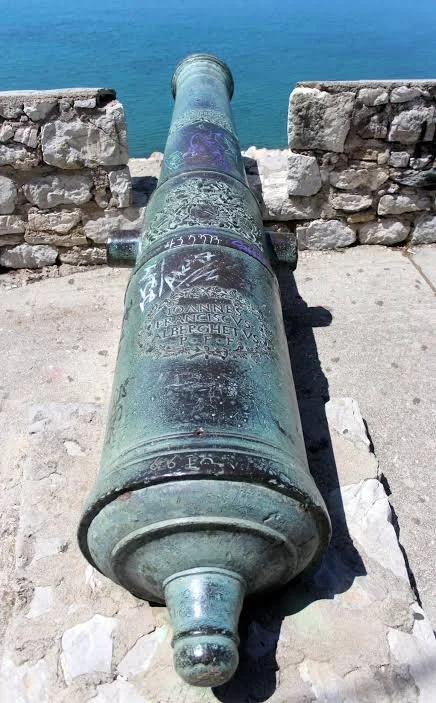
A gunport is an opening in a defensive structure designed to allow a cannon or other firearm to discharge toward an approaching enemy.
Its dimensions and shape depended on the weapon being used and the architecture of the surrounding wall.
Some gunports were narrow openings that widened toward the interior, allowing a weapon to be aimed across a broader horizontal angle.
Others were positioned within larger artillery platforms or protected chambers.
The arrangement of gunports could determine how effectively defenders covered harbor entrances, coastal approaches, and vulnerable sections of a fortress.
Koroni's Coastal Defenses
Koroni's fortress overlooks the sea and occupies an elevated position above the settlement. Its walls and towers reflect several periods of construction and modification.
The defensive complex should be understood as a layered structure rather than a single Venetian building phase. Earlier Byzantine elements, Venetian modifications, and later Ottoman repairs may all have contributed to its appearance.
Identifying a particular opening as a Venetian gunport therefore requires architectural analysis. Its position, shape, construction technique, and relationship with other defensive features can help establish its function and approximate date.
Maritime Defense and Harbor Control
Gunports positioned toward the sea could help protect vessels entering or leaving the harbor.
Defenders could use artillery to threaten hostile ships, discourage landings, and prevent enemy forces from establishing positions along the shoreline.
A coordinated defensive system might include artillery positions covering different approaches. Overlapping fields of fire were especially valuable because they reduced the number of areas an attacker could approach without exposure.
The placement of cannon openings also reflected the limits of contemporary weapons. Walls, towers, and natural terrain could obstruct firing angles, making careful positioning essential.
Archaeological and Architectural Research
Studying Venetian gunports requires detailed recording of the fortress's construction phases.
Researchers can examine masonry joints, stone dimensions, mortar composition, and the relationship between openings and defensive platforms.
Historical maps, military reports, and Venetian administrative documents may provide additional information about repairs and artillery installations.
Comparisons with other Venetian fortresses in the Peloponnese and Adriatic can help identify common engineering practices.
However, similar gunports may have been modified or reused by Ottoman defenders after the conquest of Koroni.
Preservation of the Fortress
Coastal fortifications are vulnerable to weathering, salt exposure, vegetation, earthquakes, and human activity.
Openings designed for artillery can become weakened through erosion and structural movement. Modern alterations may also obscure their original dimensions.
Conservation work should preserve the relationship between individual defensive features and the wider fortress.
Digital surveys, photography, and three-dimensional modeling can help document the structure and support future architectural research.
Conclusion
Venetian gunports in Koroni's sea fortifications illustrate the transformation of Mediterranean military architecture during the age of gunpowder.
Their arrangement and construction reveal how defenders adapted traditional fortresses to protect harbors and maritime routes against increasingly powerful artillery.
Because Koroni's fortress underwent several periods of construction and repair, individual gunports must be dated carefully before being attributed to Venetian engineers. The wider history of the site nevertheless demonstrates the importance of coastal fortification in Venice's eastern Mediterranean strategy.