Introduction
Skyros, the largest island of the Northern Sporades, occupies a strategic position in the northwestern Aegean. Its varied landscape includes mountains, coastal plains, rocky headlands, and sandy shores.
The island's prehistoric history is particularly interesting because its location connected communities across the northern Aegean with mainland Greece and neighboring islands.
Neolithic stone tools recovered from coastal dunes could provide evidence of early human activity, resource exploitation, and settlement near the shoreline. However, artifacts found in loose sand deposits can be difficult to interpret because wind, water, and later human activity may have displaced them from their original locations.
Skyros During the Neolithic Period
The Neolithic period witnessed major transformations in human society, including the development of farming, animal domestication, pottery production, and increasingly permanent settlements.
Communities established themselves in locations offering access to fertile land, freshwater, and natural resources.
In the Aegean, islands provided additional opportunities for fishing, shellfish collection, and maritime exchange.
Skyros' combination of coastal environments and inland resources makes it a useful setting for investigating how prehistoric communities adapted to island conditions.
Understanding Coastal Dunes
Coastal dunes are accumulations of sand shaped by wind and influenced by waves, vegetation, and shoreline changes.
They can develop over long periods as sand is transported from beaches and deposited farther inland.
Dune environments are dynamic. Wind erosion can expose older archaeological material, while moving sand can bury objects or carry them away from their original positions.
This creates difficulties for archaeological interpretation because a tool discovered in a dune may have originated in an occupation layer located some distance away.
Types of Neolithic Stone Tools
Neolithic communities produced a wide variety of stone tools.
Flint and chert were commonly used for blades, scrapers, and cutting implements. Obsidian, particularly important in the Aegean, was valued for its sharp edges and distinctive fracture properties.
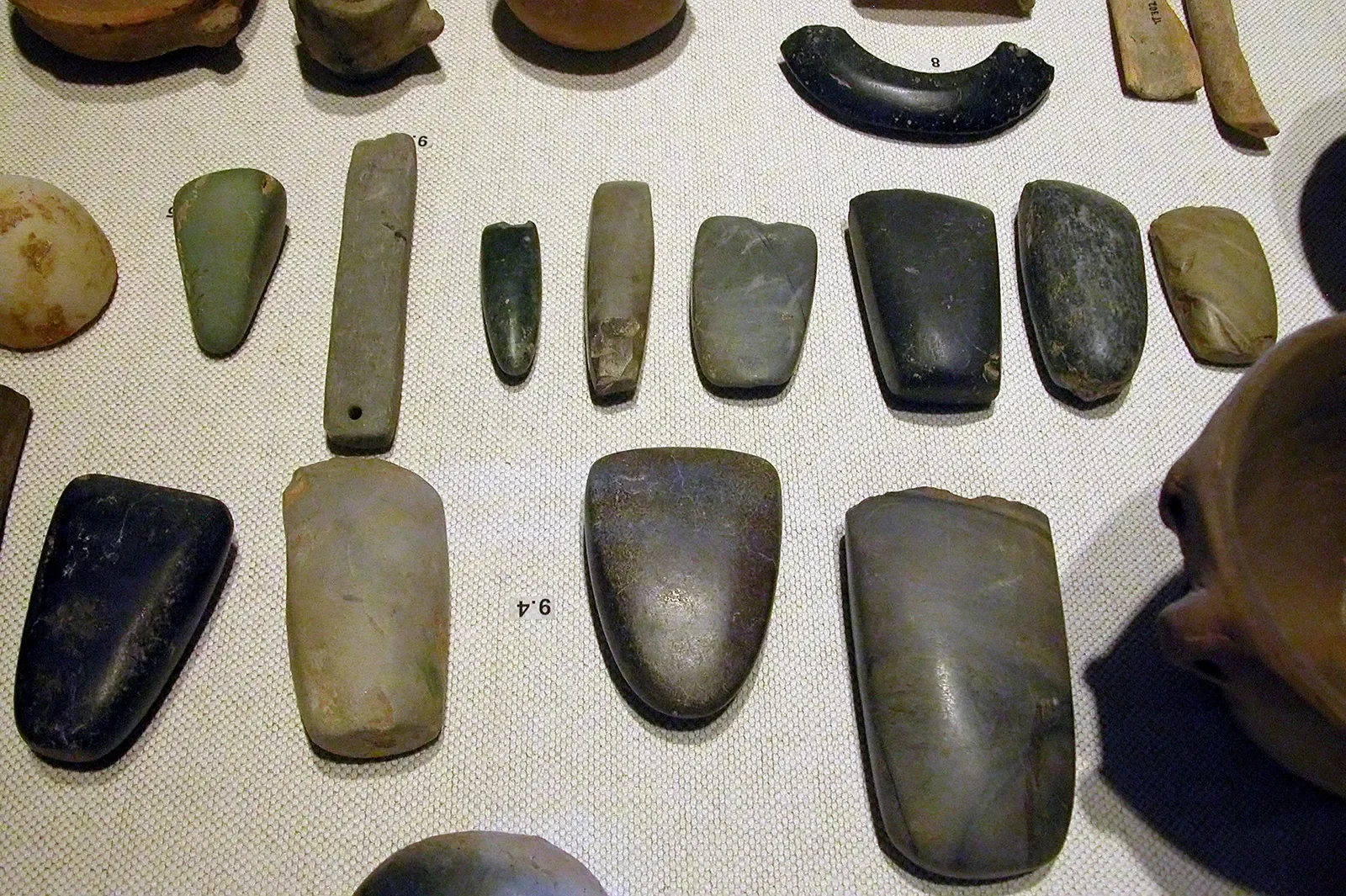
Polished stone axes and adzes were used for woodworking and other heavy tasks. Grinding stones helped process cereals and other plant materials.
The shape, manufacturing technique, and material composition of an artifact can reveal how it was produced and used.
Daily Activities Reflected in Stone Tools
Stone tools provide evidence of everyday activities that rarely survive in the archaeological record.
Cutting implements could have been used for preparing food, processing animal products, or harvesting plants.
Scrapers were useful for working hides and other materials, while polished axes could support the construction and maintenance of wooden structures.
Grinding equipment was essential for processing cereals into flour or preparing other food products.
Use-wear analysis can sometimes reveal the activities performed with a tool by examining microscopic damage along its working edge.
Coastal Subsistence and Maritime Resources
Neolithic communities living near the coast could combine farming and animal husbandry with fishing and marine resource collection.
Fish bones, shell remains, and other marine materials can reveal the importance of coastal environments in prehistoric diets.
Small boats or other watercraft may have supported movement between nearby islands, although direct evidence for particular vessels is often limited.
The presence of imported obsidian or other non-local materials can also demonstrate that communities participated in exchange networks extending beyond their immediate surroundings.
Identifying the Original Context
The archaeological value of a stone tool depends heavily on its context.
A tool recovered from a sealed Neolithic occupation layer provides stronger chronological information than one collected from loose dune sand.
Researchers must examine sediment layers, associated artifacts, and the geological processes that may have moved the object.
If several artifacts occur together with pottery, charcoal, animal remains, or structural features, they may indicate a disturbed or partially preserved settlement deposit.
A single isolated tool cannot establish the existence of a nearby Neolithic village.
Scientific Analysis
Stone tools can be examined through microscopic analysis, material identification, and experimental archaeology.
Use-wear analysis can identify patterns of polish, striation, and edge damage associated with different activities.
Petrographic and geochemical methods may help determine the geological source of the raw material.
These techniques can reveal whether a tool was made from local stone or imported material.
Comparisons with securely dated Neolithic assemblages from other Aegean sites can help establish chronology and technological relationships.
Preservation of Coastal Archaeology
Coastal dunes are vulnerable to erosion, construction, recreational activity, and changes in vegetation.
Archaeological material exposed by wind may be collected without proper documentation, resulting in the loss of valuable contextual information.
Survey teams should record the precise location of artifacts and examine the surrounding sediment before objects are removed.
Protecting dune environments can therefore contribute directly to preserving the archaeological history of Skyros.
Conclusion
Neolithic tools in Skyros' coastal dunes could provide valuable evidence of prehistoric technology, coastal subsistence, and island exchange networks.
Their study would be especially informative when combined with environmental reconstruction and scientific analysis of stone materials. However, the specific claim of a defined Neolithic tool assemblage from Skyros' coastal dunes requires secure archaeological documentation.
The wider subject demonstrates how apparently ordinary stone objects can reveal the activities and resource strategies of early Aegean communities.