Introduction and Historical Background
Anchors and their associated equipment were essential to maritime transportation throughout the Byzantine period. Ships depended on anchoring systems to remain secure near harbors, coastal settlements, and temporary stopping places.
Skyros, located in the central Aegean, occupied a position within maritime routes connecting the northern and southern parts of the sea. Its surrounding waters and coastal geography provide a relevant setting for investigating Byzantine maritime activity.
The proposed study of Byzantine anchor chains in Skyros Gulf raises questions about ship equipment, anchoring technology, and the organization of maritime transport. However, the identification of specific chains as Byzantine requires archaeological dating and examination of their construction.
Byzantine Maritime Activity
The Byzantine Empire maintained extensive maritime connections across the Mediterranean and Black Sea. Ships transported people, food, building materials, military supplies, and commercial goods.
Maritime transportation was important for communication between islands and coastal territories. It also supported military operations and the movement of administrative personnel.
Harbors and anchorages therefore played a significant role in the Byzantine economic and political system.
Anchoring Systems and Chain Technology
Anchoring systems changed over time as shipbuilding and maritime technology developed. Traditional anchors commonly used ropes, while chains became increasingly important in later maritime equipment.
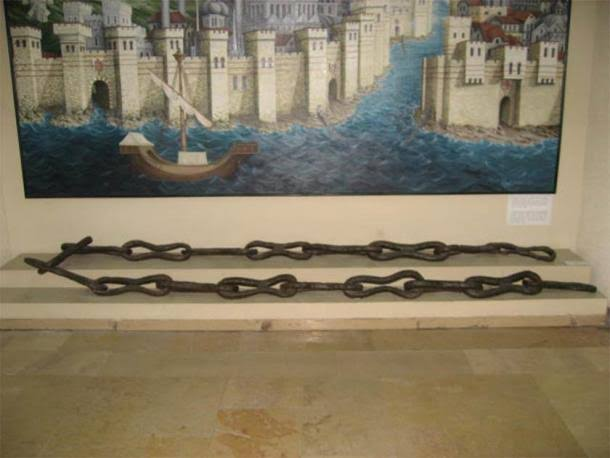
An anchor chain connected the anchor to the vessel and helped maintain the ship's position. Its weight and flexibility could influence how the anchor held against the seabed.
The identification of an ancient chain requires attention to its link shape, dimensions, manufacturing method, metal composition, and possible connection with an anchor or vessel.
Metalworking and Chain Manufacture
Iron was widely used for maritime equipment because of its strength and availability. Chains were produced by shaping metal bars into links and joining them through forging or related techniques.
The manufacturing process required skilled metalworkers who could produce links strong enough to withstand repeated tension and movement.
Corrosion can make underwater chains difficult to examine. Marine conditions may alter their original dimensions, obscure manufacturing marks, and cause individual links to separate.
Skyros Gulf and Maritime Landscapes
The waters around Skyros formed part of a wider Aegean maritime environment. The island's bays and coastal areas could provide anchorage opportunities for vessels traveling between different regions.
A chain recovered from the gulf might have been lost during maritime activity, abandoned after damage, or deposited through a shipwreck.
However, an underwater chain cannot automatically be associated with a Byzantine vessel. It may belong to a later period, particularly because maritime equipment continued to evolve and older objects could be reused.
Underwater Archaeological Investigation
The study of anchor chains requires careful underwater documentation. Researchers should record the location, depth, orientation, seabed conditions, and relationship to other objects.
Photogrammetry can create a three-dimensional record of the chain and its surrounding environment. Underwater metal detection and remote sensing may help identify associated shipwreck remains.
If the chain is associated with an anchor, cargo, or other securely dated materials, its archaeological interpretation may become more reliable.
Dating and Conservation
Metal analysis may help identify the composition of the chain and provide information about its manufacturing process. However, the date of a metal object cannot always be established through composition alone.
Associated pottery, coins, shipwreck materials, and stratigraphic evidence are important for establishing chronology.
Recovered iron objects require careful conservation because corrosion products and salts may continue to damage the metal after removal from the sea.
Conclusion
The proposed study of Byzantine anchor chains in Skyros Gulf provides a framework for investigating maritime equipment, underwater archaeology, and Byzantine navigation.
The objects must be securely dated and distinguished from later maritime chains. Their relationship with anchors, shipwrecks, and harbor activity should be documented before conclusions are drawn about Byzantine maritime technology.