Introduction and Historical Background
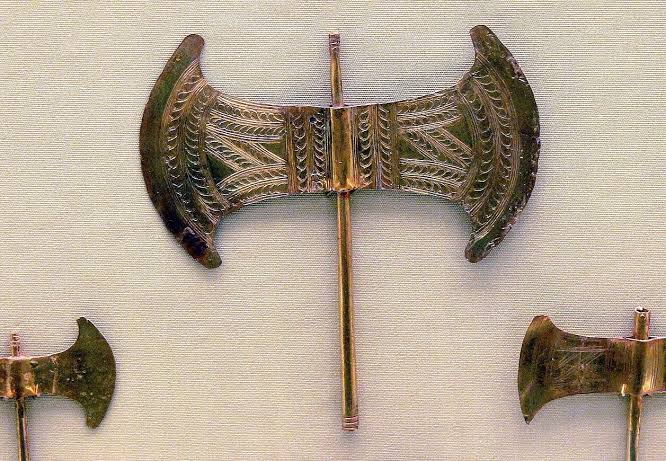
Ritual axes are among the most recognizable objects associated with Minoan religious and symbolic traditions. The double axe, commonly called the labrys, appears in Minoan art, architecture, and archaeological contexts. It is frequently associated with religious activity, although its precise meaning varied according to context.
The Minoan civilization developed on Crete during the Bronze Age and maintained extensive connections with other Aegean islands and coastal regions. Psara, a small island in the northeastern Aegean near Chios, occupies a geographical position relevant to the study of maritime connections.
The proposed study of Minoan ritual axes from Psara headlands raises questions about the movement of religious objects, the spread of Minoan artistic traditions, and the relationship between island communities. However, the identification of actual Minoan ritual axes from Psara requires confirmation through archaeological documentation. The presence of an axe-shaped object alone does not establish a Minoan origin or religious function.
The Double Axe in Minoan Culture
The double axe was an important symbol in Minoan visual culture. It appears in religious imagery, architectural settings, and objects associated with ritual activity.
Examples of the symbol have been found in different forms, including representations on pottery, seals, wall paintings, and metal objects. Some double axes were made as miniature offerings, while others may have served practical or ceremonial functions.
The widespread use of the symbol demonstrates its importance in Minoan artistic and religious expression. However, scholars continue to discuss the precise meanings associated with the double axe and its relationship to specific deities or ritual practices.
Minoan Religious Practices
Minoan religious activity took place in several types of settings, including caves, peak sanctuaries, palatial complexes, and other sacred spaces.
Offerings could include pottery, figurines, metal objects, weapons, and symbolic items. Their placement may have reflected acts of devotion, requests for protection, expressions of gratitude, or participation in communal ceremonies.
The interpretation of an object as ritual equipment requires consideration of its archaeological context. An axe may have been used as a practical tool, a ceremonial object, or a symbolic offering depending on its material, size, wear, and associated finds.
Aegean Connections and the Island of Psara
The Aegean Sea provided routes for the movement of people, goods, and cultural practices. Island communities maintained contact through fishing, trade, travel, and other forms of maritime activity.
Crete's influence extended beyond the island itself, and Minoan objects and artistic traditions have been identified in different parts of the Aegean. Such connections demonstrate the importance of maritime networks during the Bronze Age.
If an object of secure Minoan origin were documented on Psara, it could provide evidence of contact between the island and Minoan communities. However, the object's arrival might have involved direct exchange, intermediary trade, gift-giving, or later movement.
Headlands and Archaeological Context
Headlands can be significant archaeological locations because they overlook coastal routes, provide elevated positions, and may contain areas suitable for ritual activity or settlement.
The location of an object on a headland does not automatically indicate a sanctuary. Researchers must investigate whether the area contains architectural remains, repeated deposits, associated pottery, or other evidence of organized ritual activity.
Natural processes such as erosion, landslides, and coastal movement may also relocate archaeological materials. The original position of a recovered object must therefore be established as accurately as possible.
Material Analysis and Dating
A proposed Minoan axe should be examined through its material, manufacturing technique, dimensions, and decorative features. Metal analysis may help identify the alloy used, while microscopic examination can reveal traces of casting, hammering, polishing, or use.
Chronological interpretation should rely on secure archaeological context and comparison with dated examples from Crete and other Aegean sites.
If the object is made from stone, mineralogical analysis may help identify its raw material and possible source. If it is metal, elemental and isotopic studies may provide additional information, although provenance conclusions require caution.
Religious Symbolism and Cultural Exchange
The double axe is often discussed in relation to Minoan religious symbolism, but its meaning should not be treated as universal or unchanging.
The adoption of Minoan symbols by other communities could reflect religious influence, artistic imitation, exchange, or the movement of objects. A symbol may also acquire new meanings when used outside its original cultural setting.
For this reason, the study of a possible Minoan axe from Psara should consider both its relationship to Minoan traditions and the local context in which it was deposited.
Conclusion
The proposed study of Minoan ritual axes from Psara headlands offers a framework for examining Bronze Age religious symbolism and maritime interaction in the northeastern Aegean.
A reliable interpretation requires confirmation of the object's date, material, origin, and archaeological context. If securely identified, such an object could contribute to understanding the circulation of Minoan symbols and the cultural relationships between Aegean island communities