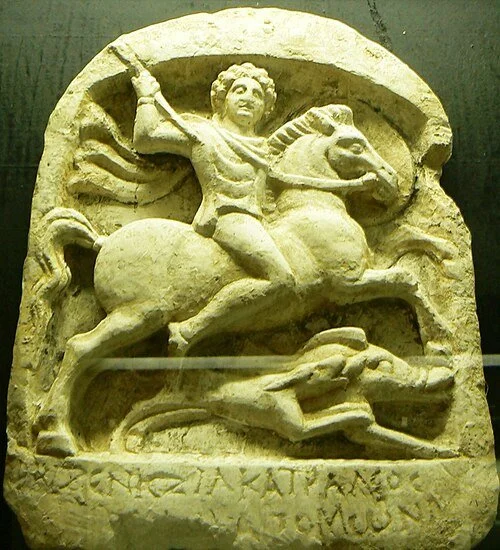
Introduction and Historical Background
The Thracian Rider, also known as the Thracian Horseman, is a distinctive figure in ancient Balkan religious and funerary art. The motif generally depicts a mounted rider, often accompanied by an altar, tree, animal, or other symbolic elements.
Rider reliefs appeared across parts of Thrace and neighboring regions during the Hellenistic and Roman periods. They are particularly important for studying religious beliefs, local identity, and the relationship between Greek, Thracian, and Roman cultural traditions.
Karditsa is located in Thessaly, a region of central Greece rather than ancient Thrace. The proposed study of Thracian Rider reliefs in the Karditsa plains should therefore be approached as a question of cultural interaction, artistic influence, or the movement of objects. The presence of a rider motif in Thessaly would not automatically establish that the object was made by a Thracian community.
The Thracian Rider Motif
The Thracian Rider is commonly represented on stone reliefs, votive monuments, and funerary objects. The mounted figure may be shown moving toward an altar, approaching a sacred tree, or participating in a symbolic scene.
The rider's appearance varies. Some reliefs show a hunting scene, while others emphasize a religious or commemorative function. Inscriptions may identify a deity, dedicant, or individual associated with the monument.
The motif became widespread in parts of the Balkans and could represent different religious meanings depending on local traditions. It is therefore important not to assume that every mounted figure represents the same deity or religious concept.
Religious and Funerary Significance
Rider reliefs were frequently associated with votive and funerary practices. A relief could be dedicated to a divine figure in response to a personal request, as an expression of gratitude, or as part of a local religious tradition.
In funerary contexts, the mounted figure may have communicated ideas about protection, status, movement, or the relationship between the deceased and the divine world.
The meaning of a relief should be interpreted through its inscription, iconography, location, and archaeological context. Similar images could serve different purposes in different communities.
Cultural Interaction Between Thrace and Thessaly
The geographical distinction between Thrace and Thessaly is important when studying the distribution of rider reliefs. Thessaly had its own political, artistic, and religious traditions, but it also maintained connections with neighboring regions.
Trade, military service, migration, and the movement of craftspeople could contribute to the circulation of artistic motifs. A rider relief found in Thessaly might reflect the adoption of an external style, the presence of an individual from another region, or local artistic adaptation.
It is also possible that a mounted figure belongs to a broader Greco-Roman iconographic tradition rather than a specifically Thracian one. Identification should therefore be based on a combination of formal features and historical evidence.
Stoneworking and Artistic Production
Rider reliefs were carved from different types of stone, depending on local availability and workshop practices. The quality of carving varied from simple, schematic representations to more detailed compositions.
The sculptor had to create the rider, horse, and accompanying elements within a limited surface. The proportions, treatment of clothing, horse anatomy, and arrangement of symbolic objects can help researchers compare monuments.
Tool marks and stone composition may provide information about production techniques and possible workshop connections. However, the use of locally available stone does not necessarily prove that the monument was produced locally.
Inscriptions and Historical Interpretation
Inscriptions are among the most valuable forms of evidence for interpreting rider reliefs. They may preserve personal names, divine names, dedications, family relationships, and commemorative statements.
Language and naming patterns can help researchers investigate cultural and linguistic connections. Nevertheless, personal names alone cannot always establish an individual's ethnic identity.
A complete study should document the inscription, stone type, dimensions, iconography, and original location of each monument. If the relief has been reused in later construction, its original context may be difficult to establish.
Archaeological Research in the Karditsa Plains
Research into possible rider reliefs in Karditsa should begin with a review of local archaeological collections, excavation reports, and architectural records. Objects recorded in older collections may have incomplete provenance, making it necessary to examine their documentation carefully.
Field surveys may identify monuments reused in churches, houses, walls, or other later structures. Such discoveries can be valuable, but the original archaeological context must be reconstructed wherever possible.
Comparisons with documented reliefs from Thrace, Macedonia, and Thessaly can help determine whether the objects share a specific regional tradition or reflect wider artistic influence.
Conclusion
The proposed study of Thracian Rider reliefs in the Karditsa plains offers an opportunity to investigate the circulation of religious imagery and artistic traditions across the ancient Balkans.
Because Karditsa is situated in Thessaly, the term Thracian should describe a possible iconographic or cultural connection rather than an assumed local ethnic identity. Reliable interpretation requires inscriptions, stylistic analysis, provenance, and archaeological context.