Introduction and Historical Background
Seals were important objects in the administrative, economic, and social systems of Bronze Age societies. They were used to identify individuals, authenticate transactions, mark ownership, and control access to stored goods. In the Aegean Bronze Age, seals also served as objects of personal identity and artistic expression.
The Mycenaean civilization developed during the Late Bronze Age, particularly between approximately 1600 and 1100 BCE. Its major centers included Mycenae, Pylos, Tiryns, and Thebes. Mycenaean communities maintained extensive connections throughout the Aegean and eastern Mediterranean through trade, political relationships, and maritime movement.
Torone, located on the Sithonia peninsula of Chalkidiki, occupied a coastal position that made maritime exchange important to its historical development. The proposed study of Mycenaean seals recovered from harbor silt at Torone could contribute to understanding Bronze Age maritime activity and the circulation of administrative objects. However, the existence and identification of such seals in this particular context must be confirmed through archaeological documentation.
Mycenaean Seals and Their Functions
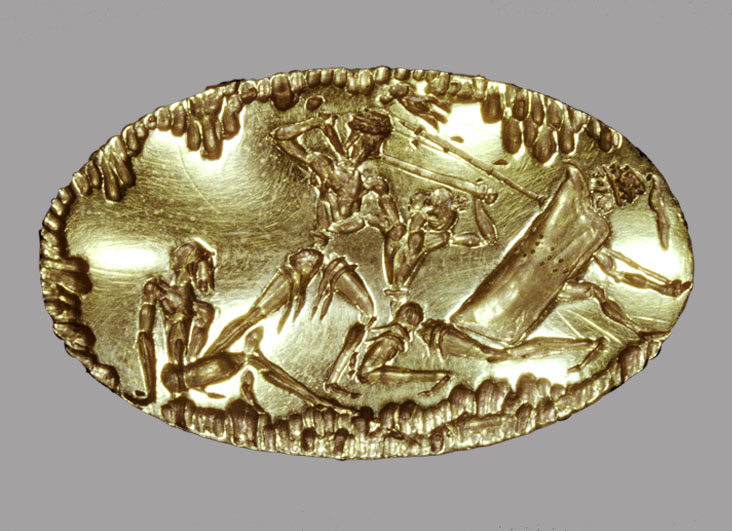
Mycenaean seals were produced from different materials, including stone, ivory, and other suitable substances. Their surfaces could contain engraved geometric, floral, animal, or human motifs.
Seals were used in administrative and personal contexts. They could be pressed into clay to create impressions that helped secure containers, doors, or packages. Such impressions could indicate ownership, responsibility, or the identity of an individual or institution.
In palatial societies, sealing systems formed part of a wider administrative structure. Clay sealings could preserve evidence of how goods were stored, transported, and monitored. Although sealings are particularly important in the study of Minoan and Mycenaean administration, the precise function of an individual seal must be established through its archaeological context.
Mycenaean Maritime Networks
The Mycenaean world participated in extensive maritime exchange. Ships transported pottery, metals, textiles, agricultural products, and other materials between mainland Greece, the Aegean islands, Crete, Cyprus, and the eastern Mediterranean.
Coastal settlements played an important role in these networks. Harbors provided opportunities for the arrival and departure of goods, while nearby settlements could support storage, processing, and exchange activities.
The geographical position of Torone makes it relevant to discussions of coastal movement in the northern Aegean. Nevertheless, evidence of maritime trade in a particular period must be established through securely dated archaeological materials.
Harbor Silt as an Archaeological Context
Harbor sediments can preserve archaeological materials that have been lost, discarded, or transported into the water. Silt deposits may contain pottery fragments, anchors, metal objects, organic remains, and other evidence of maritime activity.
However, underwater and harbor deposits are often disturbed by currents, erosion, dredging, and later human activity. Objects found together in harbor silt do not necessarily belong to the same period.
The study of any proposed Mycenaean seals from Torone should therefore include sediment analysis, stratigraphic documentation, and examination of the precise recovery location. Researchers must determine whether the objects were deposited during Bronze Age activity or reached the harbor through later disturbance.
Iconography and Artistic Interpretation
The motifs engraved on Mycenaean seals can provide information about artistic traditions, religious ideas, and cultural interaction. Animals, plants, human figures, and abstract patterns may reflect the visual language of the period.
Comparisons with seals from other Mycenaean centers can help establish stylistic relationships. Similarities may suggest shared artistic traditions, workshop connections, or the movement of objects between communities.
Nevertheless, stylistic similarity does not automatically prove a common place of manufacture. Seals could be copied, reused, or transported over long distances.
Scientific and Archaeological Methods
The study of seals requires careful recording of their dimensions, material, shape, engraving technique, and surface condition. High-resolution photography and microscopic examination can reveal details of carving that are not visible to the naked eye.
Material analysis may help identify the stone or other substance used in production. Clay impressions, if present, can be examined separately to investigate how the seals were used.
Underwater archaeological methods, sediment analysis, and the comparison of associated pottery are essential for establishing the chronological context of harbor finds.
Conclusion
The proposed study of Mycenaean seals from Torone harbor silt offers a framework for examining Bronze Age administration, maritime exchange, and artistic interaction in the northern Aegean.
The significance of any specific seal assemblage depends on confirming its authenticity, date, and archaeological context. Properly documented evidence could contribute to understanding how Mycenaean objects and administrative practices circulated beyond the major centers of the Bronze Age Aegean.