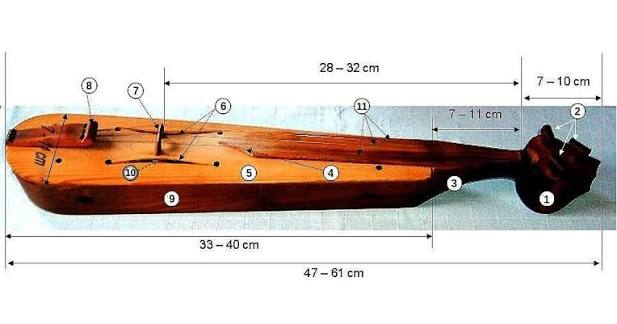
The Pontic lyra, also known as the kemenche in some contexts, is a bowed string instrument strongly associated with the musical traditions of Pontic Greeks. Its narrow body, short fingerboard, and distinctive playing technique produce a sound closely connected with Pontic dance and song.
Samsun, historically known as Amisos, was one of the important centers of the Black Sea region. Pontic Greek communities lived in and around the city before the population displacements and forced migrations associated with the collapse of the Ottoman Empire and the Greco-Turkish population exchange of the early twentieth century. Refugees carried musical instruments, songs, dances, and memories to new settlements in Greece and elsewhere.
The lyra became an important vehicle for maintaining cultural continuity. Tunes could accompany dances, weddings, festivals, and community gatherings. Musical repertoire also carried memories of places that many displaced families could no longer visit. A melody associated with a village or district could become a symbolic connection to the homeland.
The expression “Samsun exiles” should be understood within this wider history of displacement rather than as a single, uniform musical group. Refugees came from different settlements and carried diverse repertoires. Their descendants continued to adapt the music, combining inherited melodies with new compositions and performance styles.
A study of Pontic lyra tunes associated with Samsun could compare recordings, song texts, dance rhythms, and family histories. It could also examine how musicians preserved regional distinctions while participating in broader Pontic cultural organizations. The instrument’s importance lies not only in its sound but also in its role as a bearer of memory, identity, and community belonging.