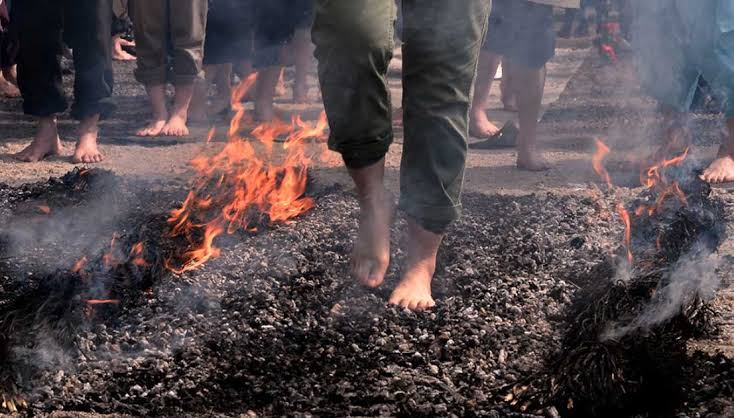
Firewalking is a ritual practice in which participants walk barefoot over or near heated embers. In parts of northern Greece, the Anastenaria tradition is particularly associated with communities in Macedonia and Thrace. It involves religious devotion, music, icons, communal participation, and ritual movement.
The Anastenaria is commonly associated with the feast of Saints Constantine and Helen. Participants may carry icons, dance to music, and enter a heightened ritual state. The tradition has been studied as an example of the interaction between Christian devotion, inherited local customs, and communal identity.
The reference to Serres places the subject in a region with a diverse history of population movement and cultural exchange. However, the precise form of firewalking practices varies by community, and not every village in the wider region has the same ritual calendar or ceremonial structure.
A study of firewalking should focus on its religious and social meaning rather than treating it as a spectacle. Researchers can examine the role of ritual specialists, the use of music, the preparation of ceremonial spaces, and the transmission of knowledge between generations. They can also investigate how participants explain the relationship between faith, courage, suffering, and protection.
It is important not to imitate firewalking as an experiment or recreational activity. The practice carries a risk of serious burns and should be understood through ethnographic observation and historical documentation rather than reenactment.
The tradition demonstrates how ritual performance can preserve community identity while adapting to modern religious, social, and cultural conditions.