The myth of Daedalus is the ultimate exploration of the "double-edged sword" of technology. He was the Leonardo da Vinci of the ancient world—an architect, sculptor, and mechanical engineer whose name literally means "skilled worker."
While his inventions were legendary, his story is a cautionary tale about the ethical weight of genius and the devastating personal cost of pride.
1. The Jealousy of an Artist
Before he was a legend in Crete, Daedalus lived in Athens. His brilliance was matched only by his vanity.
The Apprentice: Daedalus took on his nephew, Perdix, as a student. When the boy showed signs of surpassing his master by inventing the saw (inspired by a fish’s spine) and the compass, Daedalus was consumed by envy.
The Crime: In a moment of rage, Daedalus pushed Perdix off the Acropolis. Forced to flee Athens to avoid execution, he sought asylum in the court of King Minos on the island of Crete.
2. The Labyrinth and the Minotaur
In Crete, Daedalus became the king’s chief engineer, but his inventions often facilitated the scandals of the royal family.
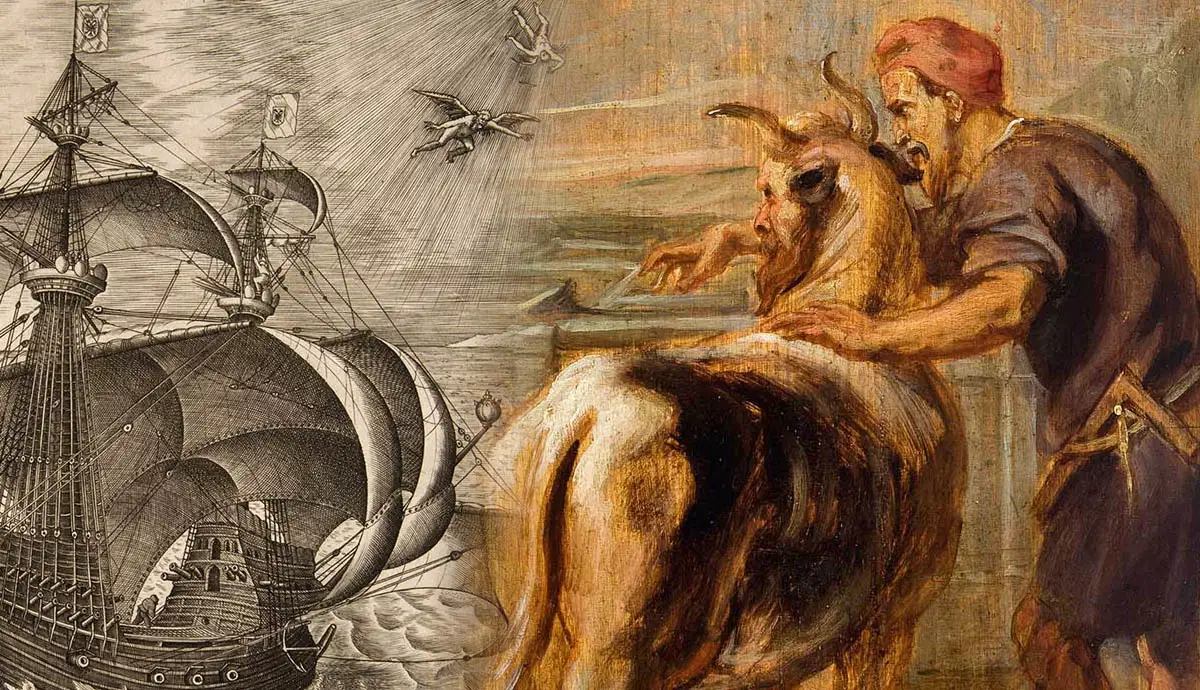
The Wooden Cow: When Queen Pasiphae was cursed by Poseidon to fall in love with a bull, Daedalus built a realistic, hollow wooden cow for her to hide inside. The result of this union was the Minotaur.
The Maze: To hide the shame of the Minotaur, King Minos ordered Daedalus to build the Labyrinth—a structure so complex that even Daedalus himself nearly got lost in it.
3. The Thread of Ariadne
When the hero Theseus came to Crete to slay the Minotaur, Princess Ariadne turned to Daedalus for help.
The Solution: Daedalus gave her the "Clew"—a ball of silk thread. By tying one end to the entrance, Theseus could find his way back out of the maze.
The Imprisonment: Enraged that Daedalus had helped Theseus escape, King Minos imprisoned Daedalus and his young son, Icarus, in the very Labyrinth Daedalus had designed.
4. The Flight of Icarus
Knowing that Minos controlled the land and the sea, Daedalus looked to the sky. "Minos may control everything else," he said, "but he does not control the air."
The Engineering: Using feathers from birds and wax from beehives, Daedalus fashioned two pairs of massive wings.
The Warning: Before they took flight, Daedalus gave Icarus a famous warning: The Middle Way. Fly too low, and the sea spray will soak the feathers; fly too high, and the sun will melt the wax.
The Tragedy: Icarus, intoxicated by the thrill of flight, ignored his father and soared toward the sun. The wax melted, the wings disintegrated, and Icarus fell into the sea (now called the Icarian Sea).
5. The Shell and the Thread: The Escape to Sicily
Daedalus eventually landed in Sicily, but Minos was obsessed with finding him. Minos traveled from city to city with a complex puzzle: Who can thread a spiraled triton shell?
The Genius revealed: Daedalus, unable to resist a challenge, took the shell. He tied a silk thread to an ant, put a drop of honey at the other end of the shell, and let the ant crawl through the spirals, pulling the thread behind it.
The Final Confrontation: When Minos saw the threaded shell, he knew only Daedalus could have done it. He demanded the inventor be turned over, but the King of Sicily killed Minos in a bath designed by Daedalus, finally ending the pursuit.
6. The Architectural Legacy
In the Greek mind, Daedalus was credited with the invention of "living statues." Before him, Greek statues were stiff and blocky (like Egyptian art); Daedalus was said to have carved them so realistically that they had to be tied down to prevent them from walking away.
[Image comparing archaic Greek block statues with more dynamic Daedalic sculpture]
Daedalus represents the "Technocratic Tragedy." He could solve any physical problem—how to build a maze, how to fly, how to thread a shell—but he could not solve the human problems of jealousy, consequences, or grief. He is the patron saint of inventors who realize too late that once the "wings" are built, they can no longer control how they are used.