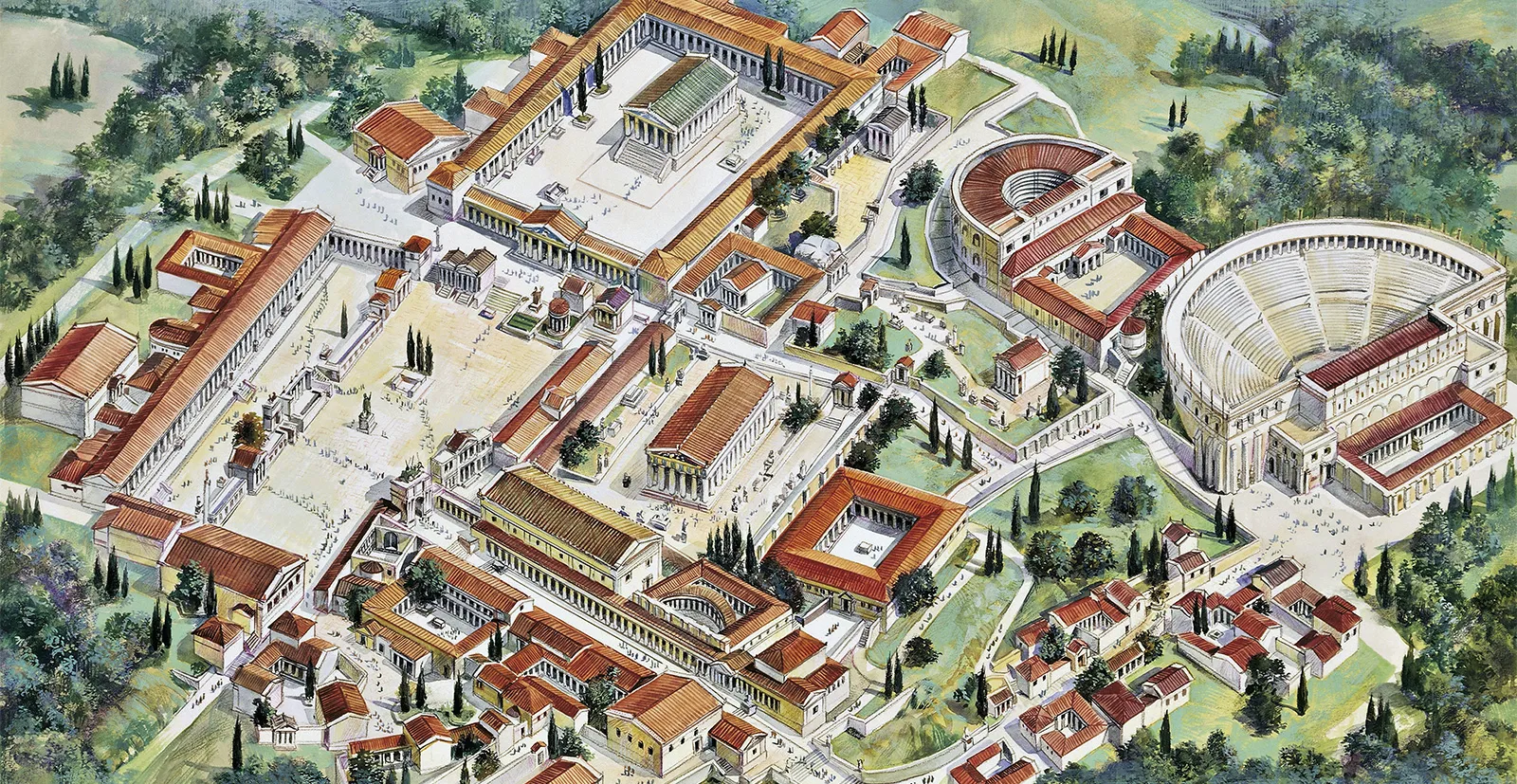
The Agora (literally meaning "gathering place") was the heart and soul of the ancient Greek city-state. It was far more than a simple market; it was the focal point of political, judicial, commercial, and social life. If the Acropolis was the city's spiritual and defensive crown, the Agora was its beating, everyday heart.
1. The Marketplace (The Emporion)
Every morning, the Agora transformed into a bustling commercial hub. Vendors set up stalls, often grouped by the type of goods they sold—an area for fish, another for cheese, and another for slaves or pottery.
Trade and Currency: Here, merchants from across the Mediterranean exchanged goods. It was also where "money changers" sat at tables, converting various Greek currencies into local drachmae.
The Agoranomoi: These were the "market police." They were officials elected to ensure that goods were sold at fair prices, that weights and measures were accurate, and that no one was cheating the public.
2. The Political and Judicial Center
For a citizen of Athens, the Agora was where democracy actually happened. It housed the buildings where the city was governed on a day-to-day basis.
The Bouleuterion: The meeting place for the Boule (the Council of 500). These citizens were chosen by lot to prepare the agenda for the general assembly.
The Tholos: A round building that served as the headquarters for the presiding officers of the council. They lived and ate there at the city's expense, ensuring that a group of leaders was always on "emergency standby."
The Law Courts: Many of the famous Athenian trials, including that of Socrates, took place in or near the Agora. Large juries of 201 to 501 citizens would gather to hear cases and cast their votes using bronze ballots.
3. The Stoas: Porticos of Philosophy
The perimeter of the Agora was lined with Stoas—long, shaded, colonnaded walkways. These were the primary sites for social interaction and intellectual growth.
Public Lounges: Stoas provided a place to escape the Mediterranean sun while still participating in the "buzz" of the city.
The Birth of Schools: Philosophers famously set up "shop" in these porches. The Stoic school of philosophy actually takes its name from the Stoa Poikile (Painted Stoa), where the philosopher Zeno taught his followers.
The Altar of the Twelve Gods: This served as the "Kilometer Zero" for the city—the central point from which all distances to other towns were measured.
4. Social Life and News
If you wanted to know what was happening in the world, you went to the Agora. It functioned as the "Ancient Internet."
"What's New?": This was the standard greeting in the Agora. Men gathered in groups to discuss military news, foreign gossip, or the latest political scandals.
The Barber Shops and Perfumeries: Located around the edges of the square, these shops were notorious hotspots for gossip and political debate.
Exclusion: It is important to note that the Agora was primarily a male domain. Respectable women generally did not linger there, instead sending enslaved people to do the shopping.
5. Monuments and Memory
The Agora was a living museum of the city’s history and values.
The Eponymous Heroes: A monument featuring statues of the ten heroes who gave their names to the tribes of Athens. It served as the city’s public notice board, where new laws, draft notices, and legal announcements were posted for all to see.
The Hephaisteion: Perched on a hill overlooking the Agora, this temple dedicated to the god of craftsmanship overlooked the metalworkers and artisans who worked in the shops below.
The Agora was the ultimate testing ground for the Greek idea of "Public Man." It was where private individuals became citizens by engaging with their neighbors, their laws, and their economy.