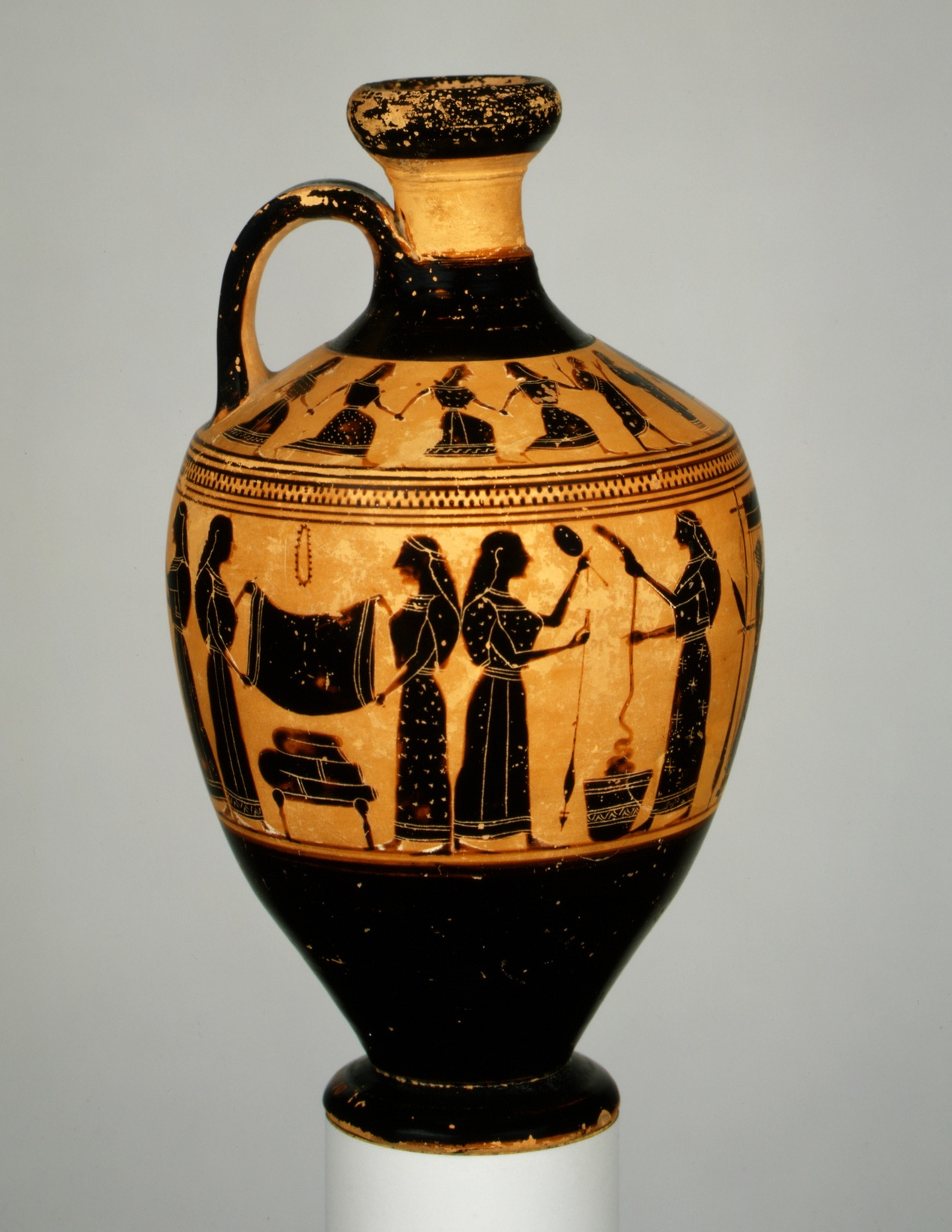
In Ancient Greece, weaving was more than a domestic chore; it was a defining symbol of womanhood, domestic order, and even political metaphor. From the royal chambers of Penelope to the humble rural oikos, the rhythmic thud of the loom was the heartbeat of the Greek home. Producing clothing in the "Old Style" was a slow, multi-stage technological process that transformed raw wool and flax into the iconic draped silhouettes of antiquity.
1. Preparation: From Fleece to Fiber
The process began with raw wool (lanos) or flax. Before a single thread could be created, the material had to be meticulously prepared.
Washing and Sorting: Raw wool was soaked to remove "suint" (natural grease) and debris.
Carding with the Epinetron: Women used a specialized ceramic thigh-guard called an epinetron. They would place it over their knee and rub the wool against its textured surface to align the fibers, creating a soft "rovings" ready for spinning.
The Distaff and Spindle: Using a drop-spindle, women spun these fibers into thread. This was a portable task; women often spun while walking or socializing, maintaining a constant supply of yarn for the heavy work of the loom.
2. The Warp-Weighted Loom: The Vertical Engine
The centerpiece of Greek textile production was the warp-weighted loom. Unlike modern horizontal looms, this was a vertical wooden frame leaned against a wall.
The Warp Threads: Long vertical threads (the warp) were hung from a top wooden beam.
Loom Weights (Pyramidalis): To keep the threads taut, ceramic or stone weights were tied to the bottom of the warp. These weights are often the only part of the loom that survives in the archaeological record.
Weaving "Top-Down": Greek weavers worked from the top of the frame downward. As they beat the horizontal threads (the weft) upward with a wooden sword or "battener," the finished cloth would slowly roll up around the top beam.
3. Geometric Precision and Patterns
Greek clothing was rarely cut or tailored with scissors. Instead, garments were woven to the exact size and shape required.
Structural Decoration: Patterns like the famous Meander (Greek Key) or floral borders were woven directly into the fabric using a "tapestry" technique. This meant the decoration was an integral part of the cloth’s structure, not just embroidered on top.
Color Palette: While we often imagine Greeks in white, they loved vibrant colors. Using natural dyes like madder (red), saffron (yellow), and the expensive murex snail (purple), weavers created complex, multi-colored striped or checkered garments.
4. The Iconic Garments: Peplos and Chiton
The "Old Style" of Greek fashion relied on the mastery of the weaver to create rectangles of cloth that could be draped into elegant forms.
The Peplos: A heavy woolen garment worn by women. It was a large rectangle folded over at the top (the apoptygma) and pinned at the shoulders with brooches called fibulae.
The Chiton: Made of lighter linen, the chiton featured more fabric and was often sewn or pinned along the arms to create "sleeves."
The Himation: A heavy rectangular cloak worn over the chiton or peplos, serving as both an overcoat and a blanket.
5. The Loom as a Social Space
The histōn (loom room) was the primary workspace for the women of the household, including the matrona and her daughters or enslaved workers.
Collaborative Labor: Large garments required two or more weavers to stand side-by-side, passing the shuttle back and forth in a synchronized dance.
Oral Tradition: The loom room was a center for storytelling and song. Many Greek myths, such as those of Arachne or Philomela, use weaving as a central theme, reflecting the importance of this craft in the female experience.
6. The Panathenaic Peplos
The ultimate expression of Greek weaving skill was the Sacred Peplos woven for the goddess Athena.
The Ergastines: Every year, a group of young noble women called the Ergastines spent nine months weaving a massive, saffron-colored peplos decorated with scenes of the battle between the Gods and Giants.
The Procession: This textile was not just a garment but a sail—it was hoisted onto the mast of a ceremonial ship and paraded through Athens during the Great Panathenaea festival, eventually draped over the ancient wooden statue of the goddess on the Acropolis.