Before knowledge could be organized into the great libraries of the Hellenistic world, it first had to be physically captured. In an era long before printing presses, paper mills, or digital hard drives, recording the thoughts of a philosopher, the inventory of a merchant, or the laws of a city-state required transforming natural raw materials into data storage.
To preserve their ideas, the ancient Greeks developed a multi-tiered system of media, choosing their materials based on a simple calculation: How long does this information need to last?
1. Ephemeral Media: The Ancient Scratchpad
For daily tasks—schoolboy exercises, rough mathematical calculations, draft letters, or market receipts—the Greeks avoided expensive materials. They relied on highly reusable, short-term mediums.
Wax Tablets (Pinakes or Deltatoi)
A wax tablet consisted of a wooden frame filled with a thin layer of blackened beeswax. Writers used a metal or bone stylus. The sharp, pointed end scratched letters into the wax, exposing the lighter wood beneath.
[ Written Text ] ──► Flat spatula end of stylus ──► Smooths over warm wax ──► Blank Slate
The true genius of the wax tablet was its reset button: the blunt, flat end of the stylus was used to iron out the wax, erasing mistakes or wiping the tablet completely clean for the next lesson.
Ostrakon: The Recycled Ceramic
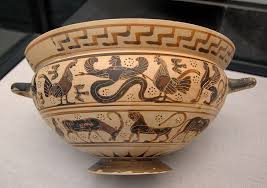
If a Greek citizen needed to cast a vote, write a quick receipt, or jot down a short note that didn't need to be erased, they reached for trash. Ostraka were broken fragments of discarded ceramic pottery. They cost absolutely nothing, were easily scratched with a sharp point or written on with ink, and were so common that they gave their name to the political practice of ostracism—where citizens wrote down the name of a politician they wished to banish from Athens onto a pottery shard.
2. Long-Term Media: The Papyrus Scroll (Biblion)
When a playwright finished a tragedy or a philosopher codified a theory, it was recorded onto papyrus. Imported extensively from the Nile Delta of Egypt, papyrus was the undisputed king of high-fidelity data preservation in the Mediterranean.
The process of constructing and using a scroll was a highly specialized craft:
1.Slicing the Pith:Step 1.
Artisans stripped the triangular stalks of the papyrus plant and sliced the fibrous inner pith into thin, vertical ribbons.
2.Weaving the Sheets:Step 2.
These ribbons were laid down in two overlapping, perpendicular layers (one horizontal, one vertical), moistened with muddy water, and pressed firmly together. The natural sap bound the fibers into a single sheet.
3.Gluing the Scroll:Step 3.
After being dried and polished smooth with pumice, individual square sheets were glued end-to-end to create a long continuous roll, usually averaging 20 to 30 feet in length.
4.The Ink and Reed:Step 4.
Scribes wrote in parallel vertical columns using a kalamos (a sharpened reed pen dipped in ink made from a mixture of soot, gum arabic, and water).
The Architectural Catch: Papyrus scrolls were written entirely in scriptura continua—a continuous stream of capital letters with no spaces between words, no punctuation, and no paragraph breaks. Reading was a loud, laborious process of decoding text, which is why ancient reading was almost always done aloud.
3. Monumental Media: Stone and Bronze
For state decrees, international treaties, sacred religious laws, and public honors, papyrus was far too fragile. To ensure knowledge survived political upheaval and weather, the Greeks turned to epigraphy—carving text into stone slabs (stelae) or bronze plaques.
[ Public Assembly Passes Law ] ──► Stone Cutter Carves Stelea ──► Erected in Agora ──► Permanent Public Record
Stone inscriptions served as the ultimate open-source public archive. Erected in the Agora (marketplace) or outside major temples, these monuments meant that laws were not hidden in a royal vault; they were physically anchored into the public square, theoretically unalterable and visible to any literate citizen.
4. The Vulnerability of the Record
Despite their ingenuity, the preservation of Greek knowledge was balanced on an incredibly fragile precipice. Papyrus is organic material; it rots rapidly in damp climates, falls prey to insects, and burns easily.
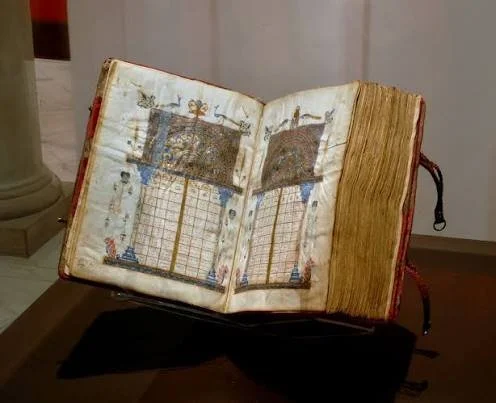
Nearly everything we possess of ancient Greek literature did not survive on its original papyrus roll. Instead, it survived because generations of scribes in the Roman, Byzantine, and Islamic worlds systematically recopied those crumbling scrolls onto parchment, and later, into bound books (codices).
On rare occasions, history provided a bizarre shortcut When Mount Vesuvius erupted in 79 CE, the intense heat of the volcanic wave instantly carbonized hundreds of Greek philosophical scrolls in a villa at Herculaneum, turning them into solid lumps of charcoal. Paradoxically, by baking them into carbon, the volcano protected them from rotting—allowing modern archaeologists to read these lost Greek library texts using advanced particle accelerators and multi-spectral imaging without ever unrolling them.