The myth of Laocoön is one of the most chilling episodes of the Trojan War, serving as a profound example of the "divine duplicity" and tragic irony prevalent in classical mythology.
The Priest’s Warning
Laocoön was a Trojan priest—most commonly identified as a priest of Poseidon (or sometimes Apollo)—who stood as the sole voice of reason when the Greeks left the massive wooden horse outside the walls of Troy. As the Trojans debated whether to bring the structure inside, Laocoön famously warned them:
"Do not trust the Horse, Trojans. Whatever it is, I fear the Greeks even bearing gifts."
In his desperation to prove the danger, he hurled a spear into the wooden belly of the horse, which reportedly echoed with the hollow sound of the hidden Greek soldiers inside.
The Divine Retribution
Despite his correct assessment, Laocoön was silenced by a horrific death. Two massive sea serpents—often said to have been sent by Athena or Poseidon, both of whom favored the Greeks—emerged from the water and crossed the shore to attack him and his two sons. The snakes coiled around them in a lethal grip, crushing and biting them until they died.
The irony was total: the Trojans, witnessing this brutal execution, misinterpreted it as a sign from the gods that Laocoön was being punished for his "impiety" in striking the sacred gift of the horse. Consequently, they brought the horse inside the city walls, sealing their own doom.
Conflicting Motives
The reason for Laocoön’s death varies across different ancient accounts, illustrating how the gods' motivations were often opaque or even contradictory:
The "Correct" Warning: In many versions (such as Virgil’s Aeneid), he was killed simply for his hostility toward the Greeks and his attempt to prevent the "divine plan" for Troy’s destruction.
The Impious Act: Other sources suggest the serpents were a delayed punishment for a previous sin. Some say he had engaged in sexual relations with his wife in front of a cult statue of a god, or that he had broken his vow of celibacy as a priest, and the serpents were merely "lucky timing" that the Trojans tragically misunderstood.
The Punishment of the Gods: Later authors, like Quintus of Smyrna, suggested Athena blinded him as he warned the people, and when he refused to stop, she sent the serpents to finish the task.
The Iconic Sculpture
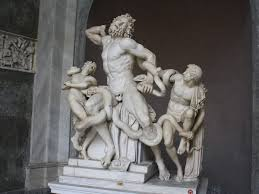
The event is immortalized in the Laocoön Group, a masterpiece of Hellenistic sculpture discovered in 1506 in Rome. The statue captures the agonizing moment of the struggle: Laocoön and his sons are locked in a desperate, twisting battle against the coils of the serpents. Michelangelo famously called it a "miracle of art." Its intense focus on human suffering and emotional turmoil deeply influenced Renaissance artists, who were captivated by the priest’s struggle against an overwhelming, divine power he could neither escape nor truly understand.
Laocoön remains the quintessential figure of the "tragic truth-teller"—a man who was entirely correct, yet destroyed because he dared to stand against the whims of the gods.