The Story of Aeolus: The Keeper of the Winds
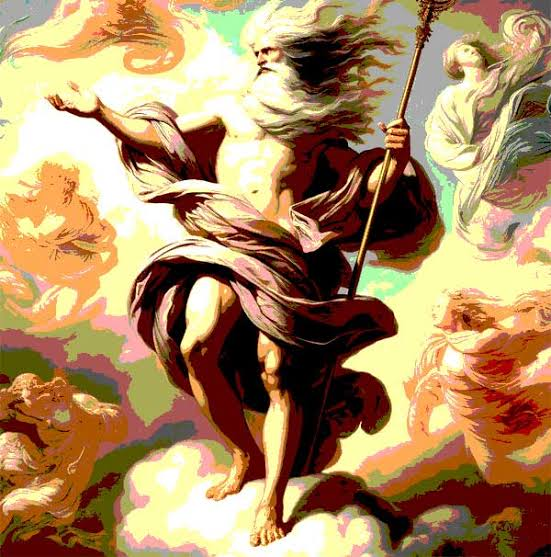
While the four individual winds (Anemoi) blew across the Mediterranean with conscious, erratic temperaments, they did not operate in absolute freedom. They were kept under lock and key by Aeolus, a mortal king elevated by Zeus to the status of an immortal guardian: The Keeper of the Winds.
The Floating Fortress of Aeolia
Aeolus lived on the mythical island of Aeolia (historically linked to the Lipari Islands north of Sicily). Aeolia was an architectural marvel: a floating, migratory island completely surrounded by an impenetrable, towering wall of solid bronze.
Inside his luxurious palace, Aeolus lived in a continuous state of domestic bliss, hosting a permanent feast alongside his wife and twelve children. However, beneath the floor of his grand estate sat a dark, subterranean cavern that served as the atmospheric vault of the world.
Within this hollow mountain, Aeolus kept the roaring, furious forces of the North, South, East, and West winds tightly chained. The winds constantly thrashed against the stone walls, roaring with a deafening noise that made the mountain shake.
If left unmanaged, their unified power would instantly rip the atmosphere apart, flattening forests and sinking entire continents. Zeus granted Aeolus the absolute authority to regulate their release, trusting his calm mind to decide exactly when to let a gentle breeze guide a merchant or when to unleash a storm to punish a wicked city.
The Encounter with Odysseus
Aeolus plays a critical, tragic role in Homer’s Odyssey. When the wandering hero Odysseus and his exhausted fleet arrived at the bronze walls of Aeolia after the sack of Troy, Aeolus welcomed them with boundless hospitality, hosting them for an entire month.
Anxious to help the hero reach his home kingdom of Ithaca, Aeolus engineered an extraordinary parting gift. He used his divine authority to summon the violent, turbulent gale-force winds from his cavern, bound them tightly inside a massive, heavy ox-hide bag, and secured it to the deck of Odysseus's ship with a silver cord.
   [ ATMOSPHERIC CONTRACT ] ──► Aeolus seals all turbulent gales inside an ox-hide bag
                                             │
                                (The Navigational Journey)
                                             │
                                             ▼
   [ THE FATAL MISTAKE ] ◄── Mutinous crew cuts silver cord ──► Catastrophic blast back to Aeolia
Aeolus left only the gentle West Wind (Zephyrus) free, blowing softly against the sails to push Odysseus's fleet straight home.
The plan worked flawlessly. For nine continuous days, the ships sailed with perfect stability, coming so close to Ithaca that Odysseus could see the smoke rising from his own palace chimneys.
However, as Odysseus fell into an exhausted sleep, a catastrophic human failure ruined the mission. His mutinous crew stared at the sealed ox-hide bag, growing deeply suspicious. Believing that Aeolus had gifted their captain a secret fortune in gold and silver that he was refusing to share, they drew their daggers and cut the silver cord.
The result was an atmospheric explosion. The highly compressed, raging gale-force winds blasted out of the bag simultaneously, generating a monstrous hurricane that instantly snatched the ships, whirled them across the sea, and dragged them helplessly all the way back to the bronze walls of Aeolia.
When Odysseus crawled back into Aeolus’s palace begging for help a second time, the king’s hospitality had vanished into ice. Aeolus realized that Odysseus was not just an unfortunate sailor, but a man actively cursed by the high gods. He cast the hero out of his palace, shouting: "Get away from this island instantly! It is an absolute sacrilege for me to assist a man whom the immortal gods detest!"