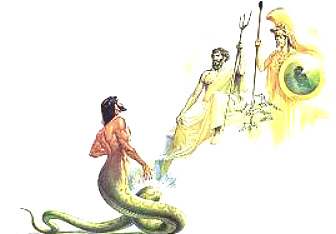
The Myth of Cecrops: The Half-Serpent King of Athens
In the foundational folklore of Athens, Cecrops stands as the primordial architect of Greek civilization. He was not born from human lineage; instead, he was an autochthon—a being born directly from the womb of the Earth itself.
The Hybrid Monarch
Because he emerged from the literal soil of Attica, Cecrops ($\text{K}\varepsilon \kappa \rho o \psi$) possessed a striking, monstrous anatomy: from the waist up, he featured the torso, arms, and intelligent head of a noble human king, but from the waist down, his body dissolved into a massive, coiling, twin-tailed serpent.
This hybrid physiology carried a profound political and philosophical meaning for the ancient Athenians. The serpent tail symbolized his deep, unseverable connection to the physical earth (autochthony), proving that the Athenians were not foreign invaders, but the original, rightful fruits of the land. Meanwhile, his human torso represented the dawn of intellect, reason, and social order.
Before Cecrops took the throne, the people of Attica lived in a state of primitive chaos: they lacked laws, wandered without permanent homes, and lived like wild animals. Cecrops systematically engineered the foundations of human society:
He abolished human sacrifice, introducing the offering of barley cakes to the gods instead.
He established the institution of monogamous marriage, creating structured family units.
He invented the concept of the census, forcing every citizen to cast a stone into a pile so he could accurately calculate the population.
He divided the region into twelve distinct municipalities to establish organized legal governance.
The Great Contest: Poseidon vs. Athena
The absolute apex of Cecrops's reign was his role as the chief arbitrator during a monumental cosmic land dispute between Poseidon, the king of the sea, and Athena, the goddess of wisdom. Both deities coveted the rapidly rising city of Cecrops and demanded to be recognized as its unique patron god.
To resolve the conflict peacefully, Cecrops staged a divine contest upon the high, rocky plateau of the Acropolis. Each god was required to produce a single, magnificent gift that would benefit the citizens of the city for generations:
                          [ THE CONTEST ON THE ACROPOLIS ]
                                         │
                   ┌─────────────────────┴─────────────────────┐
                   ▼                                           ▼
          [ POSEIDON's GIFT ]                         [ ATHENA's GIFT ]
      Struck rock with Trident                    Planted seed in the soil
                   │                                           │
                   ▼                                           ▼
      [ THE SEA-WATER SPRING ]                     [ THE FIRST OLIVE TREE ]
       * Infinite Naval Power                      * Liquid Gold, Oil, Wood
       * Too salty to drink                        * Complete Economic Engine
Poseidon’s Gift: The sea god stepped forward, raised his massive trident, and slammed it down into the bare rock of the Acropolis. The stone cracked open instantly, and a roaring geyser of water erupted from the earth. While the display showcased staggering divine power, the water was drawn from the ocean depths—it was completely salty and undrinkable, rendering it useless for agriculture.
Athena’s Gift: Athena stepped forward with quiet confidence. She struck her bronze spear into the soil and planted a single seed. Instantly, a gnarled, beautiful olive tree sprouted from the earth, laden with rich, green fruit.
Cecrops carefully evaluated both offerings. Recognizing that Poseidon’s saltwater spring offered only the volatile promise of naval war, while Athena’s olive tree provided a permanent economic engine—yielding wood for warmth, fruit for sustenance, and oil for liquid gold—he declared Athena the victor.
The enraged Poseidon cursed the city with a perpetual shortage of fresh water, but Athena took the city under her divine wing, renaming it Athens and transforming Cecrops's serpent-guarded citadel into the intellectual capital of the classical world.