The Story of Orpheus and His Journey to the Underworld
The tragedy of Orpheus and Eurydice is classical mythology’s most profound exploration of grief, the limits of human willpower, and the absolute finality of death.
The Ultimate Artist
Orpheus, the son of the Muse Calliope and King Oeagrus (or the god Apollo), possessed an artistic talent so immense that it defied the laws of physics. When he played his golden lyre and sang, the entire natural world warped around his melodies:
Raging rivers would alter their currents to flow toward his voice.
Wild predators, like lions and wolves, would sit calmly alongside lambs to listen to his chords.
Even the cold, ancient stones and trees would tear themselves out of the earth to follow his footsteps.
Orpheus used his music to survive the voyage of the Argonauts, but his greatest challenge arose when his beautiful young bride, the wood nymph Eurydice, was chased through a meadow by an aggressive suitor. In her panic, she stepped directly onto a venomous viper hidden in the deep grass. The snake bit her ankle, and she perished instantly, her shade descending into the dark realm of Hades.
Charming the Kingdom of Death
Consumed by an all-encompassing, maddening grief, Orpheus refused to accept her death. Armed with nothing but his wooden lyre, he marched down through the yawning cavern of Taenarum, stepping across the threshold of the living into the underworld.
He faced the terrifying guardians of the dead and systematically neutralized them using pure art:
He sang to the monstrous, three-headed hound Cerberus, causing the beast to whimper and lay its heads down on the stone floor.
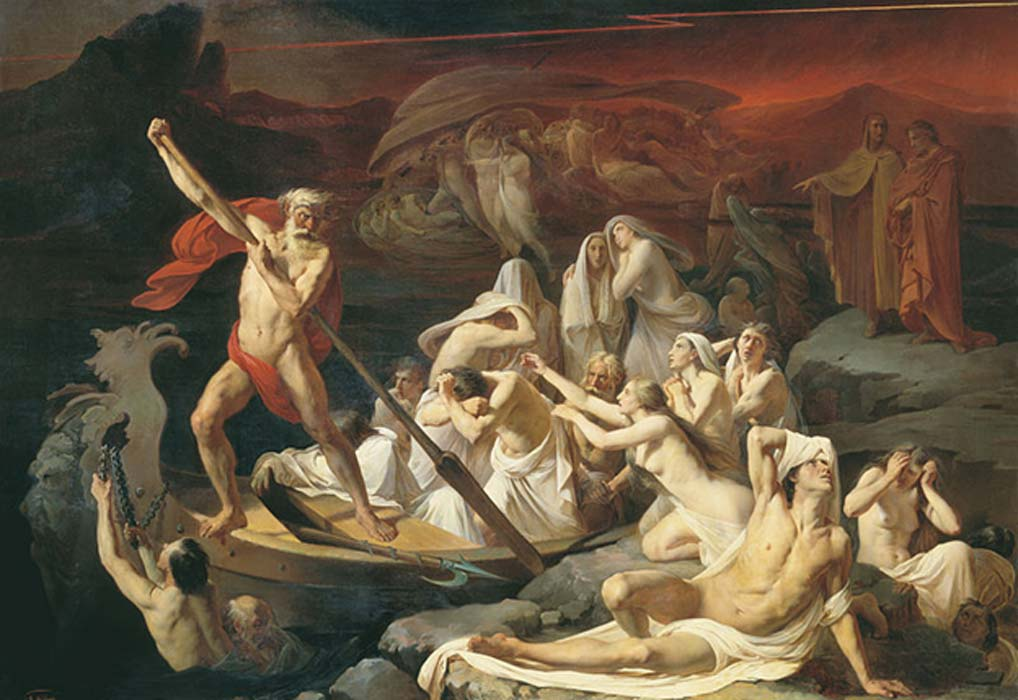
He played for the skeletal ferryman Charon, who wept tears of pure water and rowed him across the river Styx for free.
As his music echoed through the torturous pits of Tartarus, the eternal punishments of the damned ground to a halt: Tantalus forgot his hunger, Sisyphus sat down on his massive boulder, and the spinning, burning wheel of Ixion froze in space.
Finally, Orpheus stood before the obsidian thrones of Hades and Persephone, the cold, unyielding rulers of the dead. He struck his lyre and sang a desperate, heartbreaking song about love, mortality, and the inevitability that all living things will eventually belong to the underworld anyway.
For the first and only time in cosmic history, the iron heart of Hades softened. Ovid writes that the Furies' cheeks grew wet with tears. Hades agreed to grant Orpheus’s request, but on one agonizing condition:
   [ THE DESCENT ] ──► Orpheus charms Hades ──► Receives Eurydice
                                  │
                     (The Ascending Journey)
                                  │
                                  ▼
   [ THE CAVERN EXIT ] ◄── Turns to look back ──► Eurydice slips back into the dark
Orpheus was allowed to lead Eurydice's shade back to the surface world. He was to march in front, and she would walk directly behind him in the shadows. He was strictly forbidden from turning his head to look at her until both of them had fully stepped out into the sunlight of the living world.
The Fatal Glance
The ascent up the steep, silent, pitch-black tunnels of the underworld was an exercise in intense psychological torture. Orpheus marched onward, hearing absolutely nothing behind him. Because spirits have no physical weight, Eurydice's footsteps made no sound against the rocks.
Insecurity and terror began to gnaw at Orpheus's mind. Was Hades tricking him? Was she truly behind him, or was he walking out alone?
Finally, Orpheus saw the pale white light of the surface world shining through the mouth of the cavern. He stepped out into the warm sunlight, overjoyed. Forgetful of the exact wording of the divine condition—that both of them had to be out in the sun—Orpheus turned his head in an ecstasy of relief to look upon his bride.
Eurydice was still standing just a single step inside the threshold, shadowed by the cavern roof. As his eyes met hers, the contract was instantly broken.
An invisible, chthonic force snatched her backward. She stretched out her arms to touch him, but her form instantly dissolved into thin air, slipping back down into the dark abyss. Her final, dying whisper echoed through the cave: "Farewell." Orpheus tried to descend a second time, but the gods barred the gates forever. He spent the remainder of his short life wandering the wilderness in absolute isolation, his shattered heart producing a weeping music that would haunt the world until his violent death.