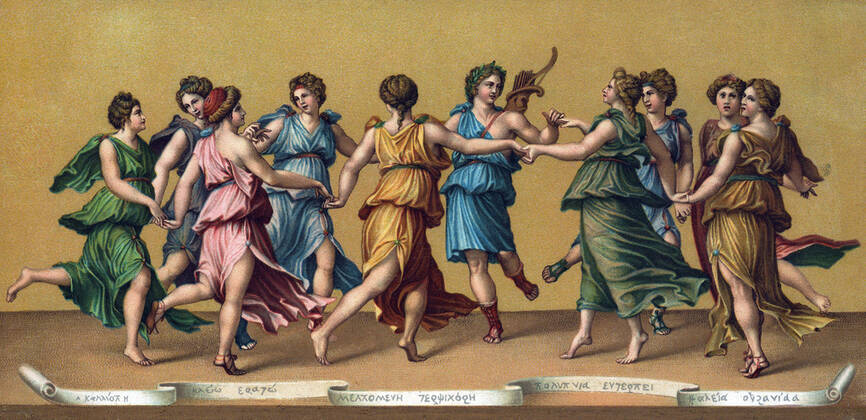
In the modern Western world, dance is often compartmentalized into discrete categories: entertainment, physical fitness, or a specialized performance art. To the ancient Greeks, however, dance—known as orchesis ($\ddot o\rho\chi\eta\sigma\iota\varsigma$)—was an all-encompassing civic, military, and spiritual language. Derived from the verb orcheomai, meaning "to leap" or "to move with rhythm," dance was viewed as an essential marker of a civilized human being.
                    [ THE THREE PILLARS OF ORCHESIS ]
                                    │
         ┌──────────────────────────┼──────────────────────────┐
         ▼                          ▼                          ▼
[ THE PYRRHIC MATRIX ]     [ THE DIONYSIAN ECSTASY ]   [ THE CIVIC APRETERION ]
* Weaponed Choreography    * Komos & Maenad Revels     * The Geranos (Labyrinth)
* Mimetic Shield Deflections* Thyris-Waving Katharsis  * Choral Paeans to Apollo
The philosopher Plato famously argued in his Laws that a man who could not dance gracefully was uneducated (achoreutos), while a master dancer possessed the ultimate harmony of mind and body (kalokagathia).
The Pyrrhic Dance: Weaponized Choreography
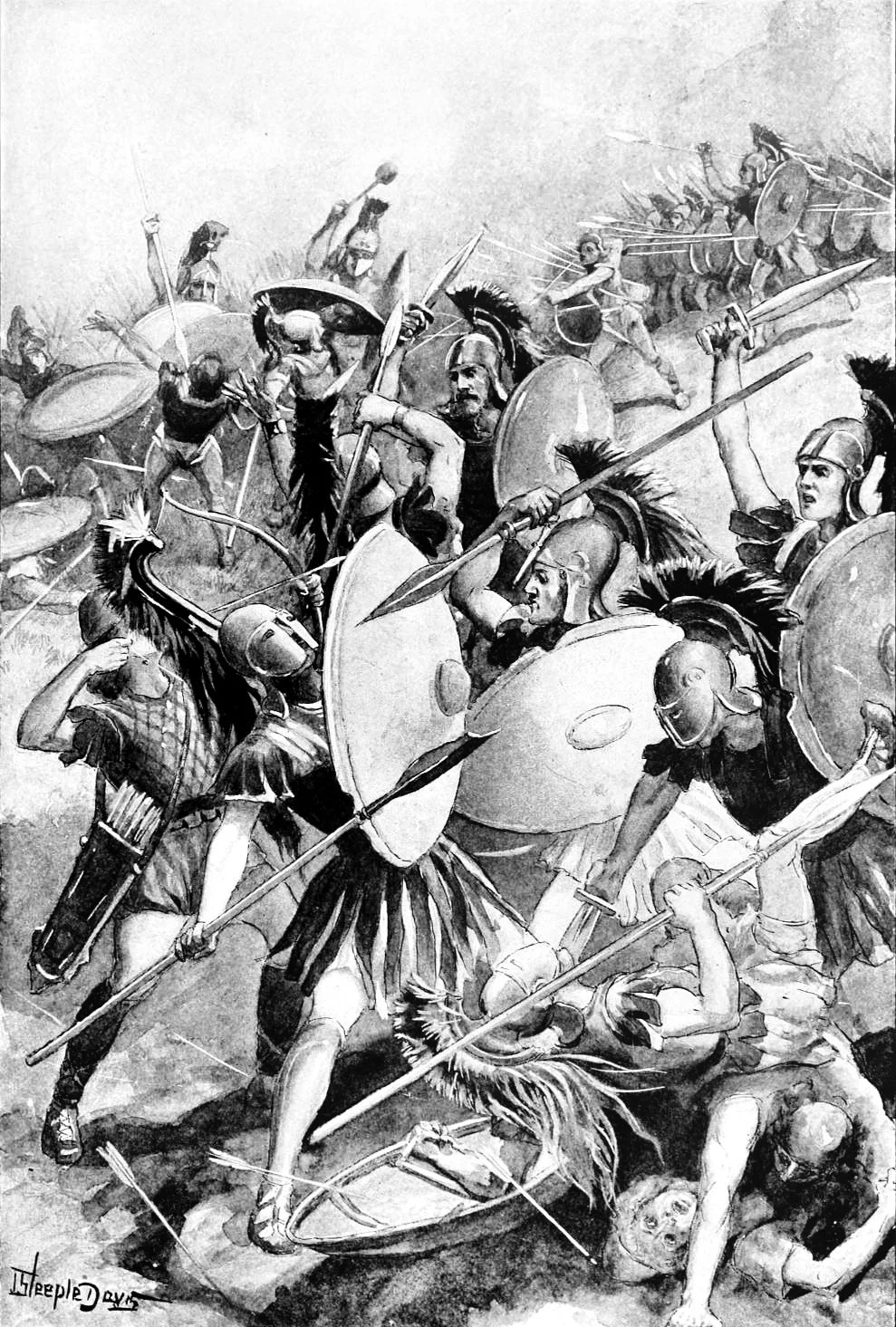
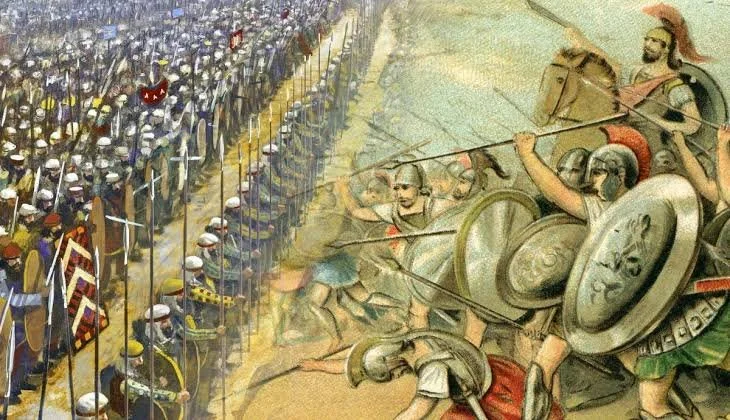
The most prestigious and popular dance across the entirety of Greece—particularly in militarized Sparta—was the Pyrrhic Dance (Pyrrhiche). This was a fast-paced, high-intensity martial dance performed by young men while completely encased in heavy hoplite armor, carrying shields, spears, and swords.
The Pyrrhic dance was not a chaotic display of aggression; it was a highly complex, rhythmic, and synchronized piece of choreography set to the sharp, driving beat of the aulos (a double-reeded pipe). The dancers executed a series of stylized, rapid movements designed to train their muscle memory for actual battlefield survival:
The Mimetic Deflection: Dancers leaped sideways, crouched low, and twisted their torsos to mimic ducking beneath flying javelins or deflecting oncoming arrows with their shields.
The Offensive Thrust: The choreography integrated sudden lunges, high-stepping charges, and downward sword-strikes, transforming a beautiful public spectacle into an elite infantry drill.
The Geranos: The Dance of the Labyrinth
While the Pyrrhic dance celebrated the rigid discipline of war, the Geranos (the "Crane Dance") celebrated mythological storytelling and civic survival. According to legendary tradition, this dance was invented by the hero Theseus after he successfully slaughtered the Minotaur inside the Labyrinth of Crete. Upon arriving on the sacred island of Delos, Theseus and his rescued Athenian youths danced around an altar to thank the gods.
The Geranos mimicked the complex, twisting topography of the Labyrinth itself. A line of male and female dancers held onto a single rope or held each other by the wrists, weaving in and out of intricate, coiling geometric patterns.
The leader of the line, known as the geranoulkos, guided the group through dizzying spirals and sudden reversals of direction, simulating the terrifying experience of losing one's way inside the maze and the triumphant, rhythmic thread-guided escape back out into the light.
The Komos: Dionysian Ecstasy and Release
In stark contrast to the structured geometry of the Crane Dance was the Komos, the uninhibited, ecstatic street dance dedicated to Dionysus, the god of wine and theater. Performed during the dark winter nights of the Rural Dionysia or following high-spirited symposia, the Komos was a riotous, nocturnal procession of citizens who shed their rigid civic identities.
Dancers hurled their bodies backward, flailed their limbs wildly, kicked their legs to the sky, and beat rhythmic patterns on heavy hand drums (tympana). The movement was deliberately erratic, designed to induce a state of ekstasis—literally "standing outside oneself."
Through these wild, fluid movements, the Greeks sought a psychological catharsis, shaking off the crushing anxieties of civic accountability and domestic duty to temporarily merge with the raw, untamed forces of the natural world.