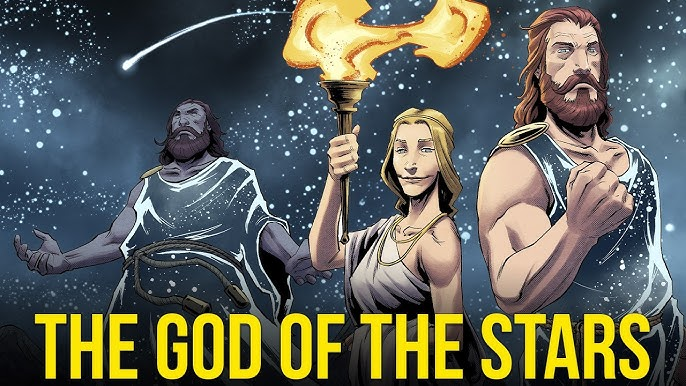
To understand Astraeus more deeply, one must look beyond his role as a mere genealogical bridge and view him as a fundamental component of the ancient Greek worldview regarding Cosmic Order (Cosmos). His identity as the "Starry One" is inextricably linked to the Greek attempt to map the heavens and discern divine intent from the motion of the stars and the behavior of the winds.
I. The Genealogy of the Celestial Order
Astraeus’s parentage—born of Crius (a Titan associated with the pillars of the world) and Eurybia (a daughter of Pontus/the Sea)—places him in a unique position between the terrestrial, the maritime, and the celestial. This heritage allowed the Greeks to conceptualize him as a mediator who translated the raw power of the earth and sea into the orderly, predictable movements of the sky.
His marriage to Eos (the Dawn) is the primary narrative anchor for his existence. In the poetic logic of the Greeks, Astraeus represents the end of the light—the arrival of the cooling, star-filled evening—while Eos represents the beginning of the light. Together, they represent the complete cyclic nature of time.
II. The Father of the Winds (Anemoi)
Perhaps his most significant functional role is as the father of the four primary winds: Boreas (North), Zephyrus (West), Notus (South), and Eurus (East). In ancient navigation and agriculture, the winds were the most unpredictable, and therefore the most terrifying, elements of the natural world.
Taming the Chaos: By establishing that these chaotic forces were "children" of a star-god, the Greeks created a symbolic framework where the winds were not random, but were instead subservient to the orderly rotation of the stars.
Meteorological Wisdom: Ancient meteorology was essentially an extension of astronomy. Sailors would observe the rising and setting of specific constellations to predict the coming of the winds. Astraeus, as the god who oversaw both, was the deity of this predictive wisdom. He was not just the father of the stars; he was the master of the "system" that connected stellar positions to the weather on earth.
III. The Astra Planeta: Celestial Geometry
Beyond the winds, Astraeus was credited as the father of the five Astra Planeta (the visible planets: Mercury, Venus, Mars, Jupiter, and Saturn). To the ancient mind, these were not just points of light; they were "wanderers" that moved with complex, sometimes retrograde patterns against the fixed sphere of the stars.
The Intersection of Myth and Math: This role highlights the intersection of Greek mythology and early scientific inquiry. Figures like Hipparchus (whom you have shown interest in) would later build on this mythic framework, moving from seeing these as "children of Astraeus" to viewing them as objects defined by geometric orbits. Astraeus represents the transition point: he is the mythic name for the complex, moving machinery of the heavens that mathematicians would later seek to quantify.
IV. The Absence of Narrative: A God of System, Not Story
Why does Astraeus lack the dramatic myths of his peers? The answer lies in his function. In the Greek hierarchy, dramatic conflict is reserved for the Olympians, who are concerned with human affairs, morality, and social order. Astraeus belongs to the generation of Titans, who represent the raw, fundamental "gears" of the universe.
He does not need to speak or intervene because his existence is the intervention itself. When the stars move across the night sky, when the winds turn from North to West, it is the manifestation of Astraeus. He is the personification of the "Clockwork Universe" before that term existed—a reminder that for the ancients, the night sky was not a void, but a precise, rhythmic, and divine structure.
V. Astraeus in the Context of Greek Philosophy
The conceptualization of Astraeus aligns with the later inquiries of the Milesian School and their successors. When these thinkers began to move away from purely mythic explanations, they did not necessarily discard figures like Astraeus; rather, they reinterpreted them as forces of nature governed by Logos (reason or proportion). Astraeus became a metaphor for the mathematical precision of the cosmos.
Astraeus embodies the ancient Greek transition from fear of the natural world to an attempt to understand it through observation. He is the bridge between the terrifying unpredictability of the wind and the soothing, mathematical certainty of the stars.