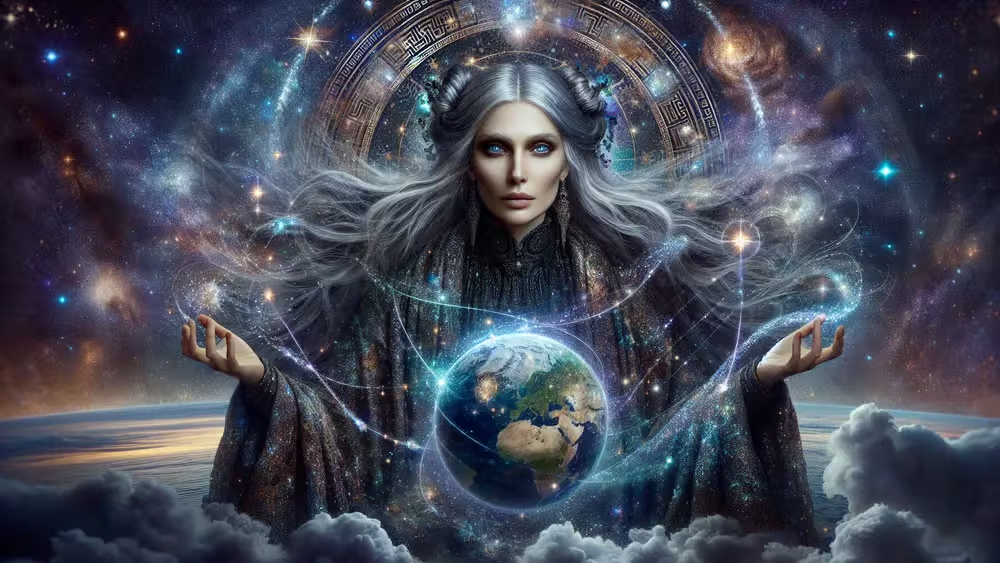
Ananke (or Necessity) is perhaps the most absolute, immutable force in the Greek mythological universe. While the Olympian gods like Zeus or Poseidon commanded elements of the world, Ananke commanded the gods themselves. She is the embodiment of the inevitability that governs all things—the cosmic blueprint that not even the most powerful deity can alter.
I. The Primordial Foundation
Ananke is a primordial deity, often described as having existed at the very dawn of creation. In the Orphic tradition, she is said to have emerged alongside Chronos (Time) at the beginning of the universe.
The Unshakable Bond: She is frequently depicted as intertwined with Chronos; together, they represent the structure of space-time. While Chronos represents the duration of time, Ananke represents the path that time must take.
The Cosmic Loom: She is often portrayed holding a spindle. This is a profound metaphor: if the universe is a tapestry, Ananke is the law that dictates how the threads are spun and where they must lie. She does not "choose" the fate of individuals; she simply ensures that the laws of cause and effect remain unbroken.
II. The Ruler of All
Ananke’s defining characteristic is that she is beyond divine influence. Even Zeus, the king of the gods, is said to be subject to the laws of Ananke.
The Limit of Power: In Greek tragedy and philosophy, a common refrain is that "not even the gods can fight against Necessity." If a prophecy is issued, it is because Ananke has woven it into the fabric of reality. For a god to fight against it would be to try and unmake the universe itself.
The Iron Constraint: Her name literally means "necessity" or "compulsion." She represents the inescapable reality that certain things must happen—birth, death, and the movement of the celestial bodies. She is the final answer to the question "Why?"
III. Ananke in Philosophy and Literature
Her role evolved from a purely mythological figure into a cornerstone of Greek philosophical thought, particularly among the Platonists.
Plato’s Myth of Er: In Plato’s Republic, Ananke is central to the afterlife. He describes her as the mother of the Moirai (the Fates). In his vision, she sits in the center of the cosmos, holding the "spindle of necessity" upon which the orbits of the stars and planets turn. This solidified her as the guarantor of cosmic order.
The Fatalistic Worldview: Ananke represents the Greek concept of fatalism. For a mortal, the awareness of Ananke was not meant to cause despair, but rather to provide a sense of perspective. It was the acknowledgement that life is governed by patterns, and that there is a profound, if sometimes cruel, order to the universe.
IV. Iconography and Legacy
Ananke was rarely worshipped in temples like the Olympians. She was a conceptual deity—an abstract principle that people respected rather than petitioned.
The Inevitable Path: She was often visualized as having arms of fire or chains, representing the inescapable grip she holds over the cosmos. She is the ultimate "boundary." When a character in Greek myth reaches a point where no other option exists—where their choices have finally narrowed to one inevitable outcome—they have met Ananke.
Ananke serves as the "background code" of the Greek universe. She reminds us that behind the chaotic, human-like drama of the gods, there exists a rigid, mathematical, and unyielding framework that ensures the universe remains functional.