To fully grasp the reality of ancient Greece, one must peel back the layers of myth and look at the physical and social infrastructure that supported the "Greek Miracle." It was a world of sharp contrasts: a highly communal civic life that relied on radical individual exclusion, and a life of profound philosophical inquiry built upon the backs of those who had no voice in the polis.
I. The Architectural and Civic Landscape
The city-state (polis) was a masterpiece of urban planning designed to force interaction.
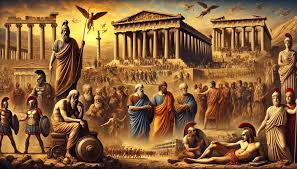
The Agora: This was the beating heart of the city—a bustling, open marketplace and civic center. Here, one could find everything from fresh fish and olive oil to philosophical debates, legal trials, and political assemblies. It was an environment of intense sensory overload, where the boundaries between commercial trade and intellectual exchange were non-existent.
The Acropolis: While the Agora was for the living, the Acropolis was for the divine. These elevated temple complexes served as constant visual reminders of the city’s patrons (like the Parthenon in Athens). They represented the city’s piety and, equally importantly, its status and wealth.
Domestic Living: The average home was modest, built of sun-dried mud bricks around a central courtyard (aulos). The layout was designed for privacy from the street, with windows being rare. The house was essentially a walled-off sanctuary for the family unit, with distinct areas for men (andron) and women (gynaikon), ensuring that public and private lives remained strictly separated.
II. The Rhythm of Labor and Leisure
Life was heavily dictated by the seasons and the solar cycle. There was no artificial lighting, so the Greeks were early risers.
Agriculture and Trade: The majority of the population were peasants, and their lives were a grueling cycle of the harvest. They lived by the sun; in winter, labor was light, and in summer, it was intense. The Mediterranean climate—with its long, dry summers—made the collection and storage of water and grain the most critical civic tasks.
The Paradox of Leisure (Schole): The Greek word for "leisure" is schole, the root of our modern word "school." For a citizen, leisure was not merely "free time"; it was a moral obligation to engage in civic duties, exercise, and intellectual growth. This pursuit of the "cultivated life" was only possible because of the reliance on enslaved labor, which freed the citizen class from the manual tasks of production.
III. The Ritual of Health and Medicine
The Greeks viewed health not just as a medical state, but as a balance—a reflection of the balance they sought in their political and social lives.
Hippocratic Influence: As medicine moved away from pure superstition toward the observation of symptoms, individuals became increasingly concerned with dietetics—managing one’s daily consumption of food, wine, and exercise to maintain the balance of the four humors.
The Healing Sanctuaries: For the average person, professional medicine was often combined with religion. The cult of Asclepius, the god of healing, was immensely popular. People would travel to these sanctuaries to undergo incubation—sleeping in a temple in the hope that the god would appear in a dream to provide a cure. It was a fascinating blend of proto-scientific observation and profound spiritual faith.
IV. The Social Hierarchy and "The Other"
The Greek polis was a "club" with very strict membership rules.
The Concept of "Barbaros": The Greeks classified everyone who was not Greek as a barbaros—a term derived from the sound "bar-bar," suggesting they did not speak a "real" language. This distinction was central to their identity, creating a firm boundary between the "civilized" Greek and the "others."
The Metics: Even within the city, many residents were metics—resident aliens who lived and worked in the city but lacked citizenship. They were essential to the economy, often working as skilled craftsmen, bankers, or merchants, yet they remained legally marginalized, always subject to the whims of the citizen body.
V. The Enduring Legacy of the Symposion
While we have mentioned the symposion (the drinking party), its cultural importance cannot be overstated. It was the primary venue for Greek social bonding.
Structured Intoxication: The wine was always mixed with water, usually in a ratio of 3:1 or 2:1. To drink "straight" wine was considered barbaric. This practice was meant to facilitate conversation and wit, not drunkenness.
A "Democratic" Space: While restricted to men of status, the symposion operated on an internal meritocracy. Participants would take turns reciting poetry, performing songs, or proposing topics for debate. It was here that Greek social values—arete (excellence), xenia (hospitality), and sophrosyne (moderation)—were tested and refined.
Ultimately, daily life in ancient Greece was characterized by a tension between the small scale of the household and the immense scale of the state. They were a people who lived in a harsh, demanding landscape, yet their cultural obsession was with order, harmony, and the pursuit of knowledge. They viewed their lives as a constant negotiation with the gods, fate, and the limitations of their own mortality.