The Mediterranean climate is characterized by intense, baking summer heat and long seasonal droughts, creating an environment where fresh agricultural produce, meat, and dairy spoil within hours. To prevent systemic starvation and build up strategic reserves for military campaigns and winter food shortages, the ancient Greeks developed a sophisticated, highly practical toolkit of biochemical and physical preservation methods.
Dehydration and Solar Desiccation
The simplest and most energy-efficient preservation method was the systematic removal of water from organic tissues, preventing the proliferation of spoilage bacteria and molds. The Greeks turned the intense solar radiation of their summers into an industrial dehydrator:
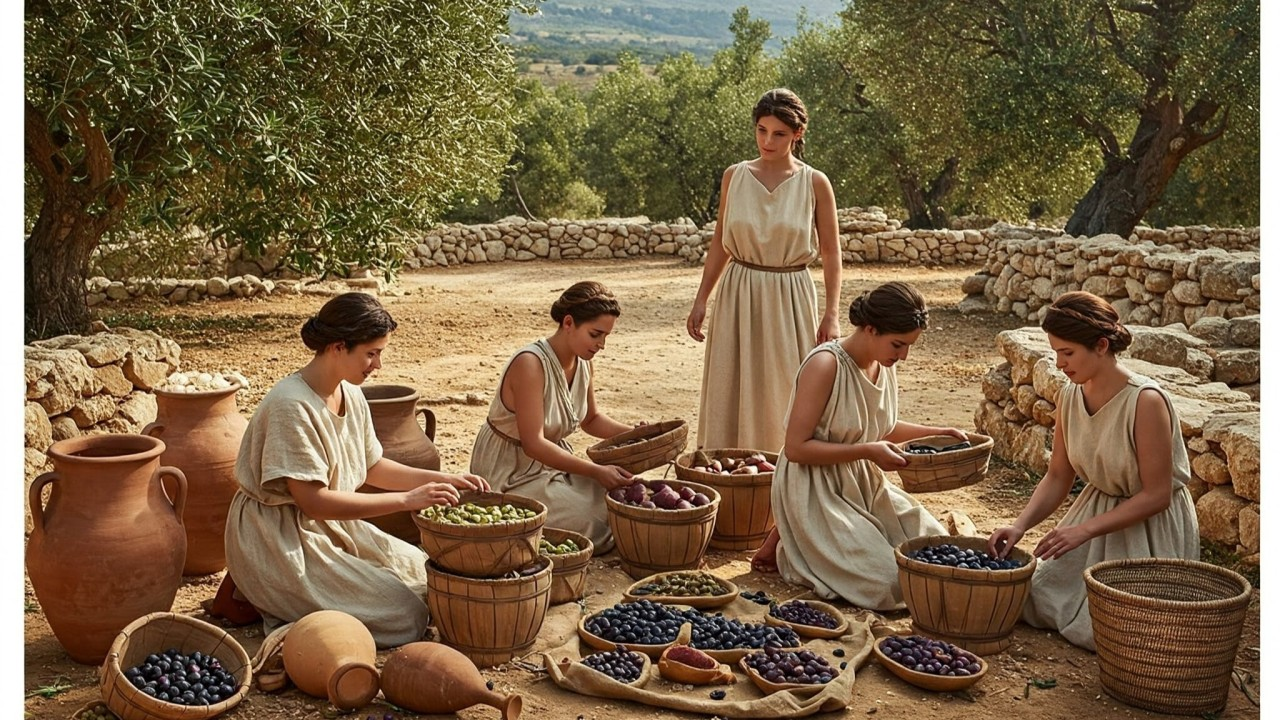
Fruit Processing: Massive annual harvests of figs, grapes (raisins), and pomegranates were laid out on wide straw mats in the direct sun for weeks. Once thoroughly desiccated, these sugar-dense fruits were packed tightly into clay jars layered with dry bay leaves to repel insects, providing a critical source of winter carbohydrates.
Legume Infrastructure: Field crops like lentils, chickpeas, and fava beans were left to dry completely on the stalk before being threshed, winnowed, and deposited into dry underground silos, remaining viable for years.
Anaerobic Submersion: Honey and Oil
For delicate items that could not be dried without losing their nutritional or structural integrity, the Greeks used the method of exclusion preservation—submerging foods inside liquid mediums that completely cut off contact with ambient oxygen.
  [ FOOD PRODUCT ] ───► Submerged in Liquid Medium ───► Complete Oxygen Exclusion
                              │
               ┌──────────────┴──────────────┐
               ▼                             ▼
       [ PURE RAW HONEY ]            [ INFUSED OLIVE OIL ]
       * High Osmotic Pressure       * Hydrophobic Barrier
       * Halts Bacterial Growth      * Seals Cheeses & Meats
Honey Preserves: Pure, raw honey possesses an exceptionally low water content and high osmotic pressure, naturally drawing moisture out of bacterial cells and halting their reproduction. The Greeks submerged fresh wild berries, flowers, and even delicate cuts of meat inside jars of raw honey, sealing the tops with beeswax.
The Oil Blanket: Olive oil acts as a hydrophobic barrier, blocking oxygen and ambient airborne fungal spores. Cheeses (such as proto-feta) were cut into dense blocks, heavily salted, and packed into ceramic vessels completely topped off with olive oil, creating an airtight seal that kept the cheese soft and edible for months.
Structural Isolation: Pithoi and Silos
On an industrial scale, the ultimate preservation tool was the pithos ($\pi\dot\iota\theta o\varsigma$)—a massive, thick-walled ceramic storage jar that could stand up to 6 feet tall.
These massive jars were not left exposed to the ambient air; they were systematically buried up to their necks directly into the dirt floors of deep underground storerooms and palace cellars.
By embedding the jars in the earth, the Greeks utilized the natural insulation of the soil to maintain a remarkably stable, cool internal temperature ($15^\circ\text{C}$ to $18^\circ\text{C}$) year-round, successfully slowing down the oxidation of olive oil, preventing the fermentation of wine into vinegar, and protecting grain reserves from the catastrophic infestations of weevils and rodents.