1. How Greek Sailors Navigated the Aegean Sea
Navigating the Aegean Sea was a masterclass in reading nature. The ancient Greeks did not possess magnetic compasses or sextants; instead, they relied on maritime experiential mapping and a deep intimacy with the landscape, stars, and seasonal winds. Because the Aegean is densely populated with islands, navigation was primarily periplus—coastal piloting and island-hopping where sailors rarely lost sight of land.
The Anemoi: Navigating by the Winds
The wind was the primary compass of the Aegean sailor. The Greeks conceptualized the winds as divine entities (Anemoi) flowing from the cardinal directions. Sailors calibrated their vectors using a mental framework called the Wind Rose, which mapped twelve distinct wind streams.
The absolute master of Aegean navigation was the Meltemi (ancient Etesian winds), a strong, dry north wind that blew relentlessly across the Aegean from May to September.
Sailing South: Navigators could run directly before the wind, making rapid southern transits toward Crete or Egypt.
Sailing North: Returning north required intense, tactical tacking (zigzagging against the wind), a grueling process that forced sailors to seek shelter in protected island coves during the peak afternoon gales.
Stellar and Solar Orientation
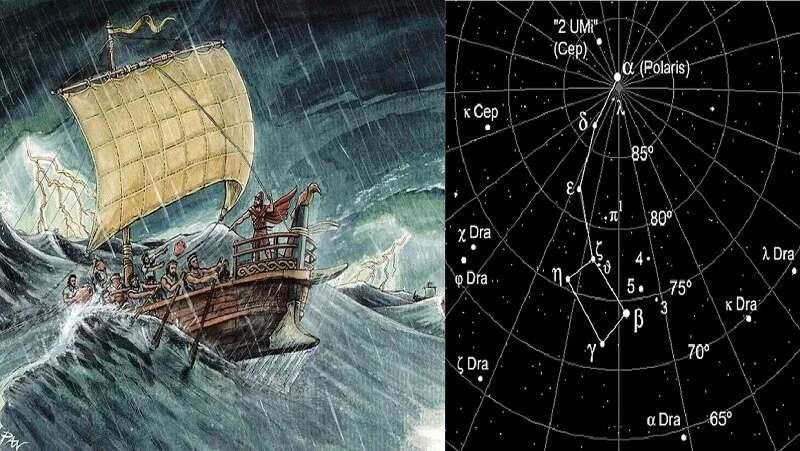
When forced to make open-water crossings at night, the helmsman (kybernetes) turned his eyes to the night sky. Navigators used a technique called sidereal navigation, calculating their heading by tracking the rising and setting points of specific constellations:
Ursa Major and Minor: Known to the Greeks as Arktos (The Bear), these constellations provided a fixed anchor for identifying true north.
The Pleiades and Orion: The seasonal appearances of these stellar clusters signaled the official opening and closing of the safe sailing season. If the Pleiades dipped below the horizon, it was an explicit cosmic warning that winter storms were imminent and all fleets should be safely hauled onto dry land.
Hydrostatic Sounding: The Lead Line
When vision was compromised by dense sea mists or dark nights, sailors deployed their most crucial material instrument: the sounding lead (bolis). This tool consisted of a heavy, cone-shaped lead weight attached to a long, knotted hemp rope.
The weight featured a hollow base packed with sticky animal tallow or grease. When dropped to the seafloor, it performed two vital diagnostic functions: it measured the exact water depth in cubits to prevent groundings on hidden sandbars, and it brought up samples of the seafloor (mud, shells, or volcanic sand), allowing experienced captains to pinpoint their exact position.