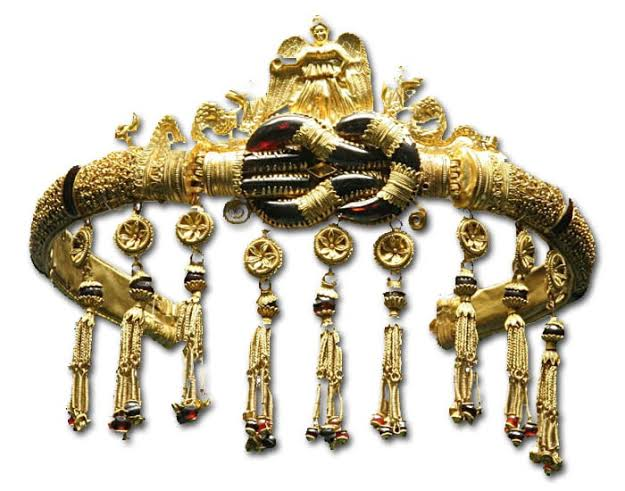
In the ancient Greek world, jewelry was far more than an accessory for personal vanity; it was a profound medium for displaying civic status, religious devotion, family lineage, and immense economic wealth. Greek smiths transformed raw precious metals into breathtaking wearable art, moving away from the heavy, cast-metal styles of the Near East to pioneer ultra-fine, delicate manipulation techniques that remain a pinnacle of metallurgical history.
The core of Greek jewelry mastery lay in two highly specialized micro-soldering techniques: filigree and granulation. To create filigree, a master smith, or chrysochoos, would draw pure gold through progressively smaller holes in an iron plate until it was reduced to a wire as thin as a human hair. This wire was then twisted, plaited, and soldered onto a flat gold base sheet to form complex floral patterns, spirals, and rosettes. Granulation involved a completely different mechanical process. Smiths cut tiny snippets of gold wire and heated them on a bed of charcoal until they naturally pulled into perfect micro-spheres or granules. These granules, measuring a fraction of a millimeter, were glued onto a gold substrate using a temporary organic paste mixed with copper salts. When fired under a blowpipe in a reducing atmosphere, the copper chemically bonded the granules to the base without melting the tiny spheres, creating an incredibly complex, textured surface that caught the Mediterranean sun.
During the Hellenistic period, following the eastern conquests of Alexander the Great, the aesthetic landscape of Greek jewelry shifted dramatically. The sudden influx of vast gold reserves from the captured Persian treasuries was accompanied by an explosion of color. For the first time, Greek jewelers integrated exotic, imported gemstones into their gold matrices, using deep red garnets from India, blue sapphires, green emeralds, and iridescent pearls harvested from the Persian Gulf. This era also saw the rise of the Herakles knot design—a complex, interlocking reef knot rendered in gold wire and inlaid with gems—which was worn prominently on diadems and armbands as a powerful protective amulet capable of warding off evil spirits and physical harm.