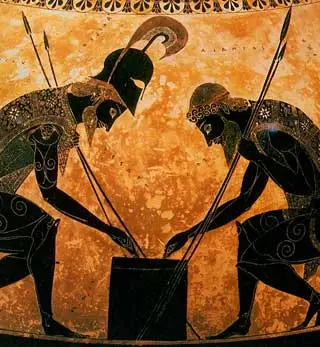
In ancient Greece, board games were not merely idle pastimes for children; they were highly competitive, intellectually rigorous pursuits played by all sectors of society, from soldiers in military camps to aristocrats at lavish symposia. Games were viewed as direct reflections of life, testing an individual's capacity for strategic planning, tactical risk management, and handling the unpredictable dictates of fate and fortune.
The most popular and prestigious game of pure strategy was Petteia ($\pi\varepsilon\tau\tau\varepsilon\dot\iota\alpha$). Played on a grid-lined wooden or marble board, each player controlled a set of identical colored stones or glass pieces, known as psephoi. Unlike games that relied on the roll of a die, Petteia was a game of absolute, deterministic skill, frequently compared by philosophers like Aristotle to the tactical maneuvers of real-world warfare.
The primary objective was to trap an opponent’s piece between two of one’s own stones, effectively capturing it and removing it from the board. The game required intense foresight and spatial calculation, serving as a popular training tool for young men preparing to enter the military phalanx.
At the opposite end of the gaming spectrum was Duodecim Scripta (or its Greek variant Grammai), an ancient ancestor of modern backgammon. This game elegantly blended tactical calculation with the chaotic element of chance, utilizing a board with lines of parallel squares and three six-sided dice carved from animal knucklebone or ivory.
Players raced their pieces across the board based on the numerical results of their dice throws, navigating blocked pathways and strategically knocking enemy pieces back to the starting line. The frantic, unpredictable nature of this game made it a fixture of public taverns, where spectators would regularly place heavy monetary wagers on the outcomes, transforming simple board games into high-stakes spectacles of public entertainment.