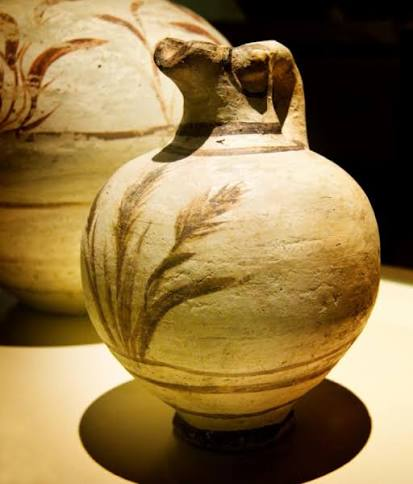
To the classical Greeks, beer—known by names like zythos ($\zeta\dot\upsilon\theta o\varsigma$) or pinnos—was viewed with intense cultural skepticism and frequent culinary disdain. It was widely stereotyped as an inferior, un-civilized beverage consumed by northern barbarians, such as the Thracians and Celts, or by the ancient Egyptians. Despite this official literary snobbery, archeological discoveries and deep-layer trade records reveal that beer brewing was actively practiced and consumed within specific regions of the Greek world, particularly along the northern frontiers and on the island of Crete.
Because the Mediterranean climate is optimized for the cultivation of grapes rather than the mass agricultural production of grains, Greek brewing was largely an imported technology that adapted local ingredients. The brewing process began with the malting of barley or emmer wheat:
The Sprouting Matrix: Harvested grain was soaked in large ceramic vats until it absorbed enough moisture to begin sprouting, a biological process that naturally converted complex starches into fermentable sugars.
The Kiln Toasting: The sprouted grain was immediately transferred to low-temperature kilns or spread out on sun-baked stones to dry, arresting the growth of the sprout while caramelizing the interior sugars.
The Mashing & Fermentation: This malted grain was coarsely ground, mixed with boiling water to create a sweet mash, and filtered through wicker baskets.
Because the ancient Greeks lacked access to hops, which act as a natural preservative and bittering agent in modern beer, the resulting sweet liquid was highly susceptible to rapid spoilage. To stabilize the brew and introduce flavor contrast, Greek brewers infused their beer with a variety of local botanicals, including wild sage, bitter pine resins, and raw honey.
The fermentation was triggered using wild airborne yeasts or by transferring yeast sediments saved from previous bakes of sourdough bread. The finished beer was a thick, highly carbonated, and slightly cloudy liquid that was often consumed through long reed straw-filters to strain out the floating husks, serving as an important alternative caloric source for working-class laborers and rural populations living beyond the reach of wealthy vineyards.