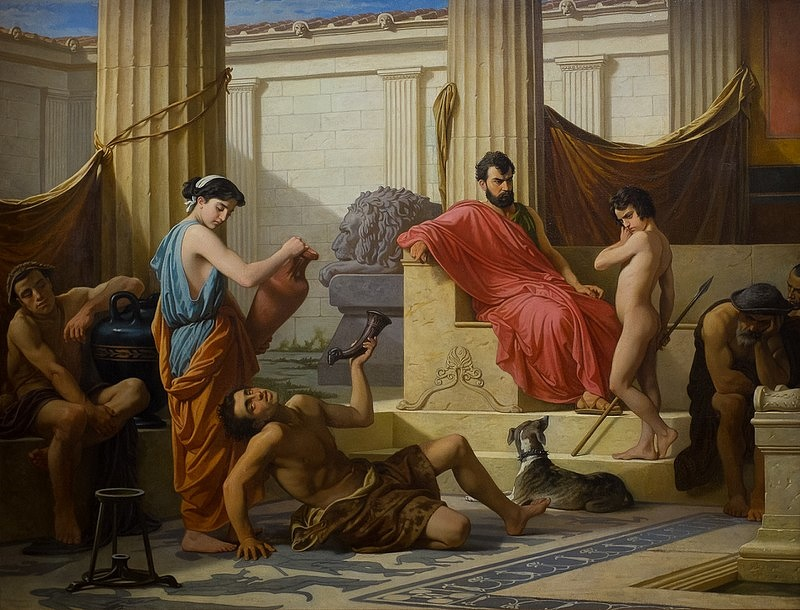
The highly celebrated democratic institutions, artistic movements, and philosophical achievements of classical Greece were entirely dependent upon a massive, structural foundation of human chattel slavery. Within the domestic framework of the oikos, household slaves—known collectively as oiketai ($\ o\mathit{\iota}\kappa\dot{\varepsilon}\tau\alpha\mathit{\iota}$)—were integrated into every facet of daily life, acting as the primary economic and physical engines that kept the private home functionally viable.
Household slaves were purchased directly from major international slave markets located in urban hubs like Athens and Delos, where prisoners of war, victims of piracy, and children sold by impoverished families on the northern frontiers were auctioned off like livestock.
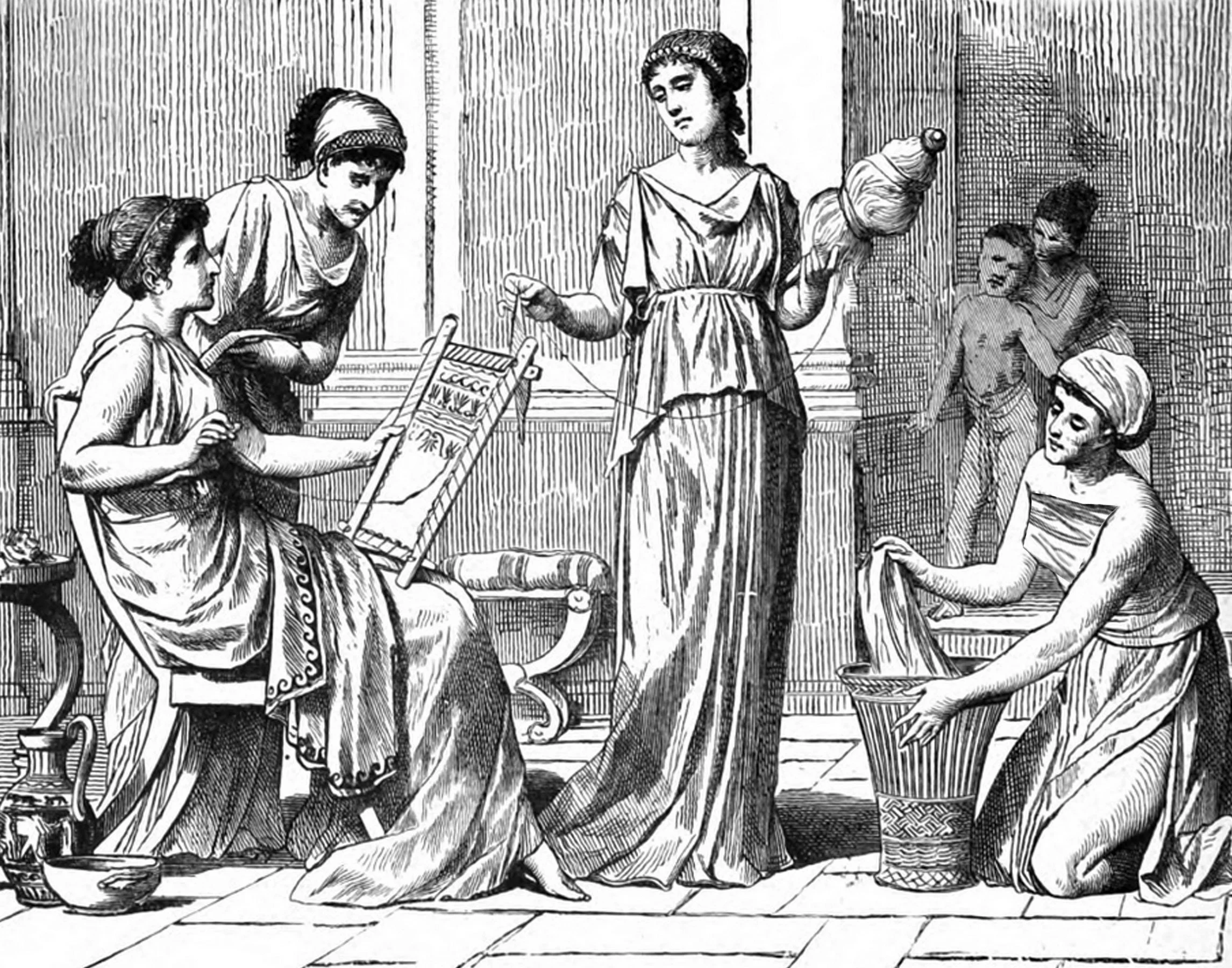
Once inside the home, their labor was highly diversified based on gender and individual skill. Female domestic slaves were responsible for the grueling, daily labor of grinding grain using heavy stone hand-mills, baking bread over clay ovens, fetching water from distant public fountains, and managing the continuous production of clothing through spinning wool and weaving on vertical looms. Male domestic slaves performed heavy physical labor, including maintaining the household structures, managing urban property, and working the family's rural agricultural plots.
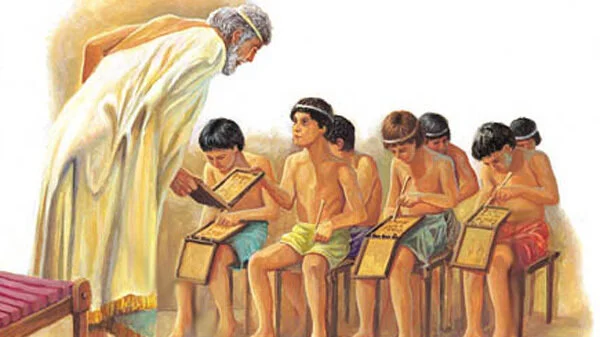
At the upper echelon of the domestic slave hierarchy was the paidagogos ($\pi\alpha\iota\delta\alpha\gamma\omega\gamma\dot{o}\varsigma$), a highly trusted male slave tasked with the complete moral and physical supervision of the family’s young sons. The paidagogos did not act as a formal schoolteacher; instead, he walked alongside the boy through the dangerous city streets to the grammar academy, carried his heavy wax writing tablets, sat in the back of the classroom to monitor his behavior, and rigorously disciplined him with a wooden switch if he displayed signs of laziness, vanity, or disrespect.
Despite this position of high domestic trust, the legal reality of the oiketai remained brutal and uncompromising. Slaves were classified under Greek law not as human citizens, but as animate property (ktena empsycha). They possessed no legal rights over their own bodies, could be physically beaten or sexually exploited at their master's absolute whim, and their testimony was considered legally inadmissible in a court of law unless it was extracted under formal judicial torture, illustrating the deep, unyielding human cost that underwrote the daily life of classical antiquity.