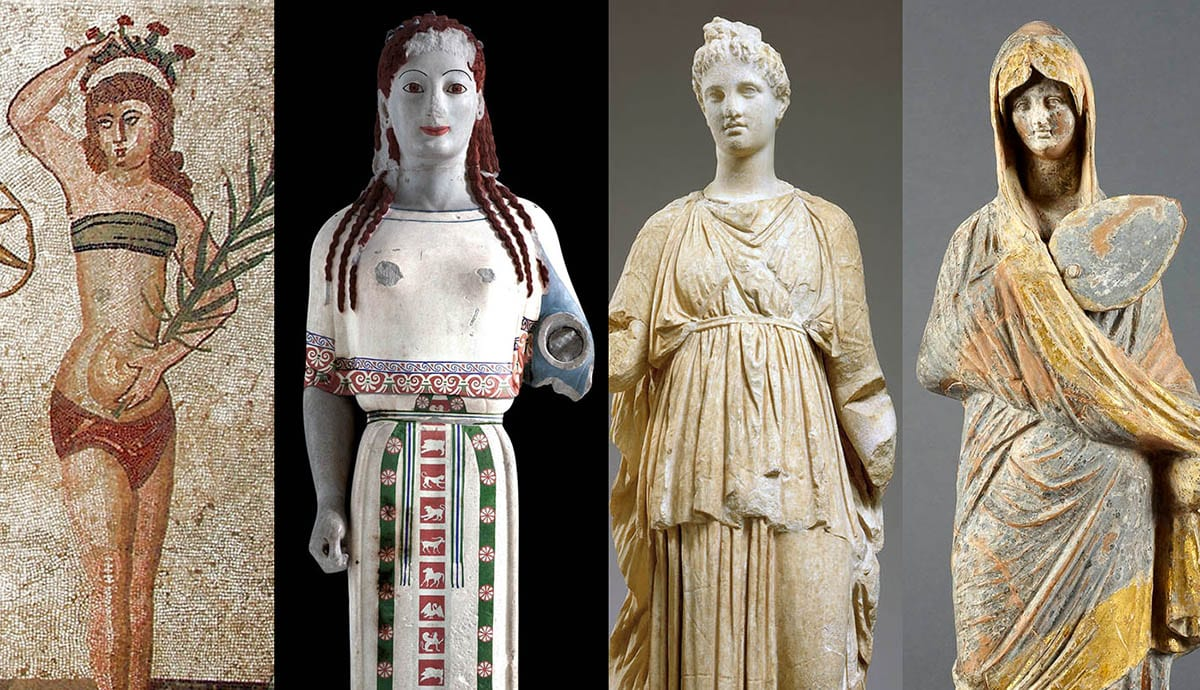
In the ancient Greek consciousness, the clothing draped over the body was never merely functional fabric; it was a deeply coded visual language directly echoing the idealized garments worn by the Olympian gods. Fashion acted as a form of cultural mimicry, where mortals styled their garments, pins, and hair to evoke the specific divine qualities—such as the virginal purity of Artemis, the severe majesty of Athena, or the untamed sensuality of Aphrodite—celebrated in epic poetry and religious cults.
The structural foundations of Greek attire, the peplos and the chiton, were deeply intertwined with mythological identities. The peplos, a heavy, column-like woolen garment pinned at the shoulders, was intimately associated with Athena, the goddess of wisdom and strategic warfare. Every year during the Panathenaic festival, the entire city of Athens united to present a magnificent, newly woven peplos to the goddess's cult statue on the Acropolis, establishing a direct connection between mortal weaving arts and divine protection. In contrast, the chiton, a lighter, more voluminous linen tunic made from wide sheets of fabric, was favored by those seeking to project the fluid grace and beauty of Aphrodite. The way the fabric was allowed to cascade over the body was carefully calculated; women utilized hidden cords and belts to create an apoptygma (an over-fold of fabric) that mimicked the effortlessly perfect drapery depicted in monumental statues of the goddesses, making the human body a living sculpture of mythic ideals.
This mythological obsession extended into the fine details of personal grooming and accessories. Men and women alike styled their hair to replicate the iconic, wavy locks of Apollo or Dionysus, using scented olive oils and beeswax to hold complex braided updos or flowing curls in place. Jewelry regularly incorporated direct mythic symbols, such as gold earrings shaped like Nike, the goddess of victory,