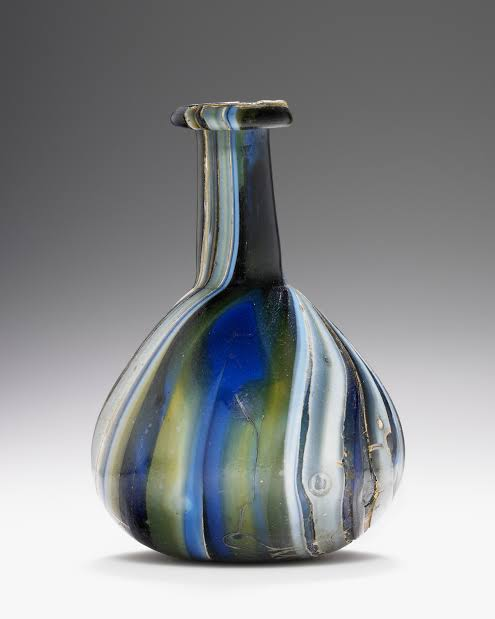
For the vast majority of Greek history, glass was not a cheap, utilitarian commodity used for everyday drinking cups or window panes. Instead, it was categorized alongside rare, high-status gemstones—an exotic luxury material highly valued for its deep, semi-translucent colors and complex, secretive manufacturing requirements.
The Core-Forming Technique: Long before the revolutionary Roman invention of glassblowing in the 1st century BCE, Classical Greek artisans created vessels using the arduous core-forming method. An artisan sculpted a core out of a precise, removable mixture of clay and organic animal dung around a central iron rod. Raw glass chunks—composed of silica sand, soda, and lime—were melted in small crucibles to over 1000°C. The molten glass was then drawn out into thick threads and wrapped repeatedly around the core.
Trailing and Marvering: While the glass was still glowing hot and malleable, the vessel was rolled flat against a smooth stone slab called a marver to fuse the exterior surface. To create patterns, wires of contrasting colored glass (often bright yellow or opaque white) were wrapped around the main blue or green body. While still hot, a metal hook or comb was used to drag the lines into wavy zig-zag or feather-like bands. Once cooled, the internal clay core was meticulously scraped out, leaving a small, beautiful flask used exclusively to hold luxury oils, perfumes, and cosmetics.
Hellenistic Innovation: During the Hellenistic period, workshop centers like Alexandria and Rhodes developed advanced casting techniques. They melted crushed colored glass inside open terracotta molds to produce stunning monochrome bowls, intricate mosaic "millefiori" (thousand flowers) glass, and "sandwich gold-glass"—luxury vessels where a delicate layer of pure gold leaf was permanently sealed between two layers of clear, cast glass.