The invention of standardized coinage in the Greek world, originating in Lydia around the seventh century before the common era and quickly spreading across the Mediterranean, revolutionized regional economic structures and transformed coins into powerful pieces of state propaganda. Rather than relying on primitive bullion weighing or bartering, individual city-states developed highly coordinated, state-regulated mints. The production of these coins was an advanced metallurgical process that combined structural chemistry, geological knowledge, and virtuosic relief engraving to produce uniform units of currency.
The manufacturing sequence began with the extraction and refining of raw metals, predominantly silver from the famous state-owned mines at Laurium in Athens, or gold and electrum from northern regional deposits. Metallurgists melted the refined metal in large ceramic crucibles, pouring the liquid into open spherical molds to create standardized, blank metal weights known as flans. Once cooled, mint workers meticulously weighed each individual flan against strict civic weight standards, such as the Athenian tetradrachm or the Corinthian stater. Flans that failed to meet the exact grain tolerances were discarded and re-melted to maintain absolute economic integrity.
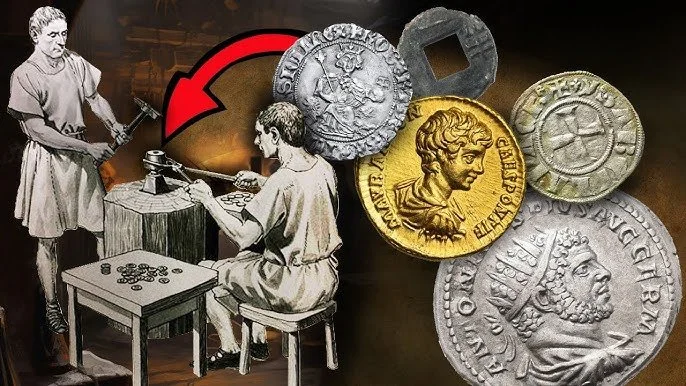
The actual transformation of a blank metal lump into an authorized coin required immense physical force and artistic precision. A master engraver carved the civic emblem in reverse onto a hard bronze or iron die. The obverse die, usually featuring the patron deity or civic symbol—such as the iconic owl of Athens or the winged Pegasus of Corinth—was fixed securely into a heavy anvil. The reverse die was attached to a hand-held iron punch. Mint workers reheated the metal flan to make it malleable, placed it onto the anvil die with tongs, held the punch die directly over the top, and struck it cleanly with a massive sledgehammer.
This violent impact forced the soft, glowing metal to expand and take on the intricate reverse impressions from both dies simultaneously. Because the dies were carved entirely by hand, early coins retained a rustic, slightly irregular edge, yet the internal imagery was incredibly crisp and detailed. These coins functioned as traveling monuments, broadcasting a city-state's wealth, technological sophistication, and political independence across international trade networks, establishing coin minting as one of the most successful combinations of industrial metallurgy and micro-sculpture in antiquity.