While classical histories frequently highlight the enduring durability of Greek stone monuments and bronze artifacts, the daily domestic, agricultural, and commercial operations of the ancient world were entirely dependent on an ephemeral, organic technology: basketry and fiber weaving. The manipulation of flexible reeds, willow twigs, rushes, and split wood into functional containers and mats was an absolute necessity. Because basketry required minimal specialized tools but demanded sophisticated geometric weaving techniques, it developed into a universal craft operating across every sector of Greek civilization.
In the agricultural sphere, baskets were the primary tools for harvesting, transporting, and storing crops. Farmers utilized the kalathos, a distinctive, flared basket woven from split willow or osier branches, to gather grapes during the autumn vintage and collect olives from the groves. The open-weave design of these baskets allowed air to circulate freely through the harvested fruit, preventing premature fermentation and bruising during transit on donkey carts. For grain processing, workers used flat, shallow winnowing baskets known as the liknon; farmers threw threshed grain into the air using these baskets, allowing the wind to blow away the light chaff while the heavy wheat kernels settled back into the tight weave.
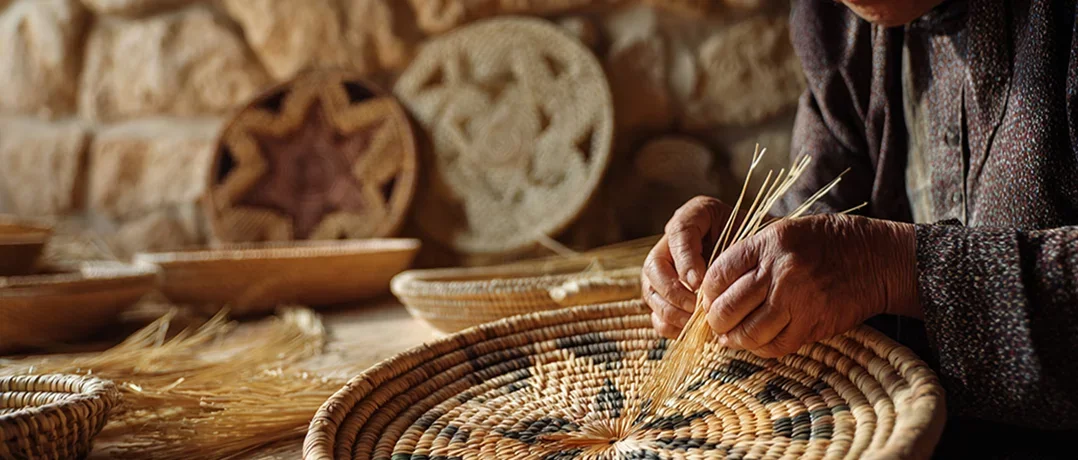
Within the urban marketplace (agora) and household storage spaces, tighter, split-cane weaving techniques were deployed to create secure containers. Merchants transported fresh fish and dry goods in heavy, double-handled wicker hampers called spyrides. Domestic storage relied on lidded wicker chests to keep wool unspun and textiles safe from dampness and pests. The manufacturing process utilized variations of the plaiting, twining, and coiling techniques, where horizontal weaver strands were wrapped systematically around rigid vertical warp rods, allowing craftsmen to control the density, flexibility, and waterproofing of the final container.
Basketry also held a sacred, highly formalized role in state religious processions. During the Panathenaic festival, elite unmarried young women known as the kanephoroi (basket-bearers) led the holy processions through the city streets carrying the kanoun, a specialized three-handled wicker ritual basket. These sacred baskets held the sacrificial knives, barley grain for consecration, and chaplets of flowers required to initiate the temple slaughters. The pristine white wicker of these baskets symbolized ritual purity, demonstrating how a simple craft born of humble reeds was elevated to the highest strata of civic and divine ceremony.