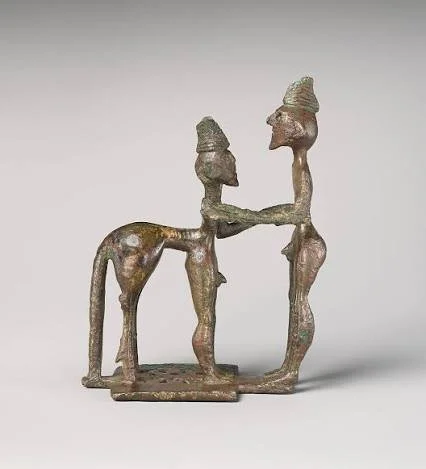
The monumental bronze statues of ancient Greece represent one of the absolute zeniths of ancient metallurgical art and sculptural expression. While the surviving landscape is dominated by white marble replicas made by the later Romans, the Greeks themselves viewed hollow-cast bronze as the supreme medium for depicting gods, athletes, and statesmen. Bronze possessed a tensile strength and elasticity that marble could never match, allowing sculptors to break away from rigid, block-like poses and capture dynamic, weightless human motion, lifelike muscle tension, and intricate anatomical detail.
The manufacturing of large-scale bronze statuary relied on the mastery of the lost-wax casting technique (indirect method), an multi-step industrial process requiring immense precision. The sculptor began by creating a full-scale master model of the statue out of clay or plaster. From this model, workers took highly detailed master molds using master pieces of clay or plaster. The interior of these negative molds was then coated with a layer of fluid, melted beeswax to the exact thickness desired for the final bronze metal shell, typically only a few millimeters thin.
Once the wax hardened, the hollow interior was filled with a liquid clay core composition, and the outer mold was removed, leaving a free-standing wax replica of the statue over a clay heart. The craftsman then inserted bronze pins called chaplets completely through the wax into the inner core to lock it in place. The entire wax figure was encased in a heavy outer mantle of coarse clay and baked in a specialized kiln. This intense heat melted the wax layer, allowing it to drain out through pre-designed vents—hence "lost-wax"—leaving a precise, hollow gap between the inner core and the outer mantle.
The final, high-stakes phase required pouring molten bronze—an alloy of roughly nine parts copper to one part tin, heated to over one thousand degrees Celsius—directly into the empty gap left by the wax. Once the metal cooled and solidified, the outer clay mantle was broken away, the inner core was raked out through hidden openings, and the statue emerged as a series of independent hollow bronze pieces. Master metalsmiths cold-joined these sections using specialized tongue-and-groove joints, hammering the seams until they became completely invisible. The surface was then chased with chisels to define hair and eyes, inlaid with ivory and glass for lifelike pupils, and polished to a gleaming, golden-brown finish.