ncient Greek civilization was deeply connected to the sea. The mountains and rugged geography of Greece made travel by land difficult, while the Aegean and Mediterranean Seas connected hundreds of islands, coastal settlements, colonies, and trading centers. Ships therefore became essential to Greek economic life, warfare, communication, exploration, and cultural expansion.
One of the most remarkable aspects of ancient Greek shipbuilding was the ability of shipwrights to construct large and seaworthy wooden vessels without depending primarily on metal nails to hold their hulls together. Instead, they developed sophisticated techniques involving carefully shaped wooden planks, mortise-and-tenon joints, wooden pegs, internal frames, ropes, and waterproofing materials.
These methods were not signs of primitive technology. On the contrary, they required precise craftsmanship and a detailed practical understanding of wood, structural strength, balance, and the behavior of ships at sea.
The Importance of Ships in Ancient Greece
The Greek world was geographically fragmented. Communities were separated by mountains, valleys, islands, and bodies of water. Ships provided a practical solution to these geographical challenges.
Greek vessels connected mainland Greece with:
the Aegean Islands,
Asia Minor,
Egypt,
southern Italy,
Sicily,
the Black Sea,
Cyprus,
and other regions of the Mediterranean.
Through maritime trade, Greeks transported goods such as grain, wine, olive oil, pottery, metals, timber, and luxury products.
Ships also made Greek colonization possible. Communities could establish settlements far from their original homeland while maintaining commercial and cultural connections through maritime routes.
For this reason, shipbuilding became one of the most important technological industries of the ancient Greek world.
Why Ancient Ships Did Not Depend Primarily on Metal Nails
Metal was valuable in the ancient world. Bronze and iron required mining, transportation, processing, and skilled labor.
Using enormous quantities of metal nails to construct an entire ship would have been expensive and, in many cases, unnecessary.
Ancient shipbuilders instead relied heavily on sophisticated woodworking techniques.
These included:
mortise-and-tenon joints,
wooden pegs,
tightly fitted planking,
ropes and lashings,
internal structural supports,
and waterproofing materials.
It is important to understand that saying Greek ships were built "without nails" does not mean metal was completely absent. Metal components could be used in certain parts of ships. However, many important structural connections depended on carefully engineered wooden joints.
The Hull-First Method of Construction
One of the most distinctive techniques used in ancient Mediterranean shipbuilding was known as shell-first construction.
In modern shipbuilding, builders often begin with an internal framework or skeleton. The outer material is then attached to this structure.
Ancient shipbuilders frequently followed a different process.
They began by constructing the outer shell of the vessel.
Individual wooden planks were shaped and joined together to form the hull. Only after the shell had reached its intended form were additional internal frames and reinforcements installed.
This method required exceptional skill.
The shipbuilder needed to understand the final shape of the vessel before the complete internal framework existed.
Each plank had to fit precisely with the next.
A mistake in the lower part of the hull could affect the entire structure.
The Mortise-and-Tenon Joint
The most famous technique associated with ancient Mediterranean shipbuilding is the mortise-and-tenon joint.
A mortise is a carefully cut opening or slot in a piece of wood.
A tenon is a projecting piece designed to fit into the mortise.
In shipbuilding, matching openings could be cut into the edges of neighboring hull planks. A separate wooden tenon was inserted between them, connecting the planks.
The process generally involved:
Shaping two neighboring planks.
Cutting matching mortises into their edges.
Inserting a wooden tenon.
Aligning the connected planks.
Securing the joint with wooden pegs or dowels.
This created a strong mechanical connection.
Hundreds or even thousands of such carefully positioned joints could work together to form the hull of a ship.
Wooden Pegs and Structural Strength
The mortise-and-tenon joints were frequently secured using wooden pegs.
These pegs were driven through carefully drilled holes, helping lock the tenon into place.
The use of wooden components allowed the ship's structure to respond naturally to changes in moisture.
Wood expands and contracts depending on environmental conditions. A structure composed largely of carefully fitted wooden elements could accommodate these changes.
The ship therefore functioned as an interconnected wooden system rather than a collection of planks simply nailed together.
Waterproofing the Hull
A structurally strong ship would still be useless if water entered through its seams.
Greek shipbuilders used various methods to reduce leakage.
Materials could include:
resin,
pitch,
wax,
plant fibers,
and other sealing substances.
Fibrous materials could be packed into gaps between planks before protective substances were applied.
The exterior of the hull could also be coated to help protect the wood from water.
Ships required regular maintenance because exposure to seawater could damage wood and weaken joints.
Greek Warships and the Trireme
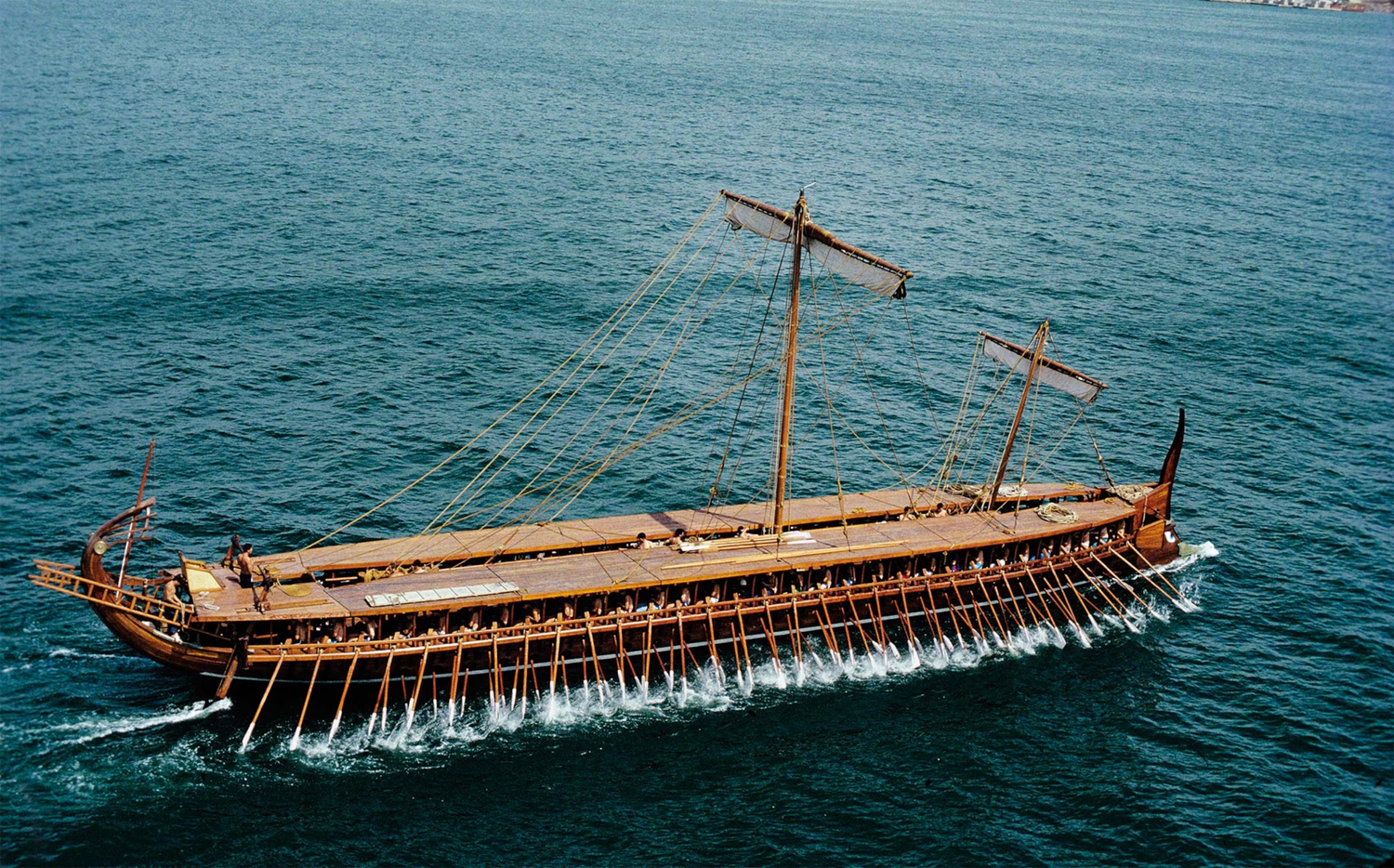
The most famous Greek warship was the trireme.
The trireme was designed primarily for speed and maneuverability.
Its crew consisted largely of rowers, allowing the ship to move rapidly and change direction during battle.
Greek naval warfare often depended on maneuvering rather than simply approaching an enemy ship directly.
The trireme could be equipped with a reinforced ram at the bow.
The purpose of the ram was to strike and damage enemy vessels.
This required a hull that was both relatively light and structurally strong.
Greek shipbuilders therefore faced a difficult engineering challenge.
The vessel needed to be:
fast,
maneuverable,
strong,
light enough for efficient rowing,
and capable of surviving combat.
Merchant Ships
Not all Greek ships were designed for warfare.
Merchant vessels transported the products that supported Mediterranean trade.
They carried:
grain,
wine,
olive oil,
pottery,
timber,
metals,
textiles,
and other goods.
Merchant ships were generally designed with greater emphasis on cargo capacity and stability.
Their hulls could be broader and deeper than those of fast warships.
The existence of specialized vessels demonstrates the diversity of Greek maritime engineering.
The Importance of Timber
Building a ship required careful selection of wood.
Different components required different physical properties.
Shipbuilders could use varieties of timber such as:
oak,
pine,
fir,
and cypress.
Some sections required exceptionally strong timber.
Others required wood that could be shaped more easily.
Naturally curved pieces of wood were particularly valuable because they could be incorporated into curved parts of the ship while preserving the natural direction of the grain.
Sails, Masts, and Ropes
Greek ships used both human and wind power.
Rowers provided movement when necessary, while sails allowed ships to take advantage of favorable winds.
The mast needed to support substantial forces generated by the sail and rigging.
Ropes were therefore essential.
Ancient ropes could be made from plant fibers and other natural materials.
They were used for:
controlling sails,
securing the mast,
steering,
anchoring,
securing cargo,
and reinforcing parts of the ship.
Greek shipbuilding was therefore dependent not only on woodworking but also on advanced knowledge of fiber and rope production.
The Legacy of Greek Shipbuilding
Ancient Greek ships transformed the Mediterranean.
They allowed communities to trade, fight, migrate, communicate, and establish colonies across enormous distances.
The techniques used to construct these vessels demonstrate the sophistication of ancient engineering.
Greek shipbuilders did not require modern steel, engines, or industrial machinery to create effective ships.
Through generations of accumulated knowledge, they learned how to transform timber into complex, durable, and seaworthy structures.
The construction of ships without relying primarily on metal nails was not a technological weakness.
It was an example of highly developed craftsmanship and structural engineering adapted to the materials of the ancient world.