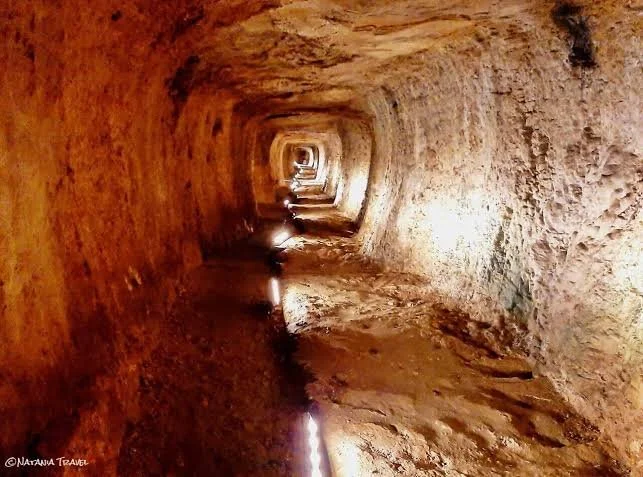
Ancient Greek engineers achieved remarkable feats using tools that would appear simple by modern standards. Among their most impressive accomplishments was the construction of tunnels through mountains, hills, and solid rock.
These projects required careful planning, surveying, mathematics, labor organization, and an understanding of geology. Greek engineers had no GPS, lasers, electric drills, or modern surveying instruments. Yet they were capable of constructing tunnels that followed carefully calculated routes and, in some cases, involved excavation from opposite directions.
Greek tunnel engineering demonstrates that advanced technology does not always require advanced machinery. Knowledge, observation, geometry, and precise measurement could produce extraordinary results.
Why Did the Greeks Build Tunnels?
Tunnels served several important purposes.
They could be used for:
transporting water,
providing access through difficult terrain,
mining,
military movement,
and infrastructure projects.
Water tunnels were particularly important because many Greek settlements depended on reliable water supplies.
Cities could face danger if their water source was located outside defensive walls.
An enemy could potentially cut off access during a siege.
Constructing an underground aqueduct provided a solution.
The Tunnel of Eupalinos
The most famous example of ancient Greek tunnel engineering is the Tunnel of Eupalinos on the island of Samos.
The tunnel was constructed during the sixth century BCE and formed part of a water supply system.
What makes the project extraordinary is that excavation appears to have proceeded from opposite sides of a mountain.
The two teams eventually met underground.
This required impressive surveying.
The engineers needed to determine:
the direction of excavation,
the desired elevation,
the angle of the route,
and the location where the two sections would meet.
A small error could have caused the tunnels to miss each other entirely.
The Engineering Challenge
Modern engineers can use electronic instruments to determine exact positions.
Ancient engineers depended on:
measuring rods,
cords,
levels,
geometry,
visual alignment,
and practical experience.
The problem was especially difficult underground.
Once workers entered the mountain, they could no longer simply look toward their destination.
The excavation teams had to trust calculations made before construction began.
Geometry and Surveying
Greek mathematics played an important role in engineering.
Surveyors could use geometric relationships to establish directions and distances.
Straight lines could be measured across open terrain before excavation began.
Angles and changes in elevation could also be calculated.
The challenge was then transferring these measurements into the mountain.
Engineers needed to maintain a route that would eventually connect with the excavation from the opposite side.
The Tunnel of Eupalinos demonstrates how theoretical geometry could be transformed into practical engineering.
Tools Used in Ancient Tunneling
Greek workers used tools such as:
hammers,
chisels,
picks,
wedges,
and other hand-operated instruments.
The type of rock influenced the difficulty of excavation.
Some materials could be broken relatively easily.
Others required enormous amounts of labor.
Workers also had to remove broken stone from the tunnel.
As the excavation progressed, transportation became increasingly difficult because debris had to be carried through the growing length of the passage.
Ventilation and Working Conditions
Underground work created serious challenges.
Workers needed sufficient air and light.
Oil lamps could provide illumination, but they also consumed oxygen and produced smoke.
Narrow tunnels could become uncomfortable and dangerous.
The organization of labor was therefore essential.
Workers may have performed different tasks, including:
breaking rock,
removing debris,
measuring the route,
reinforcing dangerous sections,
and maintaining the water channel.
Water Engineering
Many Greek tunnels were connected with aqueduct systems.
Water needed to flow at a carefully controlled gradient.
If the slope was too steep, water could move too quickly and damage the channel.
If the slope was too shallow, water might not flow efficiently.
Greek engineers therefore had to understand elevation.
A successful water tunnel required precise control over vertical measurement.
Tunnels and Military Security
Underground water systems could provide strategic advantages.
A city under siege could continue receiving water through a concealed route.
Tunnels could also allow movement through difficult terrain.
Military engineering therefore became closely connected with geography and infrastructure.
The Legacy of Greek Tunnel Engineering
Greek tunnels demonstrate the combination of mathematics and practical experience.
Their engineers did not simply excavate blindly through mountains.
They planned routes, measured distances, calculated elevations, and organized large numbers of workers.
The surviving evidence demonstrates that ancient engineering was capable of solving highly complex problems.
Greek tunnel construction remains one of the clearest examples of the technical sophistication achieved in the ancient Mediterranean.