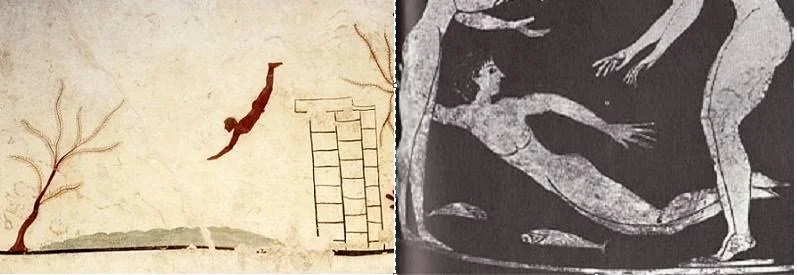
In ancient Greece, swimming was more than a recreational activity. For many communities, especially those located near the Mediterranean Sea, rivers, harbors, and coastal settlements, the ability to move safely through water could be a practical skill, a form of physical exercise, and an important element of education. Greek civilization developed in a world closely connected to the sea, where fishing, trade, naval warfare, travel, and daily life regularly brought people into contact with water.
However, ancient Greek children did not attend swimming schools in the modern sense. There were no standardized national swimming curricula, certified instructors, chlorinated pools, or universally established lessons. What children learned depended on their location, social class, family, gender, local customs, and access to safe bodies of water.
Despite these differences, swimming was sufficiently familiar within Greek culture that the ability—or inability—to swim could carry social meaning. Ancient writers occasionally used swimming as a symbol of basic education and practical competence.
Greece and the Sea
Geography played an important role in the development of Greek attitudes toward swimming.
The Greek world included:
long coastlines,
islands,
natural harbors,
rivers,
springs,
and communities connected by maritime trade.
For people living near the coast, water was an unavoidable part of life.
Fishing boats traveled between islands. Merchant ships carried grain, wine, olive oil, pottery, and other goods across the Mediterranean. Naval forces relied upon sailors who understood the dangers of the sea. Children growing up in coastal communities could therefore encounter water regularly.
Swimming was not simply an athletic activity imported into daily life. In many places, it developed naturally from the environment.
Learning Through Observation and Practice
Greek children probably learned to swim primarily through practical experience rather than through a formal, standardized educational system.
Older family members, friends, and members of the local community could introduce children to water. A child might gradually learn:
how to float,
how to move the arms and legs,
how to control breathing,
how to enter and leave the water,
and how to remain calm while afloat.
The exact techniques were unlikely to have been identical everywhere.
Ancient swimming was based upon practical ability rather than the standardized strokes used in modern competitive swimming.
Swimming as Part of Physical Education
Physical education was highly valued in many Greek communities.
The Greek ideal of education often included the development of both the mind and the body. Athletic training could involve:
running,
wrestling,
jumping,
throwing,
combat exercises,
and other physical activities.
Swimming was not necessarily a universal component of every formal educational program, but it belonged to the wider Greek appreciation of physical capability.
A person who could move confidently through different environments—including water—possessed a practical physical skill.
“He Can Neither Read Nor Swim”
One of the most famous cultural references to swimming in ancient Greece comes from a traditional expression associated with the idea that an uneducated or incompetent person could be described as someone who could “neither read nor swim.”
The phrase reflects an important cultural concept.
Reading represented intellectual education.
Swimming represented practical physical competence.
Together, they symbolized two different forms of ability that a person was expected to possess.
The saying should not be interpreted as evidence that every Greek child followed an identical swimming curriculum. Instead, it demonstrates that swimming was recognized as a familiar and valuable skill.
Where Did Children Learn?
The location of swimming instruction depended heavily on geography.
Possible environments included:
calm coastal waters,
sheltered bays,
rivers,
lakes,
natural pools,
and springs.
A community with easy access to shallow and relatively calm water offered more opportunities for children to become familiar with swimming.
Conditions were very different in open water.
The Mediterranean could be calm, but currents, waves, changing weather, and deep water created serious dangers.
Children learning informally would likely have begun in safer and shallower areas when possible.
Swimming in the Mediterranean World
The ancient Mediterranean was not a controlled aquatic environment.
There were no lifeguards positioned along most beaches, no standardized warning flags, and no modern rescue systems.
A swimmer needed to understand the natural environment.
Experience could teach practical lessons about:
waves,
water depth,
currents,
rocks,
and changing weather.
These risks made water competence valuable.
The Importance of Floating
One of the most fundamental swimming skills is the ability to remain afloat.
Although ancient sources do not provide a modern technical curriculum for Greek children, practical swimming would have required an understanding of buoyancy.
A child learning to swim could gradually become accustomed to supporting the body in water.
This was likely one of the earliest stages of developing confidence.
Before traveling long distances through water, a swimmer needed to avoid panic and learn how to remain at the surface.
Learning to Move Through Water
After becoming comfortable in water, a swimmer could learn to propel the body.
Ancient Greek swimmers did not use modern competition categories such as:
freestyle,
butterfly,
breaststroke,
or backstroke
in the standardized sense recognized today.
Instead, movement was practical.
A swimmer used combinations of arm and leg motions that allowed forward movement and helped maintain stability.
Ancient artistic representations suggest that Greeks were familiar with recognizable swimming movements, although artistic images cannot provide a complete reconstruction of everyday technique.
Swimming and Military Life
Swimming could also have military value.
The Greek world experienced frequent warfare, including naval conflict.
A soldier or sailor who fell into the water could face a life-threatening situation.
The ability to swim might therefore increase the chances of survival.
Ancient military operations sometimes involved:
crossing rivers,
moving through coastal environments,
escaping damaged ships,
and conducting operations near water.
Swimming was not a substitute for military training, but it could be an extremely useful practical ability.
The Importance of Swimming to Sailors
Greek civilization depended heavily on seafaring.
Merchant vessels connected communities throughout the Aegean and Mediterranean.
Naval forces transported soldiers and participated in major conflicts.
A sailor did not necessarily need to be an expert competitive swimmer, but familiarity with water could be essential.
Shipwrecks were a constant danger in the ancient world.
A person who could remain afloat and swim toward safety had an obvious advantage.
Swimming and Greek Mythology
Water and swimming also appear throughout Greek mythology.
Heroes and gods frequently cross seas, rivers, and other bodies of water.
Mythological narratives do not provide direct evidence for how children learned to swim, but they demonstrate the importance of water within Greek imagination.
The sea could represent:
opportunity,
danger,
travel,
divine power,
and the unknown.
Greek children growing up with these stories would have understood that water was both essential and potentially dangerous.
Gender and Access to Swimming
It is difficult to make universal statements about whether all Greek girls and boys received the same opportunities to learn swimming.
Ancient Greek society was not culturally uniform.
Athens, Sparta, island communities, and rural settlements could have different customs.
Social expectations regarding women's education and physical activity also varied.
Sparta is particularly famous for placing greater emphasis on physical training for girls than many other Greek city-states.
However, this does not mean that all Spartan girls necessarily received formal swimming instruction.
The surviving evidence does not support a single universal model.
Social Class and Swimming
Social class also influenced education.
Children from wealthier families could receive forms of formal instruction unavailable to poorer children.
However, swimming was different from skills requiring expensive equipment.
Access to water could make practical learning possible across social classes.
A wealthy child and a working child could both grow up near the sea.
Their reasons for swimming and the contexts in which they learned might nevertheless differ.
Swimming as Recreation
Swimming could also provide enjoyment.
Natural bodies of water offered opportunities for bathing, play, and recreation.
Children often learn physical skills through play.
Informal activities with friends could help develop confidence and coordination.
This type of learning did not require a written curriculum.
Repeated exposure to water could gradually produce practical competence.
Ancient Greek Views of the Body
Greek culture placed significant attention on the human body.
Athletic competitions, gymnasia, sculpture, and philosophical discussions all reflected an interest in physical development.
The ideal of physical excellence, often associated with concepts such as arete, encouraged the cultivation of ability and competence.
Swimming could fit within this broader appreciation of physical skill.
However, the Greeks did not necessarily treat every useful activity as a formal competitive sport.
Some skills remained practical rather than institutionalized.
The Gymnasium and Physical Education
The Greek gymnasium became an important institution for male physical education, particularly in the Classical period.
Training commonly focused on activities such as:
wrestling,
running,
jumping,
discus throwing,
and javelin throwing.
Swimming was not the central activity of the gymnasium in the same way as these events.
This distinction is important.
The cultural value of swimming does not mean that every gymnasium functioned as a swimming academy.
Greek education included both formal institutions and skills learned through ordinary life.
Swimming in Ancient Literature
Ancient Greek literature contains references to people swimming in practical situations.
Epic poetry, historical accounts, and other writings describe individuals entering water, escaping danger, or moving through rivers and seas.
These references show that authors expected audiences to understand the basic reality of swimming.
In Homer's Odyssey, for example, Odysseus struggles to survive after being shipwrecked, demonstrating the dangerous relationship between humans and the sea.
Literature often dramatizes such events, but it reflects a society in which the act of swimming was familiar.
The Limits of the Evidence
Historians must be careful when reconstructing how Greek children learned to swim.
There is no surviving ancient manual that provides a complete lesson plan such as:
Lesson 1: Floating.
Lesson 2: Arm movement.
Lesson 3: Breathing technique.
Most knowledge must instead be reconstructed from:
literary references,
artistic representations,
educational traditions,
archaeological evidence,
and the environmental realities of Greek life.
Therefore, the most accurate conclusion is that swimming was a recognized and useful skill, but the specific method of instruction varied and was often informal.
A Likely Pattern of Learning
Although the exact process cannot be reconstructed in detail for every community, a plausible progression may have involved:
1. Familiarity with Water
Children first became accustomed to shallow water and learned not to panic.
2. Floating
They gradually discovered how the body could remain supported by water.
3. Basic Movement
Simple movements of the arms and legs allowed the swimmer to move forward.
4. Increasing Distance
As confidence developed, children could swim farther from the shore.
5. Practical Experience
Repeated swimming improved endurance, coordination, and confidence.
This pattern is consistent with how practical skills are commonly learned through observation and repeated experience.
Swimming and Survival
For ancient people, swimming could mean the difference between life and death.
A person might need to enter water because of:
a shipwreck,
a river crossing,
a military emergency,
an accident,
or an attempt to reach safety.
In a society connected to the sea, swimming was therefore more than entertainment.
It was a survival skill.
From Ancient Swimming to Modern Lessons
Modern swimming instruction differs greatly from ancient practice.
Today, formal swimming education may include:
certified instructors,
safety regulations,
swimming pools,
flotation equipment,
standardized techniques,
and emergency rescue training.
Ancient Greek children had none of these advantages.
Their learning was more directly connected with the natural environment.
This could make swimming both more practical and more dangerous.
Conclusion
Greek children likely learned to swim through a combination of family experience, community interaction, physical play, observation, and repeated practice in natural bodies of water.
Swimming was not taught through a single standardized curriculum across ancient Greece. Access and instruction depended upon geography, social conditions, and local customs.
Nevertheless, the skill was sufficiently important to become associated with basic competence in Greek culture. The traditional expression linking the inability to read with the inability to swim demonstrates the value placed on both intellectual and practical education.
For a civilization shaped by islands, coastlines, harbors, trade, and naval warfare, familiarity with water was an important part of life.
Ancient Greek children did not learn swimming with lane markers, goggles, and certified instructors.
They learned in the rivers, shores, bays, and waters of the Mediterranean world where swimming was not simply a sport, but a practical connection between the human body and the environment in which Greek civilization developed.