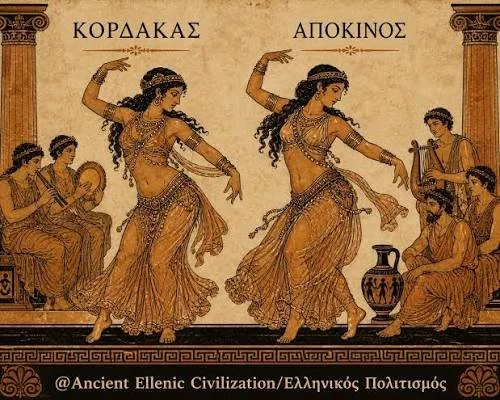
The relationship between ancient Greek dance and modern ballet is often described in broad and sometimes misleading terms. Ancient Greece did not invent ballet, and there is no direct, uninterrupted line of technical development from Greek dancers to the codified ballet traditions that emerged in the courts of Renaissance and early modern Europe. Classical ballet developed many centuries later, particularly through Italian and French court culture, before becoming an internationally recognized theatrical art form.
Nevertheless, ancient Greek ideas about movement, rhythm, music, drama, the expressive body, and the relationship between dance and storytelling have had a lasting influence on Western performance traditions. Greek dance also became an important source of inspiration for later artists, choreographers, sculptors, theater designers, and ballet creators who sought to reconnect movement with classical ideals of beauty, proportion, harmony, and dramatic expression.
The influence of Greek dance on modern ballet is therefore best understood not as a direct technical inheritance but as a cultural, artistic, and intellectual influence.
Dance in Ancient Greek Society
Dance occupied an important place in ancient Greek life.
It appeared in:
religious festivals,
theatrical performances,
military training,
athletic celebrations,
weddings,
funerals,
and communal ceremonies.
The Greeks did not sharply separate dance from music and poetry in the same way modern audiences often do. Movement was frequently connected with rhythm, song, and collective performance.
A dance could communicate emotion, religious devotion, military discipline, or narrative meaning.
The Greek Concept of Choreia
One of the most important concepts connected with ancient Greek performance is choreia.
Choreia involved the close relationship between:
dance,
music,
song,
and poetic performance.
Rather than treating these as completely separate arts, Greek performance often combined them.
This idea is important when considering later theatrical traditions.
Modern ballet also combines multiple artistic disciplines, including:
movement,
music,
costume,
visual design,
and storytelling.
The similarities do not mean that ballet descended directly from choreia, but they reveal a shared understanding of performance as a unified artistic experience.
Dance and Greek Religion
Many Greek dances had religious significance.
Groups could perform during festivals honoring particular gods and goddesses.
Dance could form part of a ritual procession or celebration.
The movement of the body therefore became a way of participating in communal religious life.
This connection between movement and symbolic meaning later influenced Western theatrical ideas about expressive dance.
The Chorus in Greek Theater
One of the strongest connections between ancient Greek performance and later theatrical dance traditions is the chorus.
In Greek tragedy and comedy, the chorus performed as a collective group.
The chorus could:
sing,
move,
comment on events,
react emotionally,
and provide information to the audience.
Its performance was organized through rhythm and coordinated movement.
This collective visual presence helped establish the idea that groups of performers could communicate meaning through movement as well as words.
Choral Movement and the Modern Corps de Ballet
Modern ballet includes the corps de ballet, a group of dancers who perform coordinated movements as part of a larger production.
The Greek chorus and the corps de ballet are not historically identical institutions.
However, they share an important artistic principle.
A group of performers can function as a collective body.
The audience does not focus only on one individual.
Instead, synchronized movement creates:
visual patterns,
atmosphere,
emotional intensity,
and narrative context.
This idea has become central to large-scale theatrical dance.
Dance as Storytelling
Greek dance frequently contributed to narrative.
Movement could express:
celebration,
grief,
victory,
fear,
worship,
and conflict.
Modern narrative ballet uses movement in a similar way.
A ballet dancer may communicate emotion and story without speaking.
Gestures, posture, direction, rhythm, and interaction with other dancers become forms of visual language.
The ancient Greek belief that movement could carry meaning therefore remained attractive to later choreographers.
Greek Ideas of Harmony and Proportion
Ancient Greek art is strongly associated with concepts of:
balance,
proportion,
symmetry,
and harmony.
These principles influenced Western art for centuries.
During the Renaissance and later periods, European artists studied Greek and Roman sculpture and architecture as models of ideal form.
Ballet developed within this wider classical revival.
The disciplined, balanced appearance of ballet was influenced by artistic cultures that admired the ordered proportions associated with classical antiquity.
The Influence of Greek Sculpture
Ancient Greek sculpture became especially important to the visual development of Western dance.
Greek statues represented the human body in carefully controlled poses.
Artists studied:
balance,
muscular tension,
weight distribution,
and the relationship between movement and stillness.
One of the most influential concepts is contrapposto, in which the body's weight is shifted primarily onto one leg, creating a natural asymmetry.
This principle helped later artists understand how the body could appear both stable and dynamic.
Movement Frozen in Stone
Greek sculpture often appears motionless, yet many statues suggest movement.
A figure may seem to be:
walking,
turning,
preparing to throw an object,
or shifting weight.
This ability to capture movement within a static form influenced Western artists and performers.
Ballet also depends upon the relationship between movement and pose.
A dancer transitions continuously between positions, but individual moments may appear visually complete.
Renaissance Interest in Classical Antiquity
The strongest historical pathway connecting ancient Greek artistic ideas with ballet developed through the Renaissance.
European scholars and artists rediscovered, translated, studied, and imitated classical Greek and Roman works.
Ancient mythology became a major source of artistic subjects.
Sculpture, literature, architecture, and philosophy influenced the visual culture of European courts.
Early forms of theatrical dance developed within this environment.
Therefore, Greek influence often reached ballet indirectly through Renaissance classicism.
The Birth of Court Ballet
Ballet emerged from Renaissance court entertainments, particularly in Italy and France.
These performances combined:
dance,
music,
poetry,
elaborate costumes,
scenery,
and mythological themes.
Greek mythology provided ideal material.
Stories involving gods, heroes, transformations, and tragic love could be transformed into theatrical spectacles.
This is one of the clearest ways ancient Greek culture influenced the history of ballet.
Greek Mythology in Ballet
Over the centuries, ballet creators repeatedly turned to Greek mythology.
Mythological subjects offer dramatic themes involving:
love,
jealousy,
fate,
divine intervention,
transformation,
heroism,
and tragedy.
These themes can be communicated visually, making them particularly suitable for dance.
Works inspired by Greek myth demonstrate how ancient stories continued to shape theatrical movement long after the disappearance of ancient Greek performance traditions.
The Apollo Tradition
The Greek god Apollo became an especially important symbol of artistic order and harmony.
In Western artistic traditions, Apollo was associated with:
music,
poetry,
artistic inspiration,
and ideal beauty.
This made him a powerful figure for choreographers and artists interested in the relationship between classical art and dance.
The association between Apollo and artistic discipline influenced the imagery of ballet, particularly during periods when classical ideals were strongly emphasized.
Neoclassicism and Ballet
The influence of ancient Greece became particularly visible in neoclassical ballet.
Neoclassicism involved a renewed interest in clarity, structure, proportion, and formal beauty.
Rather than relying entirely on elaborate narrative, neoclassical choreographers often emphasized the architecture of movement itself.
The human body became part of a carefully organized visual composition.
This approach strongly reflects the broader Western fascination with classical artistic principles.
George Balanchine and Classical Inspiration
The choreographer George Balanchine became one of the most influential figures in neoclassical ballet.
His work often emphasized:
musical structure,
clean lines,
precision,
and the visual architecture of movement.
Although modern ballet cannot be reduced to Greek influence, the broader neoclassical aesthetic drew upon ideas associated with classical harmony and proportion.
Balanchine's ballet Apollo, originally created in 1928, directly used Greek mythology as its subject.
The work explored the relationship between Apollo and the Muses and became an important example of how ancient mythology could be reinterpreted through modern dance.
Isadora Duncan and Ancient Greece
One of the most direct artistic attempts to reconnect modern dance with ancient Greek ideals came from Isadora Duncan.
Duncan rejected many rigid conventions of classical ballet.
She sought inspiration from:
Greek sculpture,
natural movement,
flowing clothing,
and the perceived freedom of ancient Greek dance.
Her performances often used tunic-like costumes and movement designed to appear natural and expressive.
Duncan did not recreate ancient Greek dance exactly.
The original techniques had not survived in sufficient detail.
Instead, she created a modern interpretation inspired by classical imagery.
Why Ancient Greek Dance Could Not Be Perfectly Reconstructed
Unlike modern ballet, ancient Greek dance was not preserved through a standardized notation system capable of recording complete choreography for thousands of years.
Researchers rely on evidence such as:
painted pottery,
sculpture,
written descriptions,
poetry,
inscriptions,
and theatrical references.
These sources provide valuable clues, but they do not reveal every movement.
As a result, modern attempts to recreate Greek dance involve interpretation.
This distinction is important.
Many performances described as “ancient Greek dance” are modern reconstructions rather than exact survivals.
Greek Dance and the Expressive Body
Ancient Greek art often treated the body as a medium of expression.
Gesture and posture could communicate identity and emotion.
A warrior stood differently from a mourner.
A dancer moved differently from a worshipper.
Modern ballet similarly depends upon the ability of the body to communicate without ordinary spoken dialogue.
The dancer's body becomes a form of language.
Gesture and Pantomime
Narrative ballet often uses gestures to communicate ideas.
A gesture can suggest:
love,
fear,
rejection,
authority,
grief,
or invitation.
Ancient Greek theater also relied upon physical expression, especially because performances occurred in large open-air spaces where audiences could not depend entirely on subtle facial expressions.
Movement and gesture therefore played an important communicative role.
The Architecture of Movement
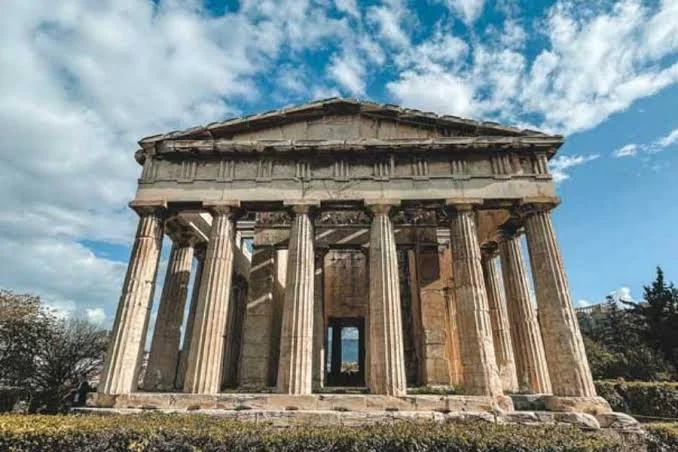
Greek architecture and sculpture influenced how Western artists thought about space.
A temple organizes physical forms through:
columns,
intervals,
repetition,
symmetry,
and proportion.
A choreographer similarly organizes dancers through:
spacing,
formations,
repetition,
direction,
and rhythm.
This analogy became especially important in modern discussions of choreography.
A dance can be understood as an architecture created through moving bodies.
Group Formations
Ancient Greek choruses performed in organized groups.
Their movement across the theatrical space could create geometric patterns.
Modern ballet also uses formations to organize large ensembles.
Dancers may form:
circles,
lines,
diagonals,
symmetrical groups,
and changing patterns.
The use of collective movement creates visual structure.
Although the exact choreography differs, the artistic principle of organized bodies occupying shared space has deep roots in ancient theatrical performance.
Greek Theater and Ballet Production
The ancient Greek theater also influenced the broader development of Western stage design.
Greek theaters emphasized visibility and the relationship between performers and audience.
Modern ballet theaters are architecturally different, but theatrical creators continue to consider:
sightlines,
movement across the stage,
visual focus,
and audience perspective.
The Greek understanding that performance must be designed for spectators remains fundamental to theater.
Music and Rhythm
Greek dance was inseparable from rhythm.
Musical patterns organized movement.
Modern ballet similarly depends upon the relationship between choreography and music.
A dancer must understand:
tempo,
rhythm,
phrasing,
and musical structure.
The specific musical systems are different, but both traditions recognize that movement can be organized through sound.
What Greek Dance Did Not Give Modern Ballet
It is equally important to understand what cannot be claimed.
Ancient Greek dance did not directly create:
pointe technique,
the five standard ballet positions,
the modern ballet barre,
formal ballet notation,
or the specific technical vocabulary of classical ballet.
These developed through later European traditions.
Claiming that ballet was simply “invented by the Greeks” would therefore be historically inaccurate.
Greek influence was primarily cultural and artistic rather than a direct transfer of technical method.
The Continuing Power of Classical Themes
Greek mythology continues to inspire ballet and other forms of dance because its stories address universal human concerns.
Ancient myths explore:
love,
ambition,
betrayal,
grief,
transformation,
family conflict,
power,
and mortality.
Dance is particularly capable of expressing these themes because it communicates emotion visually.
The continued use of Greek mythology demonstrates the long cultural life of classical stories.
Ancient Inspiration and Modern Creativity
The influence of Greek dance should not be understood as simple imitation.
Modern choreographers reinterpret classical ideas.
They may use Greek mythology, sculptural poses, architectural concepts, or philosophical ideals while creating entirely new forms of movement.
This process demonstrates how ancient cultures continue to influence art without remaining unchanged.
Conclusion
Ancient Greek dance did not directly evolve into modern ballet, and the technical foundations of ballet emerged much later in Renaissance and European court traditions. However, Greek culture contributed important artistic ideas that influenced the world from which ballet eventually developed.
Greek performance emphasized the relationship between movement, music, poetry, storytelling, ritual, and collective expression. The Greek chorus demonstrated how groups of performers could create meaning through coordinated movement. Greek sculpture influenced Western ideas about balance, anatomy, weight, and idealized motion.
During the Renaissance and later periods, artists revived classical ideals and incorporated Greek mythology into theatrical performance. Modern and neoclassical choreographers continued this tradition, using ancient stories and classical artistic principles as sources of inspiration.
The influence of Greek dance on modern ballet is therefore not a simple story of direct inheritance.
It is a story of artistic memory.
Ancient Greek dancers disappeared thousands of years ago, and their exact movements can no longer be fully reconstructed. Yet the ideas associated with Greek art harmony, expressive movement, rhythm, storytelling, proportion, and the beauty of the human body in motion continue to shape how dancers and audiences understand performance.